Fake Mac OS Leopard Screenshot Contest

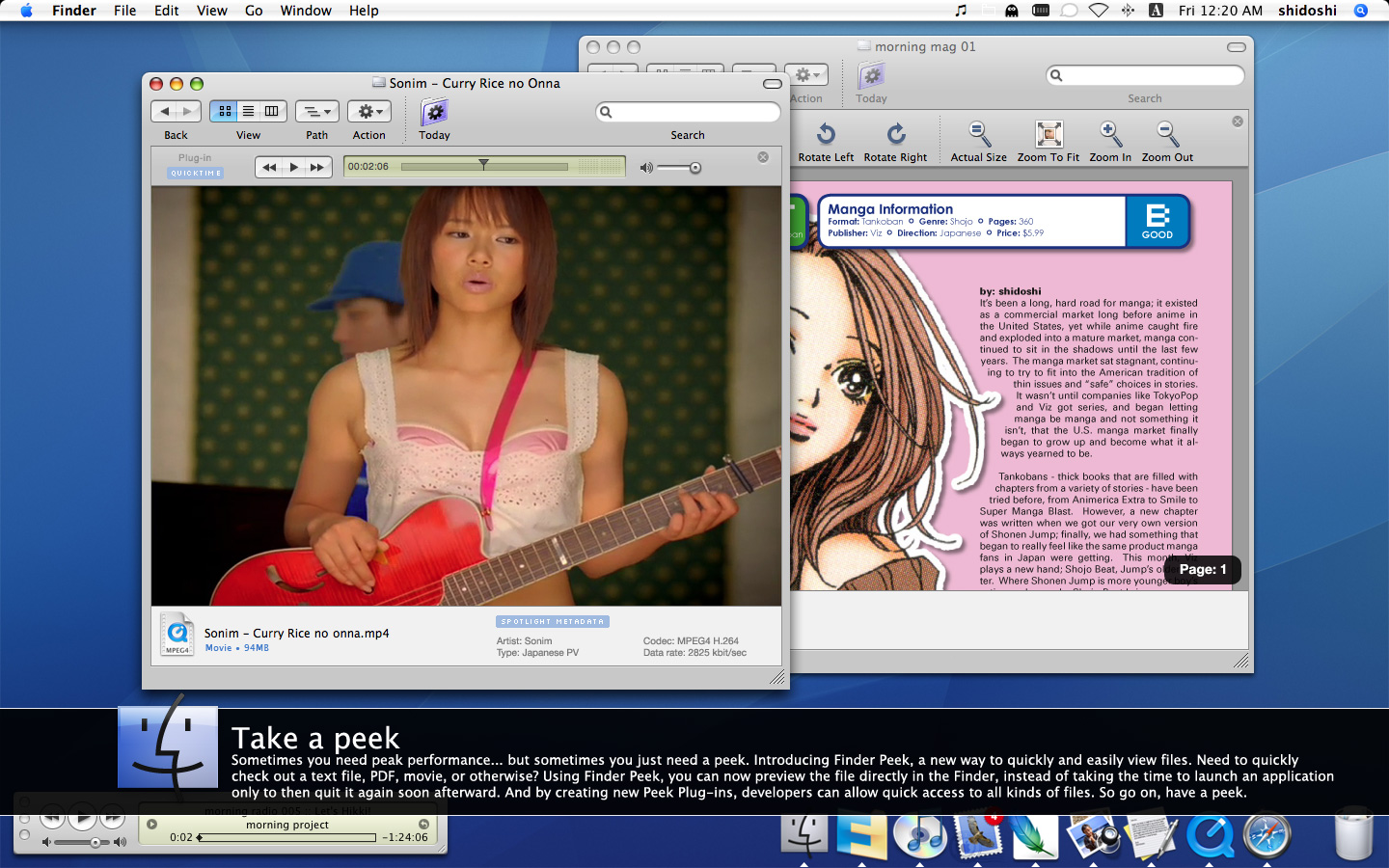
In July 2006, I entered a “Fake Leopard Screenshots” contest being held by Phill Ryu for his website. Mac OS X 10.5 (codenamed “Leopard”) was set for release later that year (though it ended up delayed until 2007), and the idea was to predict or suggest features that would be good for that next major version of the operating system.

I’d always had a love for both user interface design and mocking up ideas for said UI, so I entered four images into the contest along with a brief rundown of what I was going for. To my surprise (and delight), I ended up taking first place in the competition. My prize was a selection of free registration codes for a variety of Mac OS software, along with at least a few people saying that I should have a job at Apple.

Below is the “what I was going for” description I provided with my entry, along with the four images I submitted. I’ll also point out that my ideas for what Apple could add to the OS predated those features actually coming true, such as: Finder Peek (aka Quick Look), Column View allowing the option to sort by type, dynamics icons where you can play the media straight in the icon in the Finder, and more.

What you were going for: 

I think with a lot of the updates that Mac OS X has received over the past couple of revisions, we’ve seen a lot of “wow” features and changes, but what we’re missing is a lot of… hmm, updates that might not be as exciting, but are based more around fixing low-level things to make for a better user experience.

That’s the angle I’m coming from with my mock-ups. I chose features and ideas that might not be mind-blowing, but would hopefully provide for a far better user experience. The biggest ideas, for me, are the ones that go about trying to “fix” Column view. If you aren’t a user of Column view, my submission might be yawn-producing, but if you do use it then you know it currently sucks something fierce. My biggest aim was to provide for a much better Column view experience.

The second biggest was Mail. My girlfriend has gone through a lot of e-mail accounts, and keeping all of her old e-mail organized is a mess. Some mail gets recognized as being from when accessing Address Book, some doesn’t, and I can either have her old e-mail addresses unrecognized, or have them clogging up auto-complete. So, one of the things I want most from Mail is a much stronger system for recognizing mail by PEOPLE, not e-mail addresses. While I was at it, going back through old iChat logs is a pain in the a**, so I figured I could maybe kill two birds with one stone.

The last big feature is visual bookmarks and history in Safari. I’ve had countless, countless times when I remember I site I visited, want to go to it again, but don’t have a clue in the world what it was called. For some, it’ll seem like a small thing, but to me it was something I really wanted to see, so I put it together.

So, I guess, I went a more personal route, going for those things I think need upgrading and fixing, instead of trying to make something “life altering” like Dashboard, Expose, or whatnot. Those things are nice, but to be honest, I’d much rather have a lot of smaller upgrades and fixed in 10.5 than a couple big ones.

Why you should win: 

Well, I’d like to think that I have some nice ideas for new features, but what’s important and what’s not in an OS is so subjective. To be totally honest, I had a lot of fun just working on putting together the mock-ups, so I won’t be heartbroken if I don’t win.

Devil Summoner: Raidou Kuzunoha vs. The Soulless Army Review

Devil Summoner: Raidou Kuzunoha vs. The Soulless Army was an interesting departure for Atlus and their Devil Summoner series. Coming from a company typically known for in-depth role-playing sagas, Soulless Army still had MegaTen-style RPG underpinnings, but then contained an action-oriented combat system and more adventure-esque exploration in a project that reminded me of what Square had attempted many years before with Parasite Eve. While not without faults, it was a fresh take on the series and held a lot of potential should Atlus see fit to give the idea another try.

And try they have, resulting in Devil Summoner 2: Raidou Kuzunoha vs. King Abaddon, the sequel to Soulless Army that picks up one year after that game’s events unfolded. Once again we return to 1920s-era Japan, as the young up-and-coming tamer of demons Raidou Kuzunoha the 14th, along with his feline sidekick Gouto, return to the Capital to stop a new uprising of the forces of darkness. Joining back up with private detective Shouhei Narumi and ace reporter Tae Asakura, Raidou soon finds himself in the middle of a mysterious outbreak of “luck” in the Capital, as some folks seem to have come upon outrageously bad fortuned while other have become notorious for their ridiculous streaks of success. These changes in luck appear to have begun in conjunction with the arrival of mysterious masked men, and Raidou’s encounter with these strange foreigners starts him on a path that leads to far more sinister outcomes.

King Abaddon cemented two feelings inside of me; my unquestionable love for the Shin Megami Tensei world, and my original theory that Atlus had something special brewing in this departure from their safety genres. Even thought I came to the MegaTen franchise a little late in the game–via the original Persona in 1996–I’ve still been exposed to its numerous games countless times over the years, and yet it’s amazing how engrossing and one-of-a-kind the entire mythos still feels in King Abaddon. How it is that I still get excited the first time I run into demons like Jack Frost or Lilim, yet I’ve dealt with them in no less than three other games in like the last year or so? The reason is simple: what has made the MegaTen series so strong and so beloved by players such as myself is the time, effort, and care Atlus has put into enriching and developing every aspect of these games. When throw-away characters in a game like King Abaddon radiate more personality and charm than main character in some other titles, that tells you something.

Keeping that in mind brings us to one of the major improvements Atlus has put into place here over what we had in Soulless Army: the return of demon negotiations. One of the core ideas in the original game was working together with the demons that you tame, not only as allies in combat but also in helping you to interact with the people you’ll meet and in solving the various puzzles and obstacles that crop up to block your progress. For Soulless Army, these demons were collected in almost Pokemon fashion by encountering them in combat, weakening them, and then trapping them inside special demon-collection tubes. For King Abaddon, bringing the game’s various demons to your side of the battle is done instead through pre-combat conversations with them, and the responses you (or your current demon allies) give to their questions will determine if the demon you’re chatting up will want to be your friend or have you for breakfast. For us longtime MegaTen folks, the return of demon negotiations–a gameplay aspect that has become a trademark of the franchise thanks to its including in a number of previous games–feels like a return home, and is a most welcome addition to King Abaddon. For more casual fans, while you might not fully appreciate the change they bring over Soulless Army, it’s still a change for the positive and makes for a more entertaining experience.

Atlus also addressed one of the biggest complaints people had about Soulless Army: the combat. Attempting to craft a MegaTen game that centered around fast and furious fights instead of turn-based battles was indeed an interesting decision, but the problem was the engine created for those fights just didn’t have the polish and perfection it needed. To help address the criticisms players had, Raidou now has a wider variety of offensive and defensive abilities, as well as the option to not only upgrade to better katanas, but also swap them out for completely different melee weapons. As well, this time around, you can now summon two demonic partners to aid you in battle instead of the previous game’s solo support, providing for far more strategic possibilities due to the increase in available skills (as Raidou himself cannot use skills, and must rely on instructing his demons to do so).

Devil Summoner 2: Raidou Kuzunoha vs. King Abaddon is a title that can, and does, exist on two levels. For those long-time MegaTen fans, it is a game that brings to fruition the ideas and concepts that were originally presented in Soulless Army, resulting in a game that is more robust, more enjoyable, and more along the lines of what people like us wanted the first time around. If, instead, you’re somebody who doesn’t know a “Soul Hackers” from a “Digital Devil Saga”, King Abaddon is a fabulous action / adventure / RPG experience that will present you a lot of highly-developed characters, creatures, and concepts that provide for an enthralling journey and just might make you interested in seeing what else the Shin Megami Tensei series has to offer. Oh, and don’t worry if you’ve never even heard of the original game: King Abaddon stands very well on its own, and knowledge of Soulless Army and its events is in no way a requirement.

Adolescence of Utena Review

Please note: This review comes from my only having seen the episodes of the Utena TV series that have so far been released in the US. Thus, I may be in error or two when it comes to how the TV series ends up treating some of the character.

The entertainment review: the bane of my existence. If you really think about it, is it honestly possible to write a review concerning a piece of entertainment and have it do its function properly? Let me explain; if I was to sit down and write a review concerning a new class of car just released, it would be pretty easy to decide one way or another if the car is a quality product or not. Does it handle properly? Is the car sturdy and made well? Does it survive an impact the way a car should? All of those questions really don’t leave much to opinion. But how is a rational person supposed to review a piece of entertainment?

Typically there tends to be two ends of the spectrum: what the reviewer thinks of the product, and what the reviewer thinks others will think about the product. Most people would simply say, “A review is supposed to be what the reviewer thought of the product!” However, that idea of a review is absolutely flawed. Simply telling you what I thought of a piece of entertainment is nice, but totally worthless to anybody except those people out there who may have my exact tastes. But then, do I review the product simply from the idea of how I think others will see it? And how am I to know exactly what the general populous sees as quality, when the general populous can’t often decide on an individual basis what exactly it is that they like? A game review is one thing: I can say if the control is good or bad, I can say if the music fits the game, I can say if the difficulty is what most would agree is proper, and so on. Still, so much of the opinion of a game is up to each individual when they play. But what about a movie? The basics are still there—animation quality, music, etc.—but we get much farther into personal opinion and less into factual pieces of the whole that we can judge. How often have you read the review of a movie and based your opinion on seeing it on the review? Personally, I can honestly say that not once has a review seriously swayed my choice in seeing a movie, with the exception that if I start hearing enough people saying something is amazing that I hadn’t planned on seeing or simply hadn’t heard about.

This is the dilemma that I have entering into my review of Adolescence of Utena, the theatrical movie for the anime series Revolutionary Girl Utena. I know very well what I think of the movie; but, being absolutely honest, I really have NO clue what you’ll think about it. So, where as typically I would try my hardest to walk a fine line between what I think and what I think you’ll think, I’ll just say this:

This review is nothing more than my overzealous opinion on this film. I’ve not one clue if you’ll like it or not. If you read this review, buy this movie, and then hate it, don’t say that I didn’t warn you.

And actually, I’ll start this review by stating that I’m pretty sure that for quite a large amount of people out there, this movie will indeed not be for them. Putting it bluntly, this is a movie that takes themes like lesbianism, incest, rape, necrophilia, domination, abuse, and other such themes, and gives them an almost romantic and beautiful atmosphere. If ever there was a film to test how open-minded you are, how accepting of themes hushed up in everyday society, this is it. Either you’ll watch this film and be amazed at what you see, and be accepting of the story that is presented, or you’ll be shifting in your chair the entire time wondering if you’re committing a sin simply by watching. Well, that is, you may question if it’s okay to be watching such a movie if you actually understand what you’ve just watched your first time through.

So what exactly is this tale about? Adolescence of Utena is the big screen recreation of the manga title by Saito Chiho, which was later turned into an animated television series partially released here in the US, and directed by Ikuhara Kunihiko, who was partially responsible for the animated version of Sailor Moon. In the original story, Utena was a young girl who met a handsome prince as a child, and from that meeting her outlook on life changed. She herself ended up becoming a prince of sorts, and she would come to find herself in a situation at an almost mystical high school where she would play the part of the prince far more than she ever could have thought. Here, with the movie, the basic elements are mostly the same, but much has changed, and this is very much a re-creation of the Utena universe instead of being a simple extension of it. Familiarity will certainly help out here, as you’ll be able to appreciate the movie far more, but history with the rest of the Utena saga is not required. Our Utena here is not as much the timid and unwilling pawn that she was in the original series; instead, she seems far more headstrong, determined, and understanding of what she wants and what she must do to get it. Utena arrives as a new student at Ohtori Academy, a beautiful and fantastical academy which at first seems like an utter paradise. Utena soon learns, however, that under the bright and shiny skin is a rotten and diseased core. The school is controlled by politics and fancy, mostly those of the Duelists. She begins to learn of the wicked game the Duelists play out through a young girl named Anthy, the caretaker of a beautiful rose garden. Anthy is somehow part of this game, referred to as the “Rose Bride” and fought over as if nothing more than a trophy. She is currently in the keep of the egotistical Saionji, and his ruthless treatment of Anthy is more than Utena can take. Utena and Saionji duel, and almost as if by fate, Utena comes out victorious. From that point on, Utena has no choice but to get caught up in the darker doings of the school, and must also deal with the newfound affection that comes her way from her new “bride” Anthy.

It is upon the shoulders of these two girls that Adolescence of Utena is based. At its very core, this movie is plain and simply a love story. A love story between two girls, yes, but it isn’t about that. The relationship between Utena and Anthy isn’t about two girls, it isn’t about sex or anything else like that, it is the relationship between two people who find each other and come to form a bond of love far deeper than anything physical could form. You get the feeling that Utena and Anthy need each other, that each completes something missing in the other, and that from the earliest point in time they were meant to be together. The relationship between Utena and Anthy is so fascinating to watch as it plays out because amid everything that is going on, all of the corruption and pain and distrust and overall decadence that is rampant at Ohtori Academy, the love that forms between the two girls is so pure and innocent and untainted. As everything around them tries to corrupt them and drag them into the darkness, somehow the two girls continue to rise above it all and put all of themselves within each other, even at times when one or the other hasn’t fully realized that fact yet.  Their relationship is the epitome of love, a perfect love that a better example you’d be challenged to find. And this, this astounding example of two people finding a love so uncorrupted is the movie’s most brilliant point.

I loved the Utena series, but not unlike Tenchi and my experience with the movies, now that I have seen Adolescence of Utena, my appreciation for the original series (as well as the manga) can never be the same. The Utena movie is just so good, it so pushes the characters and situations in the directions that they should have always gone, that the brilliance of the movie is almost too good for its own good. With Tenchi Forever, I found myself confronted with characters and a storyline that finally fit everything into place and felt like the logical apex of the Tenchi storyline; so too do I feel about this movie. Where as the Utena TV series always felt like something magical, something mystical, the movie raises all of that into an almost dream state, a point of existence where it feels like you are watching a dream from which you could wake at any moment. The first hint of this is when you see the backgrounds, the school and its style and the general look of the show. You’ve never seen an anime title that looks like this—that statement I can make without doubt. Never before have I seen a title where every single background shot was so beautiful and artistic, where even the littlest of details or the most un-important of backdrops had been paid so much attention. Every frame of this anime is like looking at a rich painting, delicately crafted for hours or even days. Other anime may look better technically, but none look better artistically.

Like a good movie should, it isn’t just the visuals that receive a boost beyond what we’ve already seen. Each character presented in the film gains new dimension, new depth beyond what we have already come to know of them. Utena is the strong-willed and unafraid prince, but deep inside her is a surprisingly fragile and weak girl who simply longs to find happiness again. Anthy once again steps into the role of the quiet and almost slave-like Rose Bride, but as opposed to the original series, here she does so with an almost wicked smile on her face. We get the feeling that Anthy is what she is here because she wants to be: while at first glance it may seem like we should pity her for being where she is, maybe she is where she is because she then has far more power and ability to control the rest of the characters as puppets. When we think it is Anthy being used and controlled, one has to wonder if it isn’t the other way around. As well, the character designs for the two are quite different here. Utena how has a more boyish, short-haired look (at least when not in battle mode), and Anthy is much more the ravishing beauty. After movie Anthy, I almost can’t stand the old Anthy, and while at first I was a bit put off by Utena’s new look, it didn’t take long until it almost felt to me like she had always looked that way.

The music, too—lord, the music. I am notorious for not noticing a movie, game, or whatever’s soundtrack unless the music really stands out to me. Adolescence of Utena‘s music doesn’t just stand out, it looks you straight in the face and demands that you notice it.  Whether it be the soft yet sad tones of a lone piano, or the powerful chants of the battle theme, Utena’s soundtrack fits so perfectly that the movie and the music seem like soul mates destined to always be together.  Not once does the music falter, not once does it let the movie down and not provide the exact tone or mood that is needed. I wish I knew exactly who it was that created the music for this feature, because there name needs to be carved into the brain of all music lovers the way a name like Kanno Yoko has been.

Are there flaws? Saying that Utena has a flaw or two is like saying that being given a bag containing one million dollars is a bit annoying because you have to pull such a big heavy bag to the bank. Sure, it is a bit of a drag (ha ha!), but are you really going to complain? As is often the case with anime, the best titles typically are the ones that end up being the shortest. Adolescence of Utena is a mere 87 minutes long, and while at no point did I really feel that something was left our or lacking, such a wonderful piece of animation deserved to be longer. Had the movie been given an extra twenty or so minutes, and a few of the characters had the chance to be more fleshed out, this movie would have simply been perfect. Our experience with Saionji is too short, our look into what exactly the relationship between Miki and his sister is was woefully lacking.

If there is one negative that I can honestly bring up about the movie, it is the fact that my favorite Utena character, Nanami, was screwed when it came to the movie. Is she in it? Well.. sort of. But she got screwed, trust me. On the other hand, the uber-annoying ChuChu also got the boot for 95% of the movie, so I suppose that it is a trade-off that in the end I shouldn’t complain too much about.

In an attempt to begin to wrap this up, I’ll quickly go over the DVD features of this movie, and then close this out. The DVD contains a smattering of extras, most notably and important the Director’s Commentary with Ikuhara Kunihiko. He takes great pains to not just hand you the explanation for everything that went on in the movie, but he does give a lot of wonderful insight. His details on the production of the film are interesting, and the clues that he does give as to the meaning behind everything helped for a few spots where I simply just hadn’t even a beginning of an understanding about what I had seen. Art sketches, a behind the scenes look at the making of the dub, a “fan tribute” with some submitted fan artwork and photos, a quick trivia game, and some other content wrap up the DVD. Oh, and we are also given an amazingly unremarkable cover (a shame when so much good artwork was available for this movie) – one gets a bit of a hint that Central Park Media / Software Sculptors wasn’t totally sure how exactly to handle this release. I almost wish that Pioneer had instead been the ones to snag this film up, as they always seem to know how to do a bigger release with an amazing amount of class.

So, in the end, I say this: just as I said that Silent Hill was the game I would make if I ever made a game, so too do I say that Adolescence of Utena is the anime I would make if I ever made an anime. Never before have I seen an anime title that worked so wonderfully, that was so perfect and amazing and enjoyable in so many different ways and at so many different levels.

Seeing Sonim – Part Two

While watching TV about two weeks ago, I saw a commercial for one of the many Golden Week festivities that were to be taking place. And who was to be at said event? None other than everybody’s favorite reason to eat curry rice, sweet Sonim. Once again, the event was going to be taking place at a location an annoying distance away from me—close enough to go, but far enough to be a pain. But also, once again, it was a free event, so I knew I had to go. One chance to see Sonim live before I went back to the States was great—two chances was even better.

The problem with this event was that tickets were to be handed out at 9AM. Which, of course, meant I had to get there by at the latest 8AM, as there was sure to be a line. Which mean I had to be on a train leaving my local station by 6AM. Which meant that I had to set my alarm for 5AM. Now, one of the worst things in the world for me is getting up early. However, I was bound and determined to try to get a good seat, so I swore to myself that it would happen.

From here, we’ll jump past pretty much everything up until the point where I get to the amusement park that the mini-concert is going to be taking place at. Because, as exciting as I know my adventures in train riding is for all of you, you don’t get quality reading material like that for free.

So I get to the station outside of Portopia Land (the venue for the event), and can see from the station that there is already a decent line waiting. Crap! I wanted to get a really good place in the line this time around, so I take my place in line while cursing myself for once again being later than the people ahead of me. Taking a quick headcount, I’m about 90th in the line. Now, your normal person would take the fact that 90th when the concert will be open to 1,000 people as a pretty damn good spot. But not me. If I’m not close enough to the stage, how is Sonim supposed to notice me from the rest of the crowd, realize that I’m the only one for her, and then jump off of the stage and profess her love?! That kind of thing doesn’t happen when you’re more than a few rows back, for God’s sake!

However, there is luck: they are giving out tickets for both the Noon show and the 3PM show at the same time. My hope is that enough people won’t want to wait until the afternoon concert, and will just opt for the early ticket. When it’s finally my turn to receive a ticket, I look down at the stacks; the Noon show is on number #63, the 3PM show at #25. Score. I ask for a 3PM ticket, and walk away smiling as I think about the fact that by my best guess, I should easily score third row center. Not too shabby.

I don’t want to enter the park yet, because once I do, I can’t leave until after the concert, which isn’t for another six hours. So, if there is anything fun around the station to do, I should do it now. I go wandering for a bit, and to my utter surprise soon come to a huge building looming in front of me sporting the Konami logo. A Konami office here?! I didn’t know it was located here, and curse myself for having forgotten my camera. Boy, would that fact come back to bite me in the ass later.

Realizing that there is nothing fun to do around the area, I break down and pay the extra $20 (on top of the $10 to get into the park) for an all-day ride pass. I go in, play some games, get shocked over finding a Dairy Queen, ride some of the rides (including a roller coaster that, while small, was really, really fun), play an amusement game, and win myself a huge blow-up pink Snoopy. While riding the cheesy log ride that goes up and over the stage, I can hear a song I’m familiar with. I look down, and can see Sonim rehearsing. Christ, why am I up here when she’s down there? Once the ride finishes, I go over to a spot where you can make out the stage, and find myself joining a small group of people who have also come over to watch Sonim. A few people try to take pictures with their cellphones, but are stopped—strange considering later events. After she finishes, Sonim looks up and over at us and waves while saying hello, which gets a big reaction from the crowd. She asks us to come see her at Noon, and with another wave, walks off.

That fun over, I walk over to where the lines will be forming, and notice a booth set up to sell Sonim goods. Three posters are hanging from the table, two for Tokyo Midnight Loneliness, and one that I’ve never seen before. Closer look, and it’s a poster for Hana. Crap, I want the poster. I ask about it, but am told that I can only have one of the TML posters, and only if I purchase a copy of the single. I already have two copies, thanks, don’t need a third.

Back to more waiting. The sun is in full force today, and I just know I’m going to be going home with my third sunburn in like a month’s time. I also wonder if I would be brave enough to ride the big wave ride, get soaked, and then go for a trip in the Cold Room.

Which let me stop for a moment here—these big wave rides. You know, you ride in a boat, it goes up a hill, then back down, and you get a big splash. Japanese people are the biggest wimps I’ve ever seen when it comes to this. Now, blame my crazy American way of thinking, but I always believed the point in riding a water ride was to get wet. Everywhere in Japan that I’ve seen such rides, they always sell ponchos to wear while riding it, and 99.9% of the people always buy them. But this place was even worse—not only were the ponchos in full effect, but you could also ride in a boat that had a full enclosure on top of it.

Finally, it gets to be 2PM, and an announcement is made that all ticket holders for Sonim’s 3PM show should line up. I do, more waiting, and we’re let in in full proper order according to our numbers. #25 out of 1000, fun time. I go in, race down the walkway, and take my place third row center.

Even more waiting (to the thrilling tunes of one Mr. Phil Collins, no less), and finally the MC lady comes out on stage. Says lots of things about how exciting the amusement park is, how we have to stay for the fireworks later, and of course how you can’t take pictures, video, or cellphone photos. No mention at all of tape recording? Odd. And then she calls out Sonim, and sweet Sonim indeed makes her big entrance.

Sonim mentions how hot it is today, but that she’s about to turn up the heat even more. We fans in the crowd give out a big cheer, and she breaks out into Curry Rice no Onna. No strap mishap this time, and when she finishes, she tosses two guitar picks out into the crowd. Damnit, just like two feet to the left and it would have sailed right into my hands. Grr. She talks about how she (either five years ago, or for five years) lived in Kobe for a while, and asked if it was okay if she broke out some Kansai-ben. Crowd goes crazy, and she indeed goes full “na” and all. She gets some big laughs, and Sonim says that maybe she sounds too strange speaking Kansai-ben. Of course, it was just because we were all surprised to hear her speaking it, not because we thought she sounded weird. She sounded good speaking it, in fact. Screw Tokyo, she needs to be an Osaka girl damnit.

Next up is Natsu ga Konai I believe. To be honest, it could have been Tokyo Midnight Loneliness next, but my best memory says that it was Natsu. She spoke more (can’t remember the exact topic), then TML was up. Finally, her guitar comes back out, which can of course only mean one thing—the song, out of all others, that I wanted to hear her play live. She says the next song is more a cold-weather song, but here it comes—Tsugaru Kaikyou no Onna. I am, without question, in utter bliss.

…and the people around me are taking her stinking picture! What is up with this?! People are just raising up their cellphones, taking shots, and nobody says anything. Before the concert started, the girl next to me was told she couldn’t do as such. But here she is, taking a shot during the concert, and the staff are just looking on and not doing anything. Getting a bit braver, she takes out a full-fledged camera, and gets a shot with no hassle at all.

Why of all days did I forget my damned camera!?! I am in the position to have the absolute perfect Sonim picture, and I forgot my stupid camera. And if I had a decent mic, I could even be getting an awesome live-MD made out of this event. My incompetence at times utterly baffles me.

The concert is over, and MC lady comes out again. Sonim mentions being on Ayu Ready that night. (She is? Why didn’t her website say so?) They then get to talking about Sonim working out, and one of the three big Sonim fans sitting in front of me asks Sonim to show off her arms. She gets a bit embarrassed, but then starts taking her jacket off while the MC girl is saying how lucky we are to be getting such fanservice. Sonim finally gets the jacket off, and flexes her right arm for us, which gets a cheer.

They chat for a while, and then MC lady says that Sonim has a special gift for three fans. Huh? What’s up with this? We are then told that we’ll play a huge game of Janken, and the three final winners get signatures from Sonim. Blaaa! So we all stand up, raise our right hands, and I decided to follow the advice of my ex-roommate: always go with choki (scissors). Sonim picks—scissors as well. And here is where Mollie gets screwed: I didn’t technically lose, but as I didn’t actually beat her, I must go back to sitting down with all of the losers. Man, screw that. The game keeps on being played until finally three winners are left.

One of the winners is one of the three guys in front of me, and you can tell how happy he is to be up there meeting Sonim and getting her signature. The second, as well, was an obvious fan. Then we get to the third guy, though, and the part I thought was total bull. Now, of course, I would have loved to have won. But if I couldn’t, then someone who is a real Sonim fan deserved to win. This third guy had to have been there just for the free concert, as he obviously didn’t care that he was getting her signature. When asked where he was going to put her signature in his house, he just kind of shrugged and said he didn’t know, and when done, he didn’t even attempt to shake her hand until he was directed to. Of course, since it was all just chance, the chance of someone who wasn’t a Sonim fan winning was obviously there. But it was still crappy that it happened.

Seeing Sonim – Part One

As part of the promotion for Sonim’s latest single (Tokyo Midnight Loneliness), four special event dates were set up. One of those was to be held in Kyoto, which while not exactly close to where I live in Southern Osaka, was easy enough to get to by train that I was determined to go. I especially wanted to go because I was heartbroken when Sonim’s first solo concert tour was announced recently for Osaka on June 29th, one measly month after I would be returning to the States. I’ve been here for a year, and I miss out on my #1 want-to-do experience by a stinking month.

First, before getting into my trip, I want to ask why in God’s name this was being held in Kyoto and not Osaka. Last I checked, Osaka was one of the biggest cities in Japan. (After Tokyo and Yokohama, I think.) But no, Kyoto and freakin’ Nagoya get Sonim promo meets, but none for Osaka.

Anyhow, my plan was to get up around 7AM, be on a train by no later than 8AM, and be in Kyoto around 10AM. Check-in for the event wasn’t to start until Noon, but I knew that people would be already there waiting, so I wanted to try to get a good spot in line. Of course, as per always, I am not a person meant to get up early. By the time I finally border the train leaving from my local station, it was already 9AM.

The trip to Kyoto involved riding the local train, transferring to a subway, heading up to JR Osaka station, and then riding another train over to JR Kyoto. I unfortunately got stuck on a Local train from JR Osaka station, which stops at all stops, where the faster trains pass by all of the two-bit stations that nobody wants to go to anyhow. So, indeed, the trip did end up taking just around two hours.

I wasn’t really familiar with JR Kyoto stations, and it’s a pretty big place, but thankfully I found the place where the meet was to be pretty quickly. Indeed, when I found the line, there was already a number of people there waiting, some of which looked like they had been there for quite a while. I took my place and line, and began what would be a series of waits.

Finally it hit Noon, and the line began moving (but we couldn’t tell exactly why). As I got closer to the front, I took out the ticket that had come with the copy of Tokyo Midnight Loneliness that I had purchased. But there was no need for it—as I hit the front, I was handed a slip of paper and told that I didn’t need to return until around 4:30PM. I looked at my paper, a copied flyer with the number 133 written on it. I figured was a seat number or something, and started to wander around the area a bit. (Just in case I hadn’t understood what was going on, and needed to do something else.) We indeed were free to go, though, and then I noticed that the people who had handed us the papers still had a huge stack of them and were given them out to random people.

Hold up here a second! What is this crap? I went through the trouble of reserving a copy of the single on the first day, making sure that I had one of those little tickets, thinking it was my way to some special event, and here they are just giving out passes to any Jotaro Average walking by who might not even know who Sonim is?

I found out that I had maybe made a mistake in thinking: The event was a free mini concert, where I had thought it was like a fan meeting where you could get a signature or something. It was for the benefit of Sonim’s exposure to people, though, so I supposed I shouldn’t complain. I really wanted to meet Sonim up close, but since I couldn’t go to her concert, I figured it would be nice to at least see a mini one.

I was feeling really crappy about having gotten there late and getting a high number like 133. However, a short time later, I took a peek at one of the flyers that somebody had been handed, and noticed the number was 691. So, that made me feel a little bit better. I do wonder how many were passed out to actual Sonim fans, and how many went to people just looking to hear a free concert, though—it seemed that the stack of flyers the people were handing out started off being quite large.

So here I was, stuck waiting around a place I knew almost nothing about for four hours. I wandered the area a bit, found an arcade with cheap games (100 yen for Bemani, 50 yen for fighting and other games), and did whatever else I could do to waste some time. Around 4PM or so was back in the area, and when it was finally announced that we were to line up again, I joined a few of the other hardcore fans in running back to the queue area. You know, just in case the number we were given wasn’t important or something. It was, though, and we were let into the area ten at a time according to what number we had.

As upset as I had been about having #133, thank god that I did. From what I understood, the original place that was to be used was abandoned due to the rain. Instead, we were let into a place that was far too small to hold  a concert, even a mini one. It was basically a walkway in part of the station, and I wouldn’t have tried to put more than 200, 300 people at most in the area. Yet, there were over 1,000 people with flyers waiting to get in. I was about twenty feet, maybe less, from the stage, and thankfully everybody in front of me was sitting down. However, a row behind me, people were standing up, and stood all the way to the back. So, I imagine people not too far behind me on saw little more than Sonim’s head bobbing around over top of the crowd. As well, since we were just basically stuffed in some walkway, it was little more than sitting on a hard stone floor, and being cramped for room even trying to do that.

Some guy came up on stage, and talked to us while we were waiting for Sonim, asking if we had watched the previous night’s PopJam (which Sonim had been on), if we had watched her drama, how we were doing, things like that. He tried to get the crowd pumped up a little, and then told us to call Sonim’s name to get her out on stage. So, a Sonim chant goes up, and a few moments later from a tent in the background, out she runs.

The first thing you notice is that pictures do no justice to the beauty of this girl. Pictures also do no justice to the beauty of her hotpants.

So Sonim is there, saying hello, asking us how we were, that kind of thing. She mentioned (I think, at this point) that it had been a while since coming to Kyoto, and talked a bit about having been in Nagoya that morning. Crap if I don’t remember most of what she said—I was looking at Sonim live in the flesh, not twenty feet away from me, so you know. Up on stage, Sonim seemed a bit nervous. Not nervous in a screwing up, bad kind of way, but in a “not yet used to being up on stage in front of a crowd of people” kind of shyness way. She has her guitar with her, and she announces her first song: Curry Rice no Onna.

Oh merciful Lord almighty. Tell me she isn’t going to play all of her singles. She breaks out into Curry Rice no Onna, and I’m on the brink of tears I’m so happy. One of the things I really miss when it comes to Tokyo Midnight Loneliness is that we have no Sonim with her guitar. So here she is, just her and her guitar on stage, rocking out. This is the Sonim I wanted to see, but sadly my happiness wouldn’t last. While playing, the strap on her guitar halfway fell off—and I mean, pretty violently fell—but she didn’t miss a beat and played through it just fine. Her second song was Natsu ga Konia, the coupling song for TML, and by far (in my opinion) her weakest song. She talked a bit about being in Koukou Kyoushi, how she works out, and how she could kick the ass of everyone in the crowd. Okay, so she didn’t exactly say that part, but have you seen her? She could.

She then announces that she’s set to play her last song, and a big cry of “Whaaaaa!” breaks out from the crowd. As much as I’m loving this, as glad as I am that I could see Sonim, I’m about to seriously break something if this is all of the Sonim goodness that I get. Of course, her final song was Tokyo Midnight Loneliness. I like the song, I really do, but I wanted more than one song with guitar rocker girl Sonim, and I really really wanted to hear Tsugaru Kaikyou no Onna live.

The song ends, Sonim thanks everyone for coming, and leaves the stage. (Going the wrong way on her way back to her tent, which gets a laugh from the crowd.) Of course, the crowd begins demanding an encore, and the guy who was up on stage before is back and saying he doesn’t know if she can do one or not. (At the time I thought he was being honest, but he might have just been hamming it up.) He says that he’ll ask her management, and he looks back to the suit-wearing lady who had been accompanying Sonim. Can she do another one? The official-looking lady finally nods in agreement, and the crowd changes from chanting for an encore to chanting for Sonim.

And here comes Sonim again, and announces that she’ll sing—Tokyo Midnight Loneliness. Again. Okay, so who is to blame for this? Did the management types just not expect people to ask for an encore, so they didn’t bring the back-up music for any other songs? Whatever the case, we get the song again. Once again Sonim says her thanks and goodbyes, and she’s off again.

So is that it? All of the time and energy spent in getting there for four—technically three—songs live? That’s all the Sonim that I get?!? Just when I am ready to despair, announcer guy comes back and says that magical words that I was waiting for: “For those of you who have the special ticket from the Sonim single…” Yes! This is what I was waiting for! Those of us who have that little ticket from the CD now get to meet Sonim! Oh happy day!

Sonim comes out yet again, sits at a table set up on the stage, and the announcer guy tells people to start lining up on the righthand site to come up onstage. As the line begins forming, I mill around in my backpack to find a Whinnie the Pooh stuffed animal that I bought for Sonim. (Yeah, I know.) I look at how sadly small it is (only about 5-6 inches tall), but I didn’t know if I would actually have the chance to give it to her or not, so I didn’t want to buy a big expensive one for nothing. As I’m attaching a note to the doll (saying how great she is, and asking her to come check out my Sonim English fansite), I look at the stage and join a few of the fans around me in the shock we see. Up on stage are four hired thugs, probably from her record label or something, and they are basically pulling people across the stage. One is at the start, pushing people in the direction of the table. As a fan stand across the table from Sonim shaking her hand, two guys behind said fan were literally shoving him on his way, over to where a final person whisked them off the stage. With absolutely no exaggeration at all, each person was in front of Sonim for no more than two seconds. She didn’t even have much of a chance to see whose hand she was shaking or saying hello to, because she was already having to notice who was up next. Watching it unfold, it look like little more than a horde of cattle being herded through a fence or something.

And, to go off of the story for a moment, that is exactly one of my biggest problems with the Japanese music scene. For the most part, J-pop fans are indeed little more than cattle, expected to just buy up release after release with no question. If one of us calls foul, then screw it, there are thousands more like us shelling out the money. This is one of the reasons that my feelings towards Ayu has soured as of late; after a while, I just got tired of buying the same songs remixed and repackaged again and again. As glad as I was to see Sonim, to meet her, to hear her play live, the entire day just felt so fake in so many ways. I don’t blame Sonim at all for this, mind you. Of course, maybe she has no desire to spend much time slumming it with her fans. But when you’re an idol, you’re a carefully controlled entity, and you have little to no decision in what happens around you with your career. Get Sonim in, have her play a song or two, have her shake a hand or two, whisk her away. Call the fans in, make sure they buy the copy of the CD that comes with the poster even if they already have the CD with the DVD, crowd them into a little space, toss them a few songs, give them two seconds to meet their idol, then be sure to remind them about the upcoming album, concert tour, and i-Mode website where for only $3 a month they can download clips of Sonim’s voice.

What was I expecting? I don’t know. But it just reminded me of how fake J-pop really is, and especially with how small of an event it was, it wouldn’t have been hard to give the fans a bit more. I was especially disappointed in the way the event was handled as far as pictures. Now, obviously, there was to be no audio or video recording. And while I’m mixed on the ban of flash photography—the announcer guy tried to give us some crap about why for Sonim’s sake we shouldn’t take personal pictures of her.. because then we won’t buy the photos you’ll be selling later, of course—that is part of all Japanese events from what I’ve seen, so I wasn’t shocked. What did shock me was the ban also on cellphone photos. Now, what harm in the world would a cellphone picture of somebody be? I’ve seen many times before when cellphone pics were allowed. But here, the hired thugs were shining flashlights at any cellphones they saw trying to take pictures.

So, anyhow, back to me waiting there in the crowd. I contemplated if I should just get in line at that point, or wait to try to be one of the final people. If I’m one of the final people, maybe I’ll get a bit more time to meet her. (Watching later, the final people got a bit more, but not much. They still got shoved across the stage, but at least Sonim had the chance to see whose hand she was shaking.) Against my better judgment, I go ahead and just jump in line after a minute or so.

Give her the bear. Whatever you do, don’t let them push you offstage until she has the bear, I kept telling myself in my head. I get in line, and before I know it, I’m up onstage heading towards Sonim. And from that point… I really don’t remember. [laughs] Here I come to be not two feet from Sonim, and I can’t recall for the life of me looking her in the face from that close. I remember feeling her hand shaking mine. I remember her voice saying “Arigatou gozaimasu.” I remember dropping the bear onto the table right in front of her as I felt the hands of somebody behind me trying to force me on my way. I remember seeing a moment of her head turn in surprise as she noticed the Pooh bear that I had given to her. But the next thing I clearly remember after getting up onstage is then going right back off.

So—that was my day seeing and then meeting Sonim. Of course, I’m disappointed that I didn’t have more of a chance, to see her perform live, to meet her, to ask her to have children with me, that kind of thing. But still, I’m damn lucky that I got to meet her even for those two seconds. I actually came face to face with her, I can actually say that I’ve touched Sonim. I left the day with one pic of Sonim, and even then you have to take my word that the blob in the photo is her. If you know her Tokyo Midnight Loneliness outfit, then you can make out her boots, exposed legs, hotpants, and white jacket.

Phantasy Star Review

The Beginning
It might be hard to believe, but I used to be a hardcore Nintendo fan. For me, the NES was the next best thing to God, and I even went so far as to convince one friend who was perfectly happy with his Sega Master System to sell it and get himself an NES. Somewhere along the line, however, my thoughts started to change. Maybe the SMS wasn’t such a bad little system either. Sure, it was no NES, but it might be good to have one too. I talked my father into getting me one for Christmas, and I did have some fun with it. Then, however, a game would come along that changed my gaming life forever.

1988
Thirteen years ago. It seems so long ago, but that was when it came out—the game that had a profound affect on me. It was in 1988 that a game called Phantasy Star was released, the game that single-handedly made me a “gamer.” Well, okay, that’s a lie—Berzerk was the game that made me a gamer. What Phantasy Star did was make me the type of gamer that I would be from that point on.

What was it about Phantasy Star that was so special? What was it that grabbed hold of me and refused to let go? Simple: storyline. What game before Phantasy Star really put a lot of care and work into a decent storyline? Save the princess, kill the evil king, the end. Sure, Phantasy Star was still about killing the giant evil in the end, but it wasn’t that cut and dry. We talk about “epic” games these days, games that have a storyline and scenes that feel larger than life, like they were pulled from a timeless book or a great big-budget movie. It was this very game, however, that I feel started it all.

Phantasy Star set the stage for games that had that awe-inspiring feeling of becoming part of something far larger than you could have imagined. To someone that thought a game like The Legend of Zelda was big, suddenly here was something with its own solar system, complete with three planets and each with their own unique feel and landscape. And where typically we would set forth to save the fair maiden, this time it was the fair maiden who was doing the saving.

As she watches her brother mercilessly struck down before her eyes, we are introduced to the young Alis Landale. After losing both her father and her brother to the tyranny of a once-great king now gone wrong, Alis finds she has no choice but to take up their cause and try to bring an end to Lassic’s evil reign herself. So, not only did we have this great, epic game before us, but such a game also gave the starring role to a female? An amazing feat, and one that really wouldn’t be repeated again until Final Fantasy IV.

Looking Good
It wasn’t just Phantasy Star’s storyline that stood apart from the rest of the pack: technically, it was an astounding game. With Phantasy Star, the hardware superiority of the SMS was never more tangible, as the rich, bright color pallet of the game made everything on the NES look dark and drab by comparison. And where Dragon Warrior presented us with battles made up of a small, 1/4th sized box with a stationary background and lifeless creature, Phantasy Star‘s battles were full screen, with gorgeous (at times animated) backdrops and huge creatures with liquid smooth attacks. Every new enemy you met was something fresh, and who can forget the very first time they ran into one of the infamous sandworms on Motavia and saw the beautiful animation of their attack? With a great storyline, cast of characters, and graphics to die for, that would have been enough—but it wasn’t, for Sega.

Phantasy Star has what I think is still one of the best game soundtracks ever. I’ve always said that I typically don’t notice the music in a video game, so if I do, it is something special. To this day, I can still clearly hear at least four or five of the musical tracks from the game in my head, as if I had just played the game yesterday.

Phantasy Forever
For being one of the first real video game console RPGs to come out in the US, we couldn’t have asked for a better beginning than Phantasy Star. Not only that, but I maintain that Phantasy Star is still, to this day, one of the best RPGs ever released in the US. Sure, the graphics are a bit outdated, the music can’t hold up to fully orchestrated redbook music tracks, and the storyline isn’t “complex” next to Square’s latest RPG.

Still, even today Phantasy Star is a great game to play, and I can think of a number of RPGs released in recent years that aren’t up to the quality of this little title released thirteen years ago. It saddens me that so many gamers today don’t have a history with the older consoles, so that they probably haven’t played Phantasy Star. If you haven’t, I really recommend that you do, because it will give you a whole new appreciation for the RPG genre.

As long as I love video games, I’ll love Phantasy Star, and the adventures of my favorite video game heroine, Alis Landale. In fact, Phantasy Star still sits comfortably at #2 on my personal list of my favorite games ever, only having been bumped from the #1 spot by Silent Hill. If Sega loved me, we’d get an update to this game on the DC with Skies of Arcadia-esque 3D, or even better, a gorgeous 2D update on the GBA. Come on Sega prove that you love me. Please?

Puyo Puyo 4: Puyo Puyon FAQ

P U Y O P U Y O 4 : P U Y O P U Y O N
ぷ  よ   ぷ  よ  〜  ん
t h e   f a q

Puyo Puyon FAQ
Created by: shidoshi [[email protected]]
Version: 0.5

Game statistics:
1-4 Players
Puru Puru pack compatible
6 VMS blocks needed

The lastest version of this FAQ will always be available at:
http://relief-goddess.org

You can also find it on GameFAQs and various other websites.

————————————————————————
This FAQ is still in alpha release and is very, very early and unfinished. However, it has been released as the sections already completed may be useful to people out there currently playing Puyo Puyon. If you can help in any way with the sections of the FAQ that are incomplete, PLEASE contact shidoshi. All people contributing information which is used in the FAQ will get proper credit.
————————————————————————

C O N T E N T S :

[ 00 ] FAQ Terminology
[ 01 ] The Story
[ 02 ] Game Basics
[ 03 ] Menu Translations
[ 04 ] Characters
[ 05 ] Super Attacks
[ 06 ] Stage Information
[ 07 ] Puzzle Mode
[ 08 ] Secrets
[ 09 ] Credits

————————————————————————
[ 00 ] FAQ Terminology
————————————————————————

The following terminology is used in this FAQ to help clarify certain things.

Arena : The portion of your screen that your puyos fall into and where all of your puyos collect.

Chain : The effect of planning your puyos so that when one combo goes away, it will cause another combo to occur, and so on.

Combo : A combo is when you make four or more puyos of the same color touch, making them go away.

————————————————————————
[ 01 ] THE STORY
————————————————————————

For now, we’ll just say this: the Puyo Puyo circus has arrived in town, and Arle and Carbunkle decide to go check it out. While Satan is performing magic, he uses Carbunkle as part of the act, making him disappear. Arle loves the trick, but when Carbunkle never returns, she begins to get worried and sets off to find him.

————————————————————————
[ 02 ] GAME BASICS
————————————————————————

** HOW TO PLAY

This section goes into little real detail about the game, as I expect most players have played Puyo Puyo before. If this is the first Puyo Puyo title you have ever played, since the game is pretty simple to learn and understand, you probably won’t really need this section either. But anyhow…

If you’ve never played Puyo Puyo before, the idea is simple: colored “puyos” (little blobs of jelly) fall from the top of the screen into your arena in groups of two. Before they touch the bottom of the arena, you can move them around, or rotate them to position them in either a vertical or horizontal line (rotation always occurs with the puyo that has a glow around him being the “center” of the rotation). When one color of puyo sits next to another puyo of the same color either horizontally or vertically, they connect together. When you get four or more puyos of the same color to connect, you create a “combo” and they disappear.

By using strategy, you can make multiple combos go off one after another to create a “chain.” When you pull of a chain with two or more combos, you send penalty puyos over into your opponent’s arena. Penalty puyos are clear puyos that do not go away when next to other clear puyos. Read the section on penalty puyos below to learn how to get rid of them. When penalty puyos are sent to either side, they rest at the top of the screen until the person receiving them has fully dropped their current falling puyos. If you do a chain while you have penalty puyos waiting to fall, it will help to reduce the amount waiting to fall.

Puyos always fall from the same point at the top of your screen, and if your arena gets filled so that no more puyos can come down, your game is over.

** CONTROLS

The following are the standard settings, and are how the buttons are situated unless you go into the Options menu and change them. L, R, and D refer to directions pressed on either the digital pad or analog stick.

[L] Move the falling puyos to the left
[E] Move the falling puyos to the right
[D] Speed up the descent of the falling puyos
[A] Rotate the falling puyos Counter-Clockwise
[B] Rotate the falling puyos Clockwise
[Y] Perform the falling puyos Super Attack

** PUYO TYPES

Clear Puyos
Basic penalty puyos. To clear them you must do a “Combo Removal” – this is when you clear a combo that is touching the clear puyo. When the combo that is touching the clear puyo goes away, so does the clear puyo.

Block Puyos
Doing a combo removal against a block puyo will turn it into a clear puyo (thus, you must do a combo removal twice to get rid of them). Sometimes there is a number of the block – when you have a block puyo like this, the number tells you how many times you must do a combo removal against it before it will turn into a clear puyo.

Number Puyos
These puyos are clear with a gold ting to them with a number at the bottom of them. They can be cleared with one combo removal, just like a basic clear puyo. The purpose of these are currently unknown – anyone?

————————————————————————
[ 03 ] MENU TRANSLATIONS
————————————————————————

** MAIN MENU:

– ひとりでぷよぷよ
Hitori de Puyo Puyo / 1 Player
Single player Puyo Puyo

– ふたりでぷよぷよ
Hutari de Puyo Puyo / 2 Player
Two player Puyo Puyo

– とことんぷよぷよ
Tokoton Puyo Puyo / Time Attack
Time Attack – Variable sized arenas

– とことんなぞぷよぷよ
Tokoton Nazo Puyo Puyo / Puzzle Attack
Time attack with requirements that you must complete

– みん でぷよぷよ
Minna de Puyo Puyo / Group Play
Three or Four player Puyo Puyo

– おぷしょん
Option

*** 1 PLAYER

– ?

– Quest
You play as Arle on a quest to save (?) Carbunkle (the little yellow creature) from the clutches of Satan. You must play against and beat the characters of the game in a preset order. You begin the Quest mode with no Super Attacks, but then gain the Super Attacks of specific characters when you defeat them (you choose which you want to use before each match). The following characters give you access to their Super Attack (in order): Doraco, Seriri, Witch

– Vs. Computer
Versus mode where you choose a computer opponent to play. Background and play settings seem to be random.

*** 2 PLAYER

– Circus Stage

– Volcano Stage

– Aqua Stage

– Floating Stage

– Ruin Stage
Stage starts with clear and block puyos

– Edit Stage (uneditable)

– Edit Stage (editable)
Exacts of what each option do coming soon

*** TIME ATTACK

– Play on a 4 x 7 arena (probably the strangest part of the game)

– Play on a 6 x 12 arena

– Play on a 10 x 16 arena

– Play on a 16 x 26 arena

*** OPTIONS

– Button Layout
Change which buttons do what.

– CPU Difficulty
Change the difficulty of the computer opponent(s)

– Versus Rounds
Change the number of rounds for 2 player mode

– Demo Cut
Turn off the demo scenes (default On)

– Sound
Change sound from Stereo to Mono (default Stereo)

– Cinema Theater
Watch all of the cinema scenes that you’ve already seen in the game

– Ranking
Look at the Top 5 scores for each mode

– Backup
Manually save or load (default Save)

– Exit Options

————————————————————————
[ 04 ] CHARACTERS
————————————————————————

** Arle Nadja 「アルル ナヅヤ」 - the Consummate Hero
Profile:

Super Attack: “Arle Special Sheild”
Arle puts a shield up at the top of her arena, which holds any clear puyos that your opponent sends your way for a short time. Don’t forget to do some combos to reduce the amount that will fall, however, or else you could forget and suddenly be surprised with a HUGE drop. ^_^

——

** Doraco Centaru 「ドラコ センタウ」 - the Fiery Dragon Girl
Profile:

Super Attack: “Doraco Burning”
Doraco does a flaming uppercut which clears away her clear puyos.

——

** Seriri 「セリリ」 - the Shy Mermaid
Profile:

Super Attack:
?

——

** Witch 「ウイツチ」 - the Cunning Sorceress
Profile:

Super Attack: “Rolling Thunder”
Witch clears completely away the highest column of puyos in her arena. One of the most useless supers in the game, IMHO.

——

** Chico 「チコ」 - the Native Elf Girl
Profile:

Super Attacks: Name Unknown
Unsure – some puyos just go away. Not sure what the exacts are. Anyone?

——

** Skeleton-T 「スケルトンーT」 - the Skeleton Who Drinks Tea
Profile:

Super Attack: “Super Dynamic Ultra Bomber”
I have no idea whatsoever. Skeleton-T powers up, but what exactly this does I’m not sure of.

——

** Archan 「ア〜ちゃん」 - the Young Archery Girl
Profile:

Super Attack: “Homing Shooter”
Archan shoots away up to twelve of the puyos in her arena

——

** Kikimora 「キキ〜モラ」 - the Elegant Sweeping Girl
Profile:

Super Attack: “Let’s Clean This Mess!” (my name, not official) Kikimora sweeps away all of the clear puyos on her side.

——

** Suketoudara 「すけとうだら」 - the Jolly Fish
Profile:

Super Attack: Name Unknown
Suketoudara washes away all puyos of one color (color is chose at random, AFAIK).

——

** Panotty 「パノツチイ」 - the Cheerful Muse
Profile:

Super Attack: Name Unknown
Panotty plays a cheerful tune, which clears away any colored single puyos that are not connected with another of the same color.

——

** Nohoho 「のほほ」 - the Frog of Chance
Profile:

Super Attack: “Gero Gero Chance!” (my name, not official)
Nohoho pulls a slot machine handle, and his colored puyos begin rotating like a slot machine, stopping in a new vertical order.

——

** Harpy 「ハ〜ピ〜」 - the Masterful Songstres…?!?
Profile:

Super Attack: “Angelic Serenade” (my name, not official)
Harpy sings a song, turning all clear puyos in her arena into colored ones.

——

** Dragon 「ドラゴン」 - the Baby Dragon
Profile:

Super Attacks: Name Unknown
Unsure – some puyos just go away. Not sure what the exacts are. Anyone?

——

** Scheze Wegey 「シェゾ ウイゲイイ」 - the Silver Haired Boy
Profile:

Super Attack: Name Unknown
Scheze slashes his arena in an X shape, and any puyos hit are cleared away.

——

** Rulue 「ルル〜」 - the Elegant Woman
Profile:

Super Attack: “Shin Jyoouranpu”
Rulue gives her arena a series of punches, which flips it vertically, making the puyos fall down and re-line up.

——

** Satan 「サタンさま」 - the Handsome Devil
Profile:

Super Attack: “Satan/Saturn Cross” (not sure which it is)
Satan uses his powers to clear away puyos in his arena in the shape of a cross.

——

** Pierrot 「ピエロ」 - the Mysterious Clown
Profile:

Super Attack: Unknown

————————————————————————
[ 05 ] SUPER ATTACKS
————————————————————————

Probably the biggest difference between Puyo Puyon and other Puyo Puyo titles is the inclusion of [Super Attacks]. Super Attacks are special abilities that each character has which can affect what is going on in the game. Now, thanks to Super Attacks, a game is no longer over if your side is totally full of puyos and all seems to be lost.

At one time, a player can have up to three Super Attacks stores. The little numeric counter – [SP x.xx] – is sort of your super meter. Each time the counter reaches a whole number – 1.00, 2.00, or 3.00 – you are given another Super Attack you use. The SP counter increases with each puyo that you clear {and by other means?}. The amount that your counter goes up is determined by a number of options, most of which I currently don’t begin to understand. Right now, I’m not sure what determines how much your counter goes up – all I know is that it goes up with each combo that you do, and that different characters seem to go up quicker.

Each character has a different Super Attack, so in Puyo Puyon, character choice is now actually something to consider. For full specifics on what each character’s Super Attack is, please check the CHARACTERS section.

————————————————————————
[ 06 ] STAGE INFORMATION
————————————————————————

In Puyo Puyon, the stage that you are playing on seems to affect gameplay in different ways.

** Circus Stage
“Normal” stage.

** Volcano Stage
Clear puyos only drop down onto you one horizontal line at a time, until there are none left to fall. Good for a frustration factor. ^_^

** Aqua Stage
If you put your falling puyos horizontally, where one will break off and fall down, the falling puyo falls much slower than normal.

** Floating Stage
Unknown

** Ruin Stage
Unknown

** Netherworld
Puyos fall slower as on the Aqua stage, but the biggest point to this stage is that puyos on each side of your arena can connect with one another. Thus, if you have two yellow puyos on the far left side of your arena, and two yellow puyos on the far right at a height where they would touch if they were next to one another, then they will disappear. As well, players are unable to use their Super attacks. This stage seems to only appear after you’ve beaten the Quest mode.

** Edit
You can edit various aspects of this stage in certain modes

————————————————————————
[ 07 ] PUZZLE MODE
————————————————————————

From: Jeremy Goodwin

I’ve pretty well figured out puzzle mode.

You can play it without actually knowing Japanese, provided that you can either recognize the characters or that you are not color blind.

The commands appearing on the right side of the screen come in three colors (possibly more, but I have only seen three) red, blue and yellow.

There is a numeral at the top of the command box, but it just indicates the number of the command (1st, 2nd, 3rd…) and is not especially important in gameplay terms.

Red is a command to create a combo as you term it, using that many Puyos (there is a numeral beside the command).

Blue is a command to create a chain with that many levels.

Yellow is a command to remove that many combos at a single time. For instance, you have two vertical stacks of purple and green Puyos, three in each, right next to each other. If you get a purple/green pair, you can position it horizontally to combo both the green and the purple piles of Puyos. This action would satisfy a yellow 2 command. Any more than that would require a well-orchestrated chain, since all of the combos have to be made at a single point in time.

I think that puzzle mode is potentially the most rewarding part of the game, and adds a lot of replay value to it for a single player.

————————————————————————
[ 08 ] SECRETS
————————————————————————

** SECRET CODES

** Big Awesome 112-combo Chain (aka the “Puyo Puyo Nudity Code”)

For a very interesting little demo, choose the Tokoton Puyo Puyo mode (Time Attack) and pick the option which gives you the biggest playing field. Move to the middle difficulty setting, hold buttons X + Y, and press button A. Now, sit back, and enjoy. ^_^

** SECRET CHARACTERS

** Carbunkle – the Lovable Little Yellow Thing
How to get: Beat the Quest mode
How to play: Go beyond the “sides” of the top row on character select
Profile:

Super Attacks: “Carbunkle Cannon” (my name, not official)
Carbunkle comes out and blasts his puyos, turning them all into a random colored
puyo (even the clear ones)

——

** Shadow Arle – the Dark Girl
How to get: Beat the Quest mode
How to play: Go beyond the “sides” of the top row on character select
Profile:

Super Attacks: “Arle Super Shield”
Shadow Arle has the same Super Attack as Arle.

——

The booklet shows a number of characters from Puyo Puyo Sun that aren’t available in Puyo Puyon which makes me a bit suspicious. As well, even though you can play as Shadow Arle, I’d be willing to bet that you can play as Pierrot.

————————————————————————
[ 09 ] CREDITS
————————————————————————

Compile – for making the game, of course ^_^
Sega – for making the Dreamcast on which I’m playing PP4
Raymond McKeithen II – various translation/menu help
Amisokoy – rgvs poster of the Puyo Puyo Nudity Code
Jeremy Goodwin – Puzzle mode help

————————————————————————
This FAQ is copyright 1999 Pandora’s Box Creations. Please do not copy or reproduce in part or full in any means, post or distribute in print or electronically via any un-authorized sources, or change and/or modify in any way without first acquiring permission.
————————————————————————

Rachael Lillis – Revolutionary Girl Utena

Ahead of the North American release of the anime adaptation of Be-Papas’ breakout manga Revolutionary Girl Utena, I had the chance to speak with voice actor Rachael Lillis, who would be lending her voice to the anime’s titular heroine.


Mollie: How did you originally get into voice acting?

Rachael Lillis: I saw an ad in a trade magazine looking for voice actors for Japanese animation—I used to always enjoy the show Star Blazers back in the 70’s, I thought the art was incredibly beautiful, and was really into a lot of the other American cartoons of the time. I knew that I always wanted to do voices, be a voice actor, but never knew that I’d do something when the two art forms met.

When I was 13, I wanted to be a voice actor, and my parents were sort of like, “What’s a voice actor?” It’s a tough market to break into, and I have been into it for a little under two years, but it’s very cool to be able to participate in it, and voice acting for Japanese anime is something I love doing. It’s a fun process, we get in the studio, joke around, order lunch, get a little creative. We look at a line, and skew it a bit differently depending on how we’ve been going for the past few weeks. The words are there, but you have to take them in a direction that’s real to you.

Mollie: How do you prepare to do the voice acting for an anime title?

Rachael: You just show up at the studio every day, do it for a couple of hours, and you make notes to remember where you are at. For preparation, you look at the character, the story, maybe get the script ahead of time – but I actually prefer the cold-read format. Sometimes it’s better to not know the story ahead of time, so that you aren’t trying for a specific idea. Sometimes the best read is the one that you haven’t prepared for at all, but it doesn’t hurt to have a bit of preparation. It’s best to just experiment with things, get the person’s age, who you think they are, a few other details, then figure out who they really are depending on what they say—like when you’re reading a character in a novel.

Mollie: Do you watch the anime you are doing a voice for beforehand, to get an idea of what the original Japanese voice was like, or do you do the voice and attitude the way you think the character should be done?

Rachael: Typically we don’t get the tape beforehand, so usually it’s a visual thing when you first see the character. You just sort of experiment. Sometimes you’ll listen to the Japanese version, listen to their take on it, but usually that’s rare. You just visualize the character in your mind and work from there. They give you a lot of freedom in how you act the character, they wanted Utena to have a higher pitch, talk a bit slower, but as the series went on, she got a lower pitch, and her lines were changed a little to flow a bit better.

It’s a very dramatic series, not a lot of comedy, so you couldn’t go off into a lot of comedic lines. When you have a lot of serious characters acting, you say to yourself that the better way to do it is to have the characters talk more naturally with each other. Utena is pretty laid back, because she knows that something strange is going on with the student council, but she doesn’t give it a lot of importance. That’s really the motivation behind everything she does, don’t mess with me, don’t mess with my pals, and everyone will get along fine.

There’s a little monkey-mouse names Chuchu (I do his voice as well), who goes around saying nothing but “Chuchu”, and sometimes Utena and Chuchu will have a conversation together, and I end up talking to myself. [laughs]

The show ends up being rather dramatic, the characters confront each other, center around their destiny.

Mollie: How were you brought into this project?

Rachael: I auditioned for Central Park Media, I’ve worked with them before. I had read for the smaller roles, and they kind of put them out of order, so that you don’t know whose who. They don’t really tell you anything, they just want to see if your voice matches the idea of the character. I was really thrilled, as this is the first time I’ve been involved in a long series from the very beginning. It’s far different than when you have a small part in an anime title. When you’re doing an incidental, you go in the studio and you have no idea what’s going on—it’s just kind of like “You’re this evil sorceress, you’re going to lob this fireball, just scream a lot and stuff.”

Mollie: How did you feel about being involved in Revolutionary Girl Utena, seeing as how it looks to be such a big title for CPM?

Rachael: At first, I was kind of intimidated by the title, because I don’t know what’s popular these days. I was intimidated because I didn’t know the artists previous work, so it took me a few episodes to really the part.

Mollie: Who is your favorite character in the show?

Rachael: Miki Kaoru, I think. He is one of the younger boys, he’s in the student council, plays the piano, he’s very advanced, the older girls like him because he’s so adorable. He takes a shine to Anthy, and Utena encourages this, because she’s kind of taken in upon herself to get Anthy’s social life up. He’s not really into what the student council is doing, he’s pretty sympathetic to Utena and Anthy, he’s generally a sweet guy.

Mollie: What kind of person is Utena?

Rachael: I think she’s a tomboy, she’s kind of naive, she cares a lot about the people close to her, so much so, and I can understand this totally because I’m like this with my friends and they are with me, if someone is bothering them, you protect them. She’s really down to earth, and I think that’s all she wants to be is a good person, and she really doesn’t understand all the things around her on her campus, and she’s going along with it.

Mollie: Now let’s turn it around. What about you? What kind of person is Rachael Lillis?

Rachael: I’m a pretty boring person! I like the behind the scenes stuff, putting together jingles, working on the voice acting stuff, seeing what all going into the production. I’ve been the person running out getting bagels and donuts for the staff. [laughs]

When you’re in front of the camera, you know what it’s like on the other side, so you’re much more into everything that’s going on. I’ve done some nature narration for Tom Snyder productions, stuff like CD-ROMs on how cottons grows, how cows are milked, underwater sea life, things like that. “This is scuba gear, if you look closely, you can see all of the gadgets and switches, blah blah…” [laughs]

Narration is something different entirely, you get used to that kind of thing, counting the beats, you just keep going and learn the art of turning the page without making a sound. Then maybe you go into voice over for a commercial, and most commercial reads are this big ball of energy which you have to dredge up, then you do maybe like five takes and it’s over. You have to learn how to use your voice to sell something or tell a story without being boring. In Utena, you get to grunt, have a sword fight, put in subtle little things that really add the spice.

Mollie: What kind of reception do you think Utena will get in the US?

Rachael: I just got the tape yesterday, and I watched the first two episodes, and they turned out really well. Looks really good. Don’t know about the reception, CPM said that there was a positive reception at Comicon—based on that, I hope it goes well. You never know how these things go. It’s the first shoujo title from CPM, so we’ll see how it goes. 

Mollie: What do you think of the increase of shoujo in the US?

Rachael: I think it’s kind of disturbing—er, not the increase of shoujo in the US, but that a lot of the movies you see in theaters haven’t really been targeting a young female audience. I read this article in the NY times that that’s who we’re targeting, the young boys, and the girls will follow. I don’t know if the Utena audience will be all girls, but I do think it’s a good thing, it’s a void that certainly needs to be filled.

Mollie: Okay, so let me ask you the big question—what’s your opinion on Sailor Moon?

Rachael: I’ve never seen it! [laughs] The guy who did Utena worked on Sailor Moon, and almost everybody who has talked about anime, fan or not, has seen it. I have no clue what it’s about, all I know is that a cat with a moon on its head, and a girl with the wachamadealy—the girl with pigtails on her head. I know that because I went to the con and saw all of these guys dressed as Sailor Moon.

Mollie: Another big role for you has been playing Misty in Pokémon. How did you get involved in that series?

Rachael: TAJ (dub house) and CPM have worked together on various products, and they just called me in for a read. I had worked with them on Slayers, I did an evil sorceress and her daughter, and I guess because I didn’t suck too much they called me back—or maybe I just hadn’t given them too much lip. [laughs]

We did auditions earlier this years, they give you all of the female characters and some lines for each. I was in another room watching the first episode of Pokémon, just in time to see Pikachu and Ash—Pikachu is adorable!—and then they called me in. I read for Misty and Jessie and Ash, they had me do a few Pikachu lines in case they were going to do an English voice for him. I just auditioned, and Jim (Malone, who is also working on Utena) just had me try it, not really go out all our anything, and he basically helped me through. Jim has also worked with the people involved in casting, so he knows what they’re looking for, what they want in a character.

Mollie: How familiar are you with the Pokémon phenomenon?

Rachael: Not really. I had heard about the seizures problem, but I didn’t know it was Pokémon. [laughs]

Mollie: What’s your opinion on the sub vs. dub debate?

Rachael: As an anime fan, I wasn’t really familiar with dubbed tapes, because subtitles was most of what was available. I lived in a small town, and there wasn’t much around. There seems to be a strong anti-dubbed feeling among a lot of fans. But I’ve seen Slayers, thought that they did a fantastic job, and I’ve seen a lot of other things that they’ve released. It’s not just a case of them putting the stuff out, they want to get voice actors who really fit the characters, work well on the timing, and try to bring some of the humor over from the original Japanese to English (since some jokes don’t translate well). Most of the time it’s fine, but there are some points that you really have to change things around.

I know with Utena they wanted to keep the Japanese names, but in Pokémon they changed them all around. If they keep the Japanese names, you really have to get the names down and know how to say them correctly.

Mollie: Do you ever feel weird when you tell people what you do for a living?

Rachael: Well, my parents are like that, they’re like, “Okay, right, when are you going to medical school?” But the people I work with are mostly actors, so they understand. I haven’t told a lot of people, but those I did tell thought it was really cool, even if they didn’t know what anime is. We don’t talk a lot about what we do for work, but yet they want to know what parts I’ve done, what the anime titles I work for are about.

Mollie: If you could be the voice actress for any character or in any series, what would you want to do most?

Rachael: I’ve always liked Akane from Ranma 1/2. Or Nausicaä—when I first saw her, I thought that that would be very cool.

Mollie: What kind of anime do you like?

Rachael: Miyazaki is probably my favorite. The first anime I ever saw was Warriors of the Wind. I saw the English version after the US, a friend send my Nausicaä of the Valley of Wind with a typed-out plot, she said that I was going to need it. I thought she was going to send me the English version, but she was like, “No no no!” I really didn’t need the English version, the Japanese was so well done. She sent me Laputa: Castle in the Sky, and the whole first season of Ranma 1/2, including Japanese commercials. I got more into it, then kinda really watched all of the Miyazaki that I could, the Macross movies, those were really good. I even have a Nausicaä poster at home.

Nausicaä came with so many interesting ideas. Miyazaki always throws in a zillion time periods in his movies, like Kiki’s Delivery Service, with it’s wood burning stoves, yet it also has automobiles and flying machines. He’s always straddling the past and the future, yet you never know what time period you are in. That’s true in Nausicaä as well. Nausicaä herself is a very inspiring character, she doesn’t know much beyond the sheltered life that she’s lived, but her spirit is strong, and everyone who comes into her life is influenced by her. Nausicaä really did have an effect on me.

Mollie: What what you say your five favorite specific anime titles are?

Rachael: Fire Tripper, Akira, Ranma 1/2, Nausicaä, and Tenchi Muyo, I’ve only seen one episode of Tenchi, but I liked it. Oh, and I know it’s more than five, but Laputa as well.

Mollie: Anything you would like to say to our readers?

Rachael: [laughs] I don’t know! I’m really psyched about the fact that anime seems to be coming along in the US, and I hope that more incredible titles will be coming out, because the more dubbed titles that get released, the more people will be exposed to it, since I’ve heard that dubbed titles are usually what people are first introduced to. I hope everyone likes Revolutionary Girl Utena, we worked really hard, and I’m bracing myself for Christmas, because I’ve got to buy all of this Pokémon stuff for my nieces and nephews!

I think it’s amazing that people are pulling for anime, and I hope that it continues to grow.

US Bust a Groove Changes Guide

US Bust a Groove Changes Guide
Version v1.2
Compiled by : shidoshi ([email protected])
Last Updated : December 5th, 1998

Section 1 : WHAT WE EXPECTED TO BE CHANGED

*Hiro lost his cigarette.

*Strike’s flask has been changed to a coke (or, more specifically, a red-canned beverage).

*Hamm’s lips are not as pronounced as they once were.

*The word “Nigga” from Hamm’s song has been edited out, but poorly – the initial “N” sound can still be heard.

Section 2 : CHANGES FROM THE MANUAL

* Kitty-N is now part of the “Litterbox Warriors 5.” (I’d LOVE to know what they were thinking on that one) The original name of the group was “Love Love Senshi Miracle 5,” a group of CosPlay soldiers from a popular Japanese television show.

*Shorty’s father was changed from being a diplomat in the Japanese version to being a DJ in the US. Her mother was/is a supermodel in both versions.

Section 3 : WEIRD CHANGED / CHANGES FOR THE WORSE

* Hamm’s song has a strange part at the beginning. The line “Hamburger lovers let me hear you say ho!” is in a place where it shouldn’t be, before and ends up being in the song twice. Upon closer inspection, the line was thrown in to cover up the line “McDonalds, Burger King, or any other place.”

* Strike’s song is edited strangely too. The original song had the lines:

“Like Arnold Schwartzeneger I’m the only true eraser, Go drink that tequila here comes your cola chaser … Too Bad…”

The song now goes:

“Like Arnold Schwartzeneger I’m the only true era … blank space … Too Bad…”

This edit is odd. If it was a case of copyright, why not take out Arnold’s name? Why leave part of “eraser” in? The second line could have been taken out due to the reference to alcohol, but it’s hard to hear in the first place. Arg … stupid American standards. [grumble]

* Frida’s music NOT translated from Japanese. Very odd.

* Menus and menu fonts changed. No idea why.

* Hiro lost the “kun” from his name in the loading screen announcement – the cut sounds odd. Would have been better left untouched. (Fans still call out “Hiro-kun!” though)

* Stages are easier to “intensify.”

* Kitty-N’s music reverts back to the original Japanese mix if you turn off vocals. (Odd, and a bit disappointing, as I like the remix and wanted to hear it sans lyrics)

* Some songs seem to have a bit of distortion to them, namely Kelly’s. The English version of the song sounds like it’s being played through a blown-out stereo at it’s highest points, which was not the case in the Japanese version.

Section 4 : MUSIC CHANGED FOR THE US VERSION

* Kelly. Not too bad. Lyrics seem to fit, vocalist fits well. Thumbs up.

* Shorty. Lyrics, as far as I know, aren’t quite what the original song was about … didn’t it have to due with her being at the amusement park where she dances as well as her argument with her parents? Vocalist is also, IMHO, NOT fitting – the song used to be cute, not so much anymore. Does grow on you a bit with time. Thumbs in the middle.

* Kitty-N. This was my favorite song of the Japanese version, so I was eager to hear the changes. Name of song totally changed, lyrics don’t seem to really fit anymore – not necessarily Kitty-N’s song anymore, more generic. However, the remix is AWESOME – not better than the Japanese version, but just as good in it’s own way. Awesome opener, vocalist fits great, definitely a good English job. Thumbs way up.

* Capoeira. Ugh. This one doesn’t work at all. Lyrics and vocalist’s pitch screw the song up. Thumbs way down.

Section 5 : THE UNEXPLAINED

* [email protected] wrote me the following:

Both the US *and* original Japanese versions of Shorty’s theme are on the US version disc. If you’ve got a CD-XA player, you can toss it through that to listen to it… the Japanese track is the fifth audio track in /XA/DANCEXA2.XA. I really don’t know how to play this without either a CD-XA player, or a PAR/Gameshark with Caetla or similar tool… regardless, I was pretty excited to find this. It’s cuter than the US version! ^.^

Section 6 : SHIDOSHI’S LAST THOUGHTS

So what do I think? I bought the US version for two reason – for the English versions of the songs, and to help support the game. The latter I’ll still agree with, but the English songs are a mixed bag. Kitty-N’s and Kelly’s are awesome, Shorty’s is iffy, Capoeira’s is bad. The amount of stupid little changes in the game really turn me off, and will probably cause me to keep playing the Japanese version. If the Japanese version had the option to include the English versions of the songs, that would be the best case scenario.

As it stands, if you can’t get the Japanese version, or can’t play imports, certainly pick up the US version. If you have the Japanese version, and would be buying the US version strictly for the English-changed tracks, check the game out first. $35+ is a lot to spend just to hear a few of the songs now in English.

^_^ shidoshi
“Beware of ideas others come up with for rescuing you from the river,
especially if they involve dropping a heavy stone right on you.”

Mail : [email protected]
www : www.relief-goddess.org

Phantasy Star Review

There is no way for me to do this review without getting a bit emotional and biased. There are times when we simply have to drop the attempt to be fair and moderate when reviewing a game, and this is such a time for me. Phantasy Star was, and continues to be, my favorite video game of all time, and one of the best JRPGs I’ve ever played.

The story is a familiar one. In a distant galaxy, on the planet Palma, things aren’t the peaceful bliss they once use to be. King Lassic ruled the three planets of the Algol solar system with a kind and caring hand, but his days grew short as his age slowly began to take its toll. Fearing death, he turned for help to a new, dark religion that had began to pop up, and in doing so turned to the ways of evil. Many fought to try to find ways to end his tyrannical rule, one being a young man by the name of Nero, who was taking over for his father who had been killed doing the same. Alas, Nero was to suffer the same fate, and as he lay dying on the street of Camineet, his sister Alis clutched his in her arms. He handed over his sword, and a plea for Alis to stop Lassic before any more evil could be done. Alis swore to stop him who had taken her brother and father, and thus her quest began.

Phantasy Star looks like your classic JRPG. You see yourself from an overhead view, with towns, rivers, forest, and the like scattered around the countryside. Walk up to a town, and you are suddenly transported inside, where you get to walk the streets, talking to its citizens and having the chance to  visit its shops. Run into a random battle, and you are transported into a first person shot of the countryside, where you see your enemy on the screen in front of you. Pick your attack, or spell, and you would see the attack carried out on the creature. (You never see yourself, however. For example, if you were using a sword, you would see a streak of light go across the enemy to represent your sword slash.) Save for the fact that you couldn’t see your characters back at that time, the battle engine for PS is very close to what it still is today in its two sequels. (Okay, three, but I refuse to count PS3 as a true sequel.)

All of the first-person backgrounds were impressive, from the beautiful snow covered forests to the beach with i’s waves rolling in and out. Dungeons were done in a 3D maze format, and while there was no real floor or ceiling, it’s amazing to watch just how smooth the maze scales and scrolls for being on an 8-bit system. During your quest, you have the chance to visit all three planets (Palma, the Earth-esque green planet, Motavia, the vast desert planet, and Dezoris, the quiet and lonely snow world), and along the way you can pick up three companions: Odin, the brave and strong warrior type, Noah (aka Lutz), the esper with incredible magic power, and Myau, the cute yet deadly Musk Cat.

One of the scary parts is, while I admit to not having played it for a while, so my memory might be a bit off, Phantasy Star might take you about as much time to complete as any of today’s RPGs, maybe even a bit more. A big compliment for PS, or a sad sign of today’s JRPGs? Graphic wise, Phantasy Star took advantage of the SMS’s pastel color palette (I have to assume the SMS is good at pastels, or at least it was the popular colour scheme), and never dissapoint. The sounds effects were quite impressive, and the music was some of the best to grace any 8-bit platform (I still have some of the music running through my head to this day).

Up until the point at which Phantasy Star was released, America had not yet seen a good example of what would become the traditional JRPG. Dragon Warrior was to have come out earlier, but didn’t make it for quite sometime. When Phantasy Star was released, people were amazed (and, BTW, it won quite a few awards). Up until that point, the NES was the hot system, and few saw any serious competition from the SMS. Phantasy Star entered the scene, and it was almost instantly noticed by everyone in the game press, and it was wondered just how superious the SMS was to the NES really was. While PS didn’t save the SMS, it did indeed give it credibility, and a lot of exposure.

+ Everything, plain and simple. Phantasy Star did what any truely good game should do—show off the system like it’s never been shown before. It’s still hard to think that PS was done on a Master System … maybe it had more power than anyone thought. For it’s time, situation, and hardware, PS has no faults. Oh yeah, and the 3D mazes are still notable, looking better and scrolling smoother than many that have come since.

The face that few JRPGs since PS were done as well as it was, or the fact that there isn’t a Phantasy Star Remix in the works for the Saturn. (I can’t even think about what it would be like … my poor brain can’t handle such wonder.)

= Phantasy Star was more impressive than a lot of 16-bit games I’ve seen. It’s music, graphics, gameplay, and amazing 3D mazes were unbelievable coming from an 8-bit system, and are still quite enjoyable.

Rating 100/100

[Graph:10]  [Sound:10]  [GPlay:10]  [Orig : 6]  [Cntrl:10]  [Package: 4]
[Artwk:10]  [Fun  :10]  [Story: 5]  [Lngth: 9]  [Music:10]  [Little : 8]