Onechanbara The Movie Review

Let’s make a checklist of things that I like:

Cute Japanese girls? Check.
Girls in fashionable outfits? Check.
Cowgirls? Check.
Samurais? Check.
Schoolgirls? Check
Gun-toating girls? Check.
Zombies? Check?

The fact that a product actually exists that encompasses all of that seems impossible, but that’s exactly what developer D3 did when they created the Onechanbara series of video games in Japan. The only thing better, I thought, was somebody having the courage and passion to take such a masterpiece of storytelling and bring it to the big screen.

Last year, I found out that my wish had actually been granted, as Japanese writer/director Youhei Fukuda took up the unenviable task of trying to translate this epic saga into movie form.

The result? I’m kind of surprised that you could make a movie about a Japanese samurai cowgirl who wears a fur-lined bikini while killing zombies and not have it be the best thing since sliced bread.

Questions as to if the folks behind Onechanbara really understood the source material existed right off the bat, as for the first thirty minutes of the film, we’re treated to scene after scene shot in dark buildings and outside settings. The film’s very own theatrical poster flaunts the unapologetic sex appeal of our main heroine Aya, and actress Eri Otoguro was obviously hired to play the part due more to her visual appeal than her acting or combat training ability—and yet, for a good chunk of the movie’s scant 86 minutes of runtime, she’s presented to us in poorly-lit scene after poorly-lit scene. Why build your movie around an alluring half-dressed leading lady (in a story that can we can pretend justifies such a character), and then hide her in shadows for a good part of the movie?

There’s a bigger problem presented in this element of the film, however. The use of darkness as a creator of mood and atmosphere works only when you’ve got creative minds that know how to use it; if you aren’t quite as talented, then it comes off as a sloppy and lazy way to make up for other aspects of your film that are lacking. Think about the different between Aliens and Alien vs. Predator—one felt like a suspenseful action movie that just so happened to be dimly lit a lot of the time, while the latter was a film where you were constantly annoyed because you couldn’t see what the hell was even supposed to be going on.

The reason I’m making such a big deal out of the unbalanced feeling of Onechanbara in terms of its light and dark scenes is that it also represents the split between good and not-so-good elements of the overall movie. At times throughout the film, the darkness is broken by the light of a welcome daytime shot, just in the same way that—at times throughout the film—some true glimmers of quality and enjoyment break through what can otherwise be a lot of camp without enough fun.

Indeed, Onechanbara does work at times, and when it does, it works pretty well.

Look, seriously Japan—you’ve known about the existence of swords and their use for thousands of years now, so I can no longer forgive you when you make a movie with swordplay that is anything less than stellar. Onechanbara‘s fight scenes can be downright dull at times, yet there are other moments that are completely brilliant. Shockingly, when Aya’s battles with the undead work best are when they are at their most CG-enhanced. As her sword slices through countless bodies with a very video game-esque motion trail, the over-the-top attitude of the game shows through, and the whole thing just feels oh so right. Then, however, hits just don’t have the impact they should have, or other CG effects look ridiculously bad, or whoever was in charge of audio completely missed out on important sound effects that should have been in place, and all of the potential that existed is wasted.

Go watch Kill Bill Vol. 1 again; watch as The Bride battles the Crazy 88. Feel the weight and impact behind every movement and attack. Listen to the sounds and cries of pain. Pay attention to all of the little movements, the dance that takes place between hunter and hunted. Slap Uma in a bikini and swap out masked Yakuza for a zombie horde and you’d have a style and attitude that Onechanbara desperately needed.

Onechanbara is a movie that I really wanted to like, but is one that, while I can’t at all hate it, I also can’t find it in myself to think about watching again. Machine Girl—another example of Japanese B-movie offerings that I watched recently—was also a film that ridiculously failed when it came to its action scenes, and yet totally redeemed itself in its quirky charm and utterly ludicrous storyline and violence. Even if it didn’t have the budget or talent to pull of its zombie-slaying scenes to a level that would have done justice to its gaming heritage, Onechanbara had all of the pieces in place to be one heck of crazy and campy experience. Unfortunately, it was too restrained when it needed to go all out, and too lackadaisical when it needed to try harder.

I still hold out hope for the “Japanese samurai cowboy who wears a fur-lined bikini while killing zombies” movie genre. Somebody ship Quentin a copy of the game and see if maybe he’d give it a shot.

Avalon Code Review

Of all the genres that you could imagine the DS would end up excelling in, would one have predicted that it would become such an RPG powerhouse? The split the genre now exists in between the graphical giants hitting the high-tech console scene and the resurgence of low-fi-but-lovable titles making their way to the handheld is quite interesting, and nowhere shown as perfectly as how the kings of the kingdom, Final Fantasy XIII and DragonQuest IX, now sit on completely opposite ends of the technology spectrum.

This all actually may or may not have any relevance here, because while Avalon Code is a DS RPG, it also kinda isn’t. Pieced together by Matrix Software–folks who have a knack for doing this kind of thing, having developed the DS ports of Final Fantasy III and IV–it has many of the familiar gears that typically make the RPG engine run. Yet there’s also a decent helping of adventure, however, as time not spent in town talking to NPCs or watching cutscenes is spent instead dispatching monsters in real-time fast-action combat, or trying to beat the clock in the many time-based dungeon rooms you’ll come across.

So Avalon Code is sort of action-adventure-RPG, I suppose. Whatever you call it, it’s a final product that plays pretty decently and looks, at its best moments, absolutely stunning. (There were times while playing where, all hyperbole aside, I stopped to take a moment to appreciate what I was seeing, because I was honestly surprised at what my little DS was cranking out.)

Then, however, there’s the catch to all of this.

A wonderful, devilishly clever little catch, something that seems so small at first but then propels Avalon Code from being that not-too-shabby little action-adventure-RPG into being something special.

When the storyline kicks off after picking your hero’s name and sex, you are almost instantly handed two things: a tome called the Book of Prophecy, and the understanding that the world is soon to come to an end. Ah, but in a very welcome twist, your job this time isn’t to save the world, but instead to use the Book to record the people, creatures, and items that you want to take with you when you, the Chosen One, pass on to the world’s rebirth.

Smacking things with the Book of Prophecy creates a new page for them, a page made up in part with the game’s big, before-mentioned catch: the Code table. Here, everything added to the book has a set selection of attributes; set, that is, until you see fit to change them. As you play Noah, collecting those that you wish to save from the coming judgement, you can also play God, modifying weapons to be stronger, villagers to be healthier, items to be more useful, or monsters to be easier to defeat.

The Book of Prophecy, and its potential for changing elements of the game through Code swapping, provides for an enthralling experience. It also, unfortunately, provides for Avalon Code’s one real frustration. You can only hold four Codes on-hand at a time for swapping around, and as the Book’s page count grows, there’s no real way to track which Codes you’ve placed where. When it comes time that you need to say add Illness to a particular monster or the Fire attribute to your sword, tracking down those Code pieces can mean tediously flipping from page to page until you find where you left them. It’s a relatively small blemish on what is otherwise a vastly enjoyable game, but it’s a small mistake that could easily have been prevented.

Little Red Riding Hood’s Zombie BBQ Review

For a long time now, I’ve had a thing for Little Red Riding Hood. Not any specific girl, mind you, but the overall idea of the character herself. It’s a tale with a lot of potential, you’ve got to admit: young girl with a distinctive look, trying to save a loved one from the threat of a vicious wolf. I’ve even had, for many years, the perfect game based around the character planned out in my head. You’ve got Little Red Riding Hood, dressed in a blood-red Japanese Elegant Gothic Lolita-style outfit, traveling through the dark and daunting German countryside (complete with fully German voice acting), hunting down the bloodthirsty werewolves she has unwillingly been tasked with killing. In grand Devil May Cry fashion, the action is fast and furious, and you must fill your enemies full of silver bullets until they are severely weakened, giving Riding Hood the opportunity to relieve them of their heads with a swing of her mighty sword.

…er, anyhow, what I’m trying to say is, Little Red Riding Hood as a game character is an interesting proposition, and when I found out that not only would there be a game with her in it, but with her battling zombies of all things (another favorite of mine), I simply had to give the game a go.

Little Red Riding Hood’s Zombie BBQ could be best described as an ode to the classic era of third-person shooters, when the genre belonged to games like Nam-1975, Wild Guns, and Cabal, instead of newer entries like Gears of War or SOCOM. The dual screens of the DS are used to show the path that our heroes–Little Red Riding Hood and her companion, Japanese mythological character Momotaro–must travel, and while forward moment is handled automatically depending on the current situation, sideways movement can be done either one step at a time via the d-pad, or in a quick jump to a specific location via the stylus.

You’ll have to get the hang of both control methods, because a majority of the time, your stylus will have a more important duty: aiming your gun in order to blast the crap out of the hordes of undead creatures ready and waiting to take a bite out of you. The idea of tapping to shoot at a specific location may at first seem lacking in challenge, but that lack in aiming difficulty is made up for by a need to be smart about who you’re shooting when, not necessarily where. Even low-level zombies can take a number of hits, and when stronger creatures and obstacles start popping up, the challenge comes from carefully-timed dodging of attacks and being picky about who you’re focusing your attacks on.

Indeed, Little Red Riding Hood’s Zombie BBQ feels rather old-school in its attitude and approach to gameplay, and that’s one of the elements that really gives it its charm. With the complexity of today’s game offerings, it’s been quite some time since I’ve been able to return to simpler days of “dodge, shoot, dodge, shoot”. Gaming has advanced, however, and it would have been easy for Zombie BBQ to start as an interesting concept but end as an overall shallow experience. That pitfall was avoided by two main components: a game that is challenging not just through simple difficulty, but in offering the player the chance to use some real strategy and quick-thinking, and the overall charm presented in each of the game’s levels. Riding Hood and Momotaro end up doing battle with a who’s who of zombified fantasy characters, and the specifically-themed areas mix things up enough that they relieve some of that potential feeling of just doing the same thing over and over again.

The only real complaint I have with Little Red Riding Hood’s Zombie BBQ is in the way the auxiliary weapons were handled. In addition to your infinite-ammo main weapon, along the way you’ll also find a shotgun, flame thrower, laser, and grenade launcher, but ammo for these is woefully scarce. The few shots you’ll be able to get off often aren’t worth the precious moments it takes to switch out weapons and re-orient your aim, especially with a shotgun that is far too easy to mis-judge the proper range of. Instead of a few uses that are best saved for the boss fights, I would rather have seen Zombie BBQ incorporate another type of system from a similar style of game, such as giving these additional weapons infinite ammo but a set amount of usage time, or a higher fixed ammo count but no choice in switching back to your main weapon without giving up that bonus firepower.

That minor complaint aside, Little Red Riding Hood’s Zombie BBQ is a great mix of new and old, a game that revives a style of gameplay we haven’t seen in quite some time with a more up-to-date look and attitude. This is an enjoyable niche title worth the $20 you’ll spend in order to pick it up, and while it may not be for everyone, for those with an appreciation for the days of video gaming gone by, there’s a lot of like in this latest take on Little Red.Little Red Riding Hood’s Zombie BBQ

Retro Game Challenge Review

Shinya Arino–one of the two members of Japanese comedy duo Yoiko–hosts a late-night TV show in Japan called GameCenter CX. GCCX is a celebration of video gaming, but more specifically, it is a celebration of the days gone by of video gaming. Arino himself is a huge game fan, and every episode–at least, for every episode I myself have personally seen–he helps bring us a look back at gaming’s golden days, from what titles were released by a particular company back in the 80’s, to interviewing folks like Yuu Suzuki about his start at Sega, to meeting a man living somewhere in Tokyo who proudly owns every Famicom (Japan’s version of the NES) game ever released.

What could be considered GameCenter CX‘s main segment, and the part of the show that has made Arino so beloved among the Japanese gaming community, is Arino’s Challenge, a segment every episode where Arino must accomplish a particular feat of skill in a chosen game. These challenges can be as simply as having to clear the first Galaga bonus stage with a perfect score (something not so easy for Arino, who is notoriously bad at shooting games), or having to fully complete Ghosts n’ Goblins (which Arino refused to do upon finding out that he would have to play through the entire game twice, after struggling for two days to get through even once).

These challenges serve as the basis for Retro Game Challenge, a title inspired by and created to be a companion to GameCenter CX. (Which, by the way, will be titled Retro Game Master when, or maybe I should say if, best-of DVDs of the show do indeed end up hitting North America as is hoped.)

After picking your character name and sex, Retro Game Challenge stars off with an encounter with Game Master Arino–real life Arino’s demented digital self–who it seems isn’t too happy about always being on the losing end of game challenges. To take out his frustration, he transforms you into a child, and sends you hurling through time back to 1984. There, you run into Arino’s younger (and not quite as sinister) self; who, quite humorously, is way more excited to have somebody to play games together with than he is perplexed by how a strange person has suddenly appeared in his room. Game Master Arino announces that you can’t go back to your own time until you complete all of the challenges he presented to you, so with young Arino in tow, you set off on an adventure through eight different classic 8-bit adventures.

Except, that’s the catch; these aren’t actual games that were produced back during the era of the NES, but instead brand new creations crafted to look and feel like titles we might have seen on store shelves 20+ years ago. Your first set of challenges will come via Cosmic Gate–a play on Namco’s Galaga–and though in many ways it is a Galaga clone, it also contains within itself some interesting ideas that keep it from feeling like a retread. Completing the challenges for one game unlocks the next of Retro Game Challenge‘s “revivals”, such as the DragonQuest-inspired Guadia Quest, or the absolutely fantastic top-down shooter Star Prince. This is the first element of RGC that makes it work as fantastically as it does: there was real effort and thought put into all of these homages to gaming’s 8-bit heritage. While the games themselves are not always what one might consider “full length”, these are in no way dumbed-down mini-games that quickly lose their charm. Long after you’ve completely a game’s challenges in the storyline and gained the ability to move on to other titles, there isn’t a game in RGC that isn’t worth going back to via the game’s freeplay mode; yes, even including the sadly unloved Rally King, no matter what some may have you believe.

That storyline mode is the second element that makes Retro Game Challenge so great, as it is obvious that a lot of thought (not to mention a little love) went into its creation. Your life with young Arino provides the background for gameplay, and it is full of elements that play on the nostalgia many of us feel for the early days of gaming. RGC’sincluded games don’t just become unlocked; a new game is presented to you via young Arino coming home from the game store, freshly-purchased cartridge in hand. Start up a game, and the bottom DS screen will show you and Arino sitting on the floor, fixated on the television as you do your thing. The games themselves all have visible Famicom-styled cartridges (complete with artwork), and digital instruction manuals can be viewed and read through at any time, even during gameplay. Also available for perusing is GameFan, a “magazine” that Arino picks up from time to time that will give you tips and tricks for the games you’re trying to beat, previews of the games you have yet to unlock, and a host of other amusing bits of information that give RGC even more personality. For those of us who remember the days, back before the internet, when one would crack open a new issue of the real-world GameFan or other publications, and read about all the amazing new games that would be coming our way in the future, this little element of RGC really adds to the atmosphere.

Anybody who has an appreciation for the simpler days of gaming will love Retro Game Challenge, as it is a fabulous product with a whole lot of gaming goodness to offer. Those of you who think of the “classic days of gaming” as time spent with Cloud and Sephiroth, however, may not get as much out of what RGC has to give as those of us who became gamers with an Atari 2600 joystick or Master System controller in hand will. This is a game that, unashamedly, was made for those of us to whom the woes of “sprite flicker” are instantly explainable, those of us who remember the technique of blowing into a cartridge (or even understand what that means in the first place), and those of us who fondly remember the days when dimensions, not to mention buttons, came in twos.

For those people, people like me, much like your virtual in-game self, Retro Game Challenge will send you back in time and have you feeling like a kid again.

Persona 4 Cover Story – Play Magazine

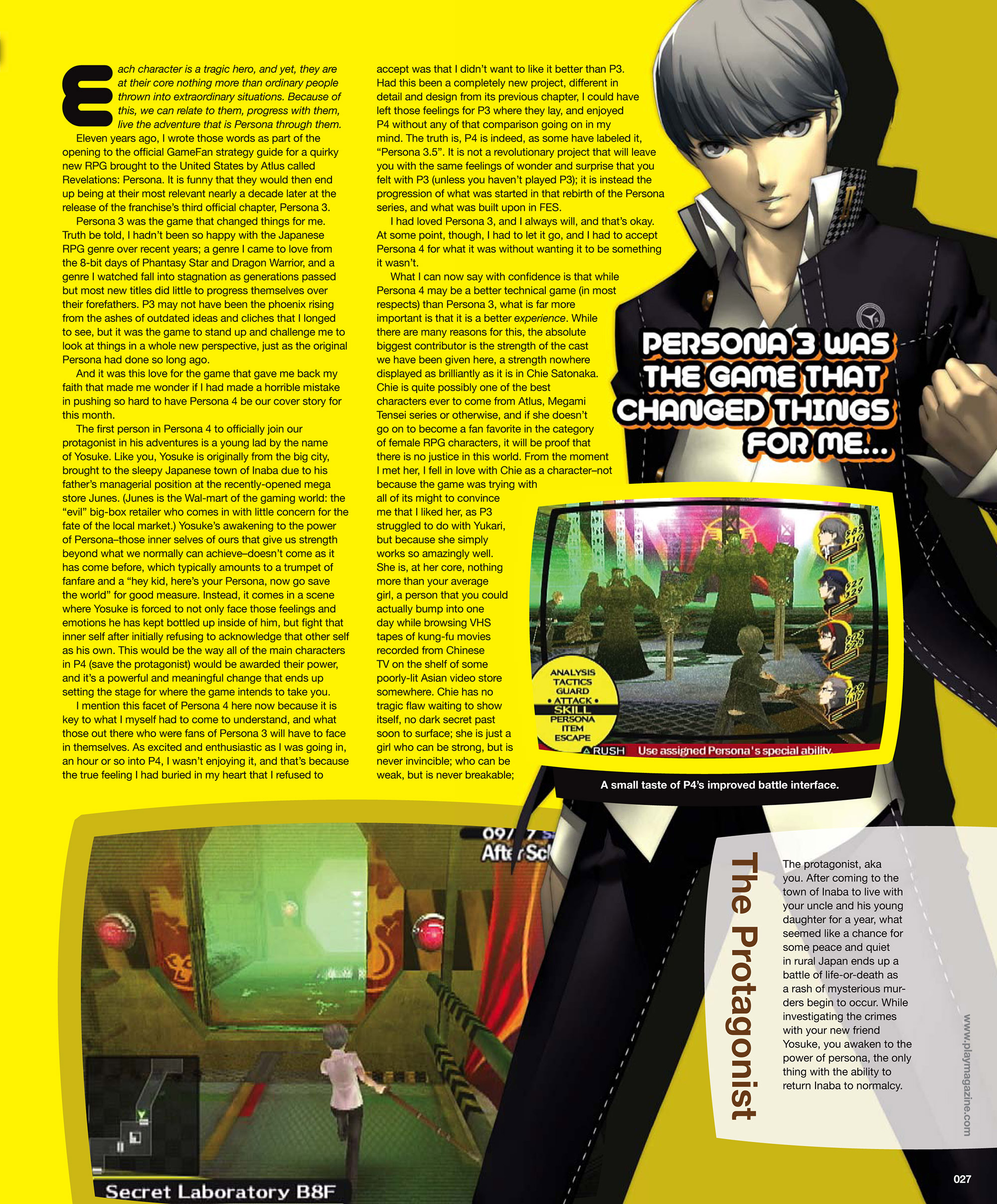
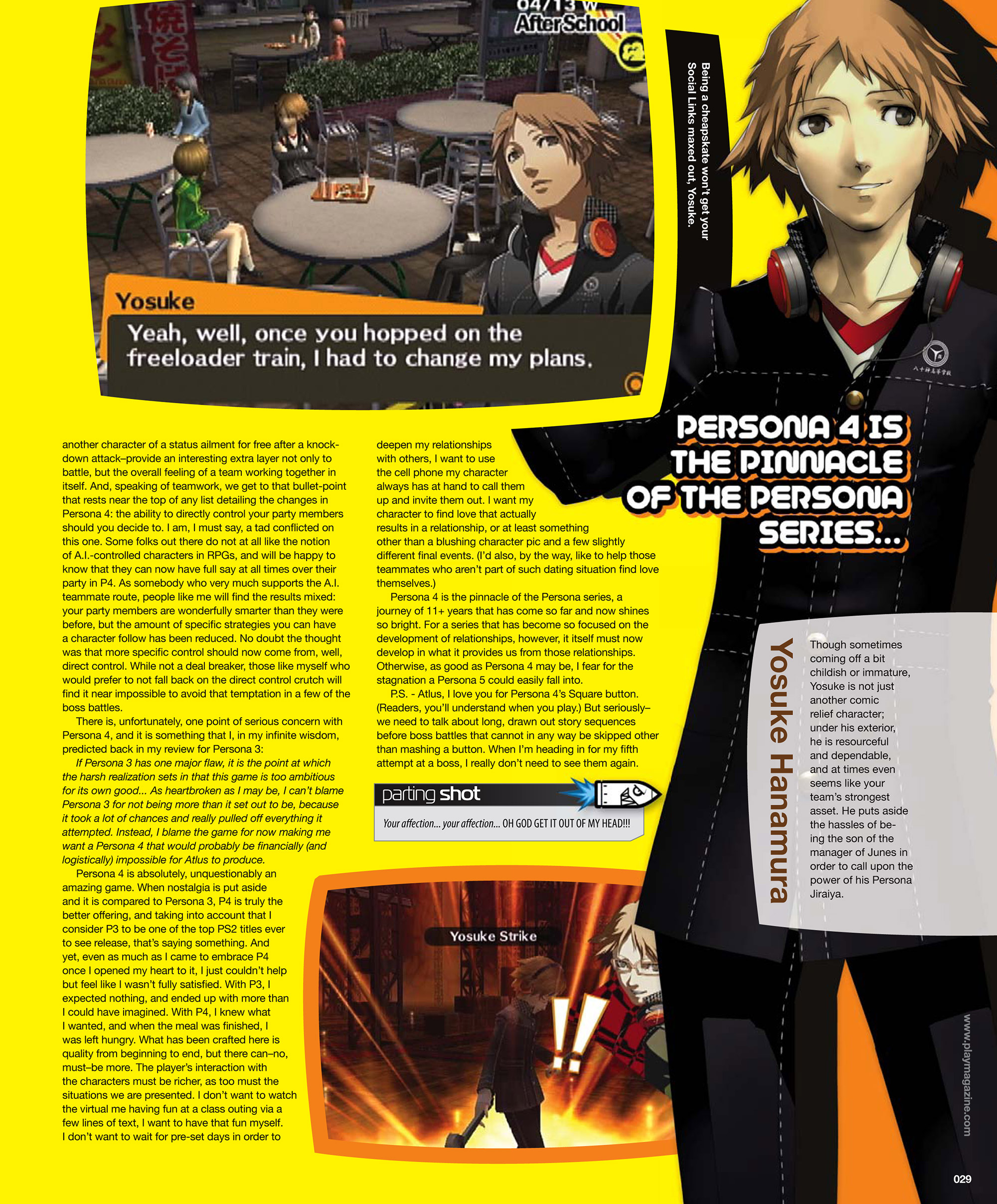
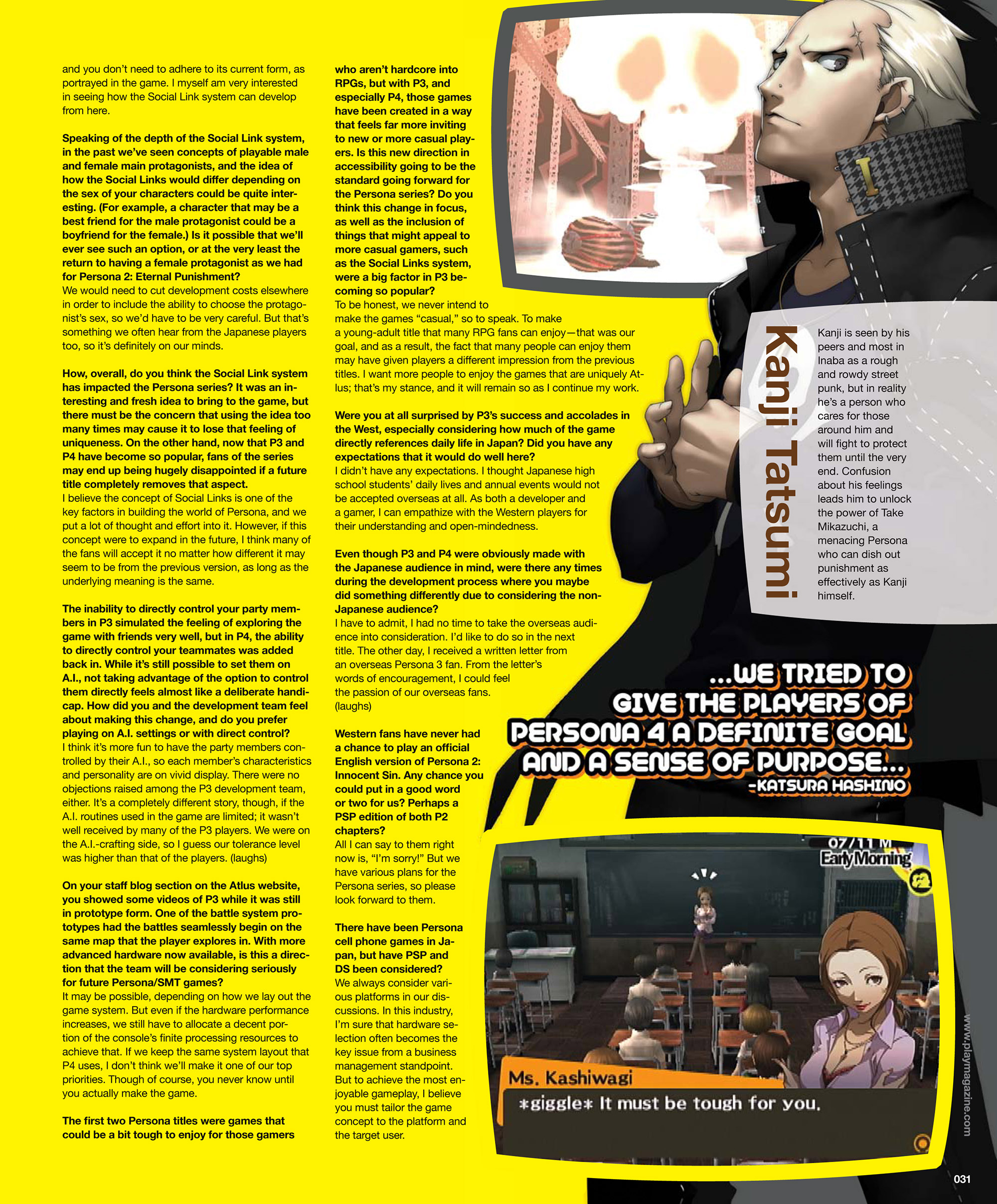
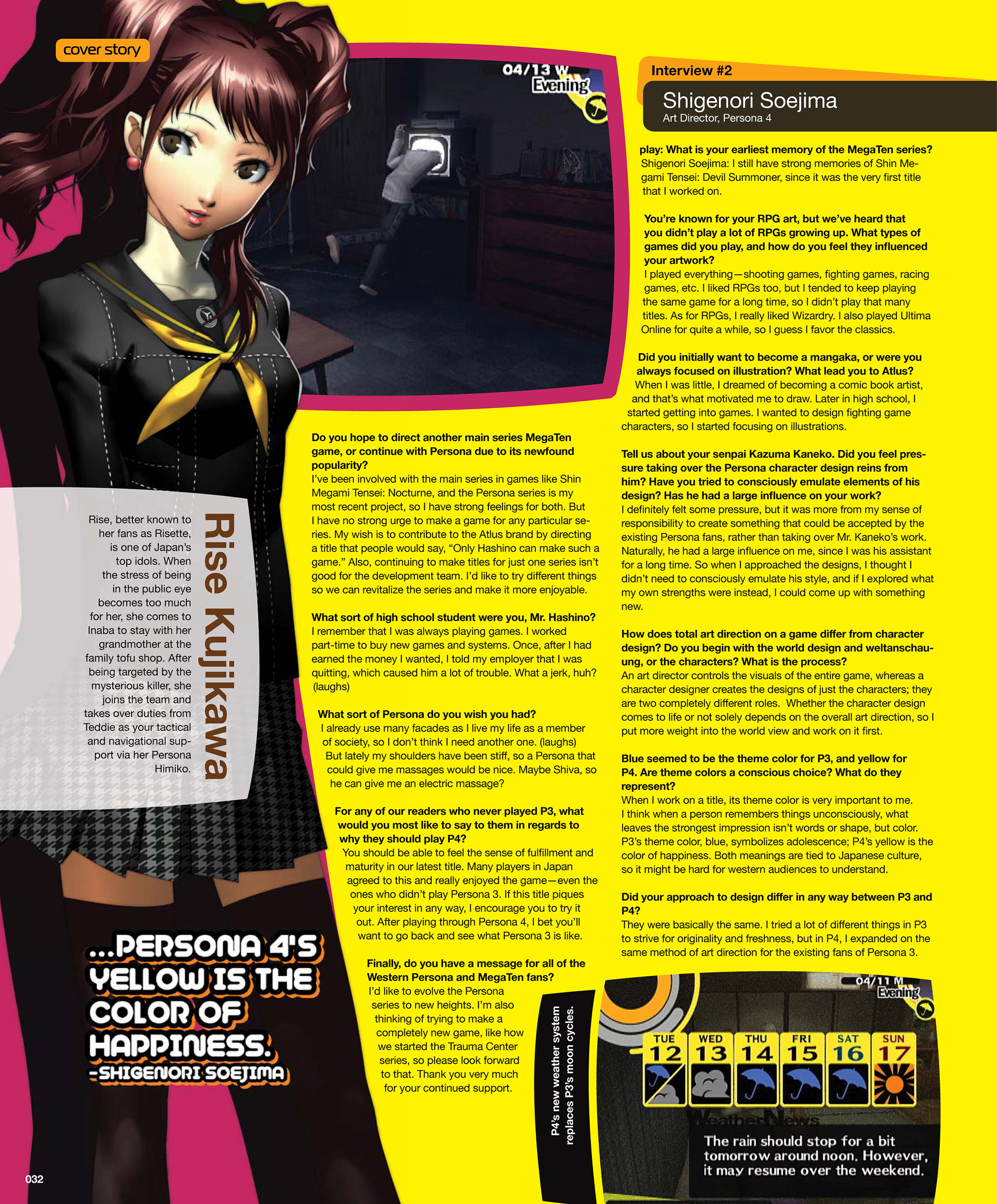
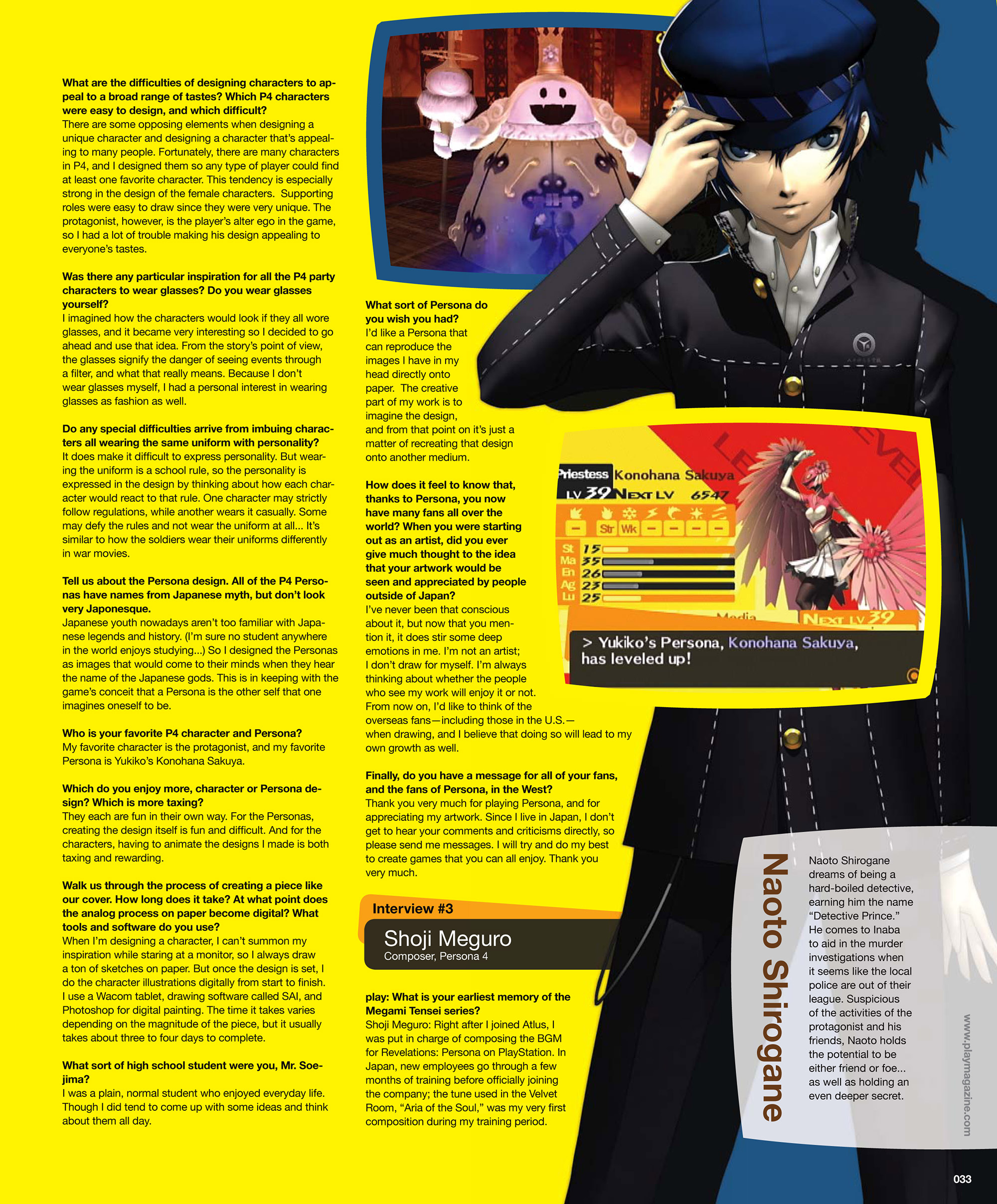
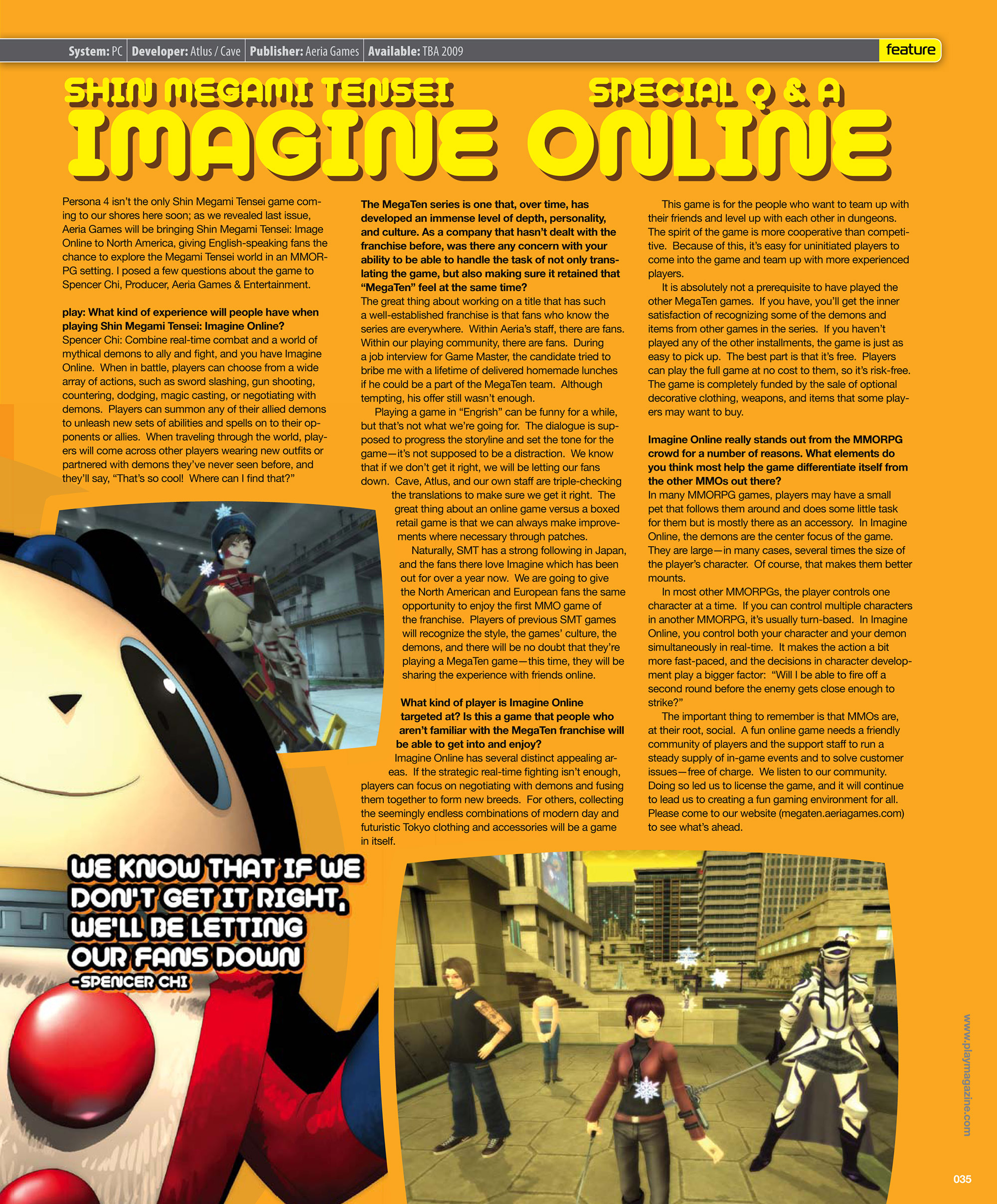
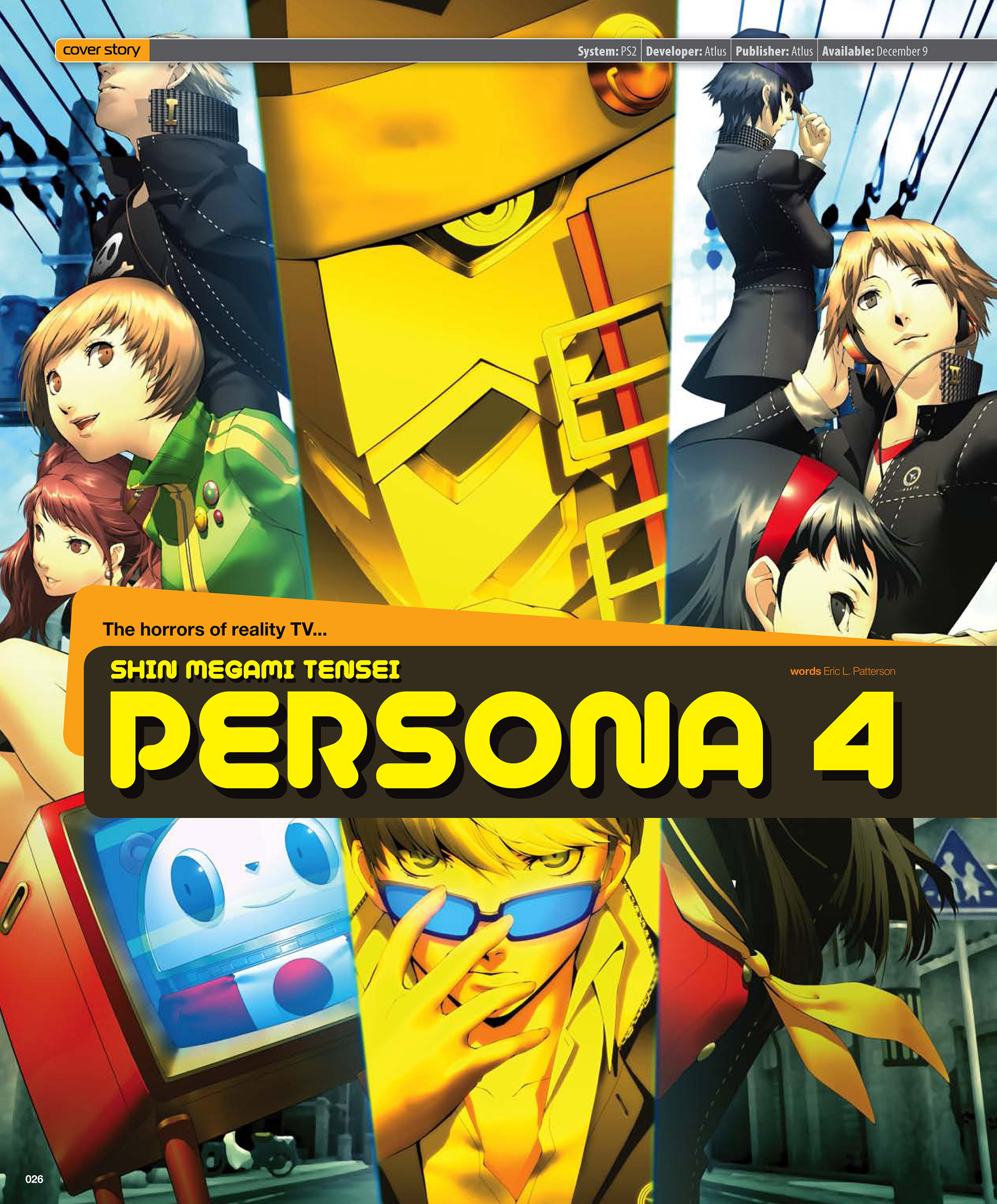
For the December 2008 issue of Play, I was given the chance to do my first cover story for the magazine: Persona 4. As a fan of the series since the original North American release of Revelations: Persona, I was super excited to do so, and not only got to play Persona 4 months beyond anyone else for the benefit of doing the cover story review, but also got to interview three of the key staff members from the development team (And—something I wouldn’t realize until later—I got the honor of doing the final cover story that a PlayStation 2 game would get in the States.)

One of the great parts of doing the cover story was that I got to handle the entirety of the cover story, from planning, to writing, to design. I was the only writer at Play that could also do their own layouts, and for Persona 4, I really wanted something that conveyed the “television” idea that was central to the game’s other world. So, all of the info boxes and screenshots were given a similar shape to CRT television screens. As well, I really liked the character art that I’d been given by Atlus, so I did the profiles for the main cast on the sides of each page in order to help introduce the new team to readers.

I’ve had plenty of design work that I’ve done that I laters wasn’t as much of a fan of anymore, but I still really like almost every aspect of my Persona 4 cover story for Play. I think the entire package turned out great, and it’s something I remain proud of to this day.

Oh, and it was also really awesome that Shigenori Soejima created an exclusive piece of Persona 4 artwork for us to use on the cover (which, so far as I know, has never been reprinted).

Persona 4 Review

Each character is a tragic hero, and yet, they are at their core nothing more than ordinary people thrown into extraordinary situations. Because of this, we can relate to them, progress with them, live the adventure that is Persona through them.

Eleven years ago, I wrote those words as part of the opening to the official GameFan strategy guide for a quirky new RPG brought to the United States by Atlus called Revelations: Persona. It is funny that they would then end up being at their most relevant nearly a decade later at the release of the franchise’s third official chapter, Persona 3.

Persona 3 was the game that changed things for me. Truth be told, I hadn’t been so happy with the Japanese RPG genre over recent years; a genre I came to love from the 8-bit days of Phantasy Star and Dragon Warrior, and a genre I watched fall into stagnation as generations passed but each new title did little to progress itself over its forefathers. P3 may not have been the phoenix rising from the ashes of outdated ideas and cliches that I longed to see, but it was the game to stand up and challenge us to look at things in a whole new perspective, just as the original Persona had done so long ago.

And it was this love for the game that gave me back my faith that made me wonder if I had made a horrible mistake in pushing so hard to have Persona 4 be our cover story for this month.

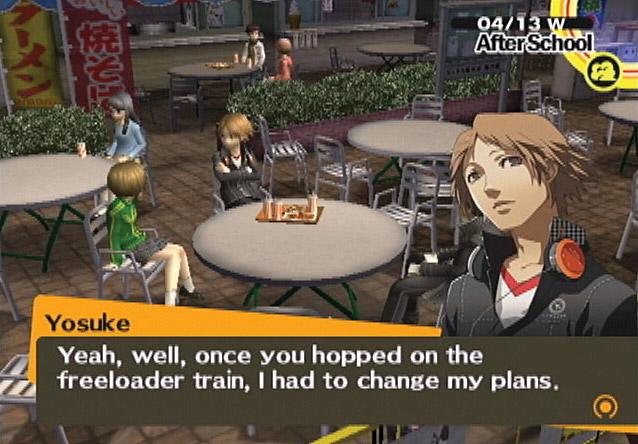
The first person in Persona 4 to officially join our protagonist in his adventures is a young lad by the name of Yosuke. Like you, Yosuke is originally from the big city, brought to the sleepy Japanese town of Inaba due to his father’s managerial position at the recently-opened mega store Junes. (Junes is the Wal-mart of the gaming world: the “evil” big-box retailer who comes in with little concern for the fate of those smaller local stores that have existed for as long as one can remember.) Yosuke’s awakening to the power of persona–those inner selves of ours that give us strength beyond what we normally can achieve–doesn’t come as it has come before, which typically amounts to a trumpet of fanfare and a “here kid, here’s your persona, now go save the world” for good measure. Instead, it comes in a scene where Yosuke is forced to not only face those feelings and emotions he has kept bottled up inside of him, but fight that inner self after initially refusing to acknowledge that other self as his own. This would be the way all of the main characters in P4 (save our protagonist) would be awarded their power, and it’s a subtle change that ends up really setting the stage for where the game intends to take you.

I mention this facet of Persona 4 here now because it is key to what I myself had to come to understand, and what those out there who were fans of Persona 3 will have to face in themselves. As excited and enthusiastic as I was going in, an hour or so into P4, I wasn’t enjoying it, and that’s because the true feeling I had buried in my heart that I refused to accept was that I didn’t want to like it better than P3. Had this been a completely new project, different in detail and design from its previous chapter, I could have left those feelings for P3 where they lay, and enjoyed P4 without any of that comparison going on in my mind. The truth is, P4 is indeed, as some have labeled it, “Persona 3.5”. It is not a revolutionary project that will leave you with the same feelings of wonder and surprise that you felt with P3 (unless you haven’t played P3); it is instead the progression of what was started in that rebirth of the Persona series, and what was built upon in FES.

I had loved Persona 3, and I always will, and that’s okay. At some point, though, I had to let it go, and I had to accept Persona 4 for what it was without wanting it to be something it wasn’t.

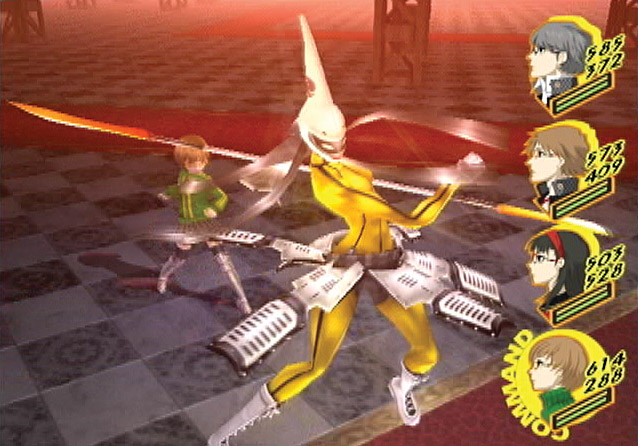
What I can now say with confidence is that while Persona 4 may be a better technical game (in most respects) than Persona 3, what is far more important is that it is a better experience. While there are many reasons for this, the absolute biggest contributor is the strength of the cast we have been given here, a strength nowhere displayed as brilliantly as it is in Chie Satonaka. Chie is quite possibly is one of the best characters ever to come from Atlus, Megami Tensei series or otherwise, and if she doesn’t go on to become a fan favorite in the category of female RPG characters, it will be proof that there is no justice in this world. From the moment I met her, I fell in love with Chie as a character–not because the game was trying with all of its might to convince me that I liked her, as P3 struggled to do with Yukari, but because she simply works so amazingly well. She is, at her core, nothing more than your average girl, a person that you could actually bump into one day while browsing VHS tapes of kung-fu movies recorded from Chinese TV on the shelf of some poorly-lit Asian video store somewhere. Chie has no tragic flaw waiting to show itself, no dark secret past soon to surface; she is just a girl who can be strong, but is never invincible; who can be weak, but is never breakable; who can be a dork, but is never dumb. When it came time to decide which I wanted to pursue her as–either a love interest or a close friend, a new option you’re given in P4 for the major female characters instead of just automatically trying to get your groove on with all of them–because I had so grown to respect her as a comrade and a friend, and didn’t want to cheapen that by feeling forced to switch her over to romance status. (Well, that, and my eye was instead on a certain red-haired ex-idol.)

What Persona 4 does in Chie, and in the entire rest of the cast, is allow the characters to simply be, for lack of a better word, “normal”. P3‘s cast, as much as I loved them, each held in themselves classic stereotypes from the world of Japanese gaming and anime: the goofy slacker, the mature older girl, the cool upperclassman all the students look up to, the shy, frail girl who has trouble fitting in. Those characters, throughout the course of P3, had to be given opportunities to show that there was more to them than just those cookie-cutter positions. The people you’ll come to know in P4 aren’t tragic heroes pushed into a situation they never wanted to be in, they’re down to earth high schoolers who are eager to use their powers to save those around them, yet who are also perfectly capable of forgetting their troubles when the opportunity to have fun arises. In stripping away that desperation of having the entire world balance on their shoulders, these heros and heroines have become far more relatable, and in turn, also more endearing.

It’s nice, then, to see that one of the changes made to Persona‘s current claim to fame, the Social Link system, is an increased importance on those closest to you. As before, your best female friends are more than eager to grow their relationships with you, but now so to are your male teammates. This initially makes the overall head count when it comes to Social Links feel artificially smaller, because a decent chunk of your possible acquaintances are already accounted for. What you find, however, is that your Social Links now have more emotional value to them, and while you’ll be spending more time with your close circle of friends because of the benefits they’ll gain in combat (which we’ll get to in a moment), but also because those are the people you most want to spend time with. Thought a few aspects of the overall social experience don’t quite feel as robust as or improved upon thought that were in Persona 3 as they should–outings with friends don’t feel as spontaneous, and events like the summer festival or school culture day are still woefully under-developed–there are a greater amount of elements that have either been nicely expanded or are completely new. Stat-boosting situations can now improve your standing with multiple characters at once, and a wide variety of jobs and side tasks now exists when you’ve got some time on your hands and nothing to do otherwise.

The changes made to Persona 4‘s social side are by far the biggest differences you’ll find when compared to Persona 3, but they certainly aren’t the only ones. Tartarus–the 250+ floor dungeon that served as the setting for most of P3‘s combat-related gameplay–was somewhat of a sticking point for some. P4 goes away from the idea of an all-encompassing location, and instead gives players smaller, much more personalized dungeons based around the personally of the characters you’re trying to save at that point. (An idea crafted to brilliance in the game’s fourth dungeon.) Coming from the monstrous Tartarus, at first they’ll feel positively tiny, but the change in attitude and atmosphere they create is unquestionably positive. Those who enjoyed the dungeon crawling of P3 should still find enough here to be satisfied, but those who found that aspect a chore will no doubt be happy to see that source of exhaustion changed into a more enjoyable experience.

Much bigger of a shock, surprisingly, was what you’ll find new this time around once you’ve actually encountered a Shadow in said dungeons. Little tweaks to the core elements of battle mean that some previous strategies no longer exist, and the addition of new skills that your teammates can unlock as you progress their Social Links–such as pushing your character out of the way of a mortal blow, or curing another character of a status ailment after a knock-down attack for free–provide an interesting extra layer not only to battle, but the overall feeling of a team working together in itself. And, speaking of teamwork, we get to that bullet-point that rests near the top of any list detailing the changes in Persona 4: the ability to directly control your party members should you decide to. I am, I must say, a bit torn on this one. Some folks out there do not at all like the notion of A.I.-controlled characters in RPGs, and will be happy to know that they can now have full say at all times over their characters in P4. As somebody who very much supports the A.I. teammate route, people like me will find the results mixed: your party members are wonderfully smarter than they were before, but the amount of specific strategies you can have a character follow has been reduced. No doubt the thought is that more specific control should now come from, well, direct control. While not a deal breaker, those like myself who would prefer to not fall back on the direct control crutch will find it near impossible to avoid that temptation in a few of the boss battles.

There is, unfortunately, one point of serious concern with Persona 4, and it is something that I, in my infinite wisdom, predicted back in my review for Persona 3:

If Persona 3 has one major flaw, it is the point at which the harsh realization sets in that this game is too ambitious for its own good… As heartbroken as I may be, I can’t blame Persona 3 for not being more than it set out to be, because it took a lot of chances and really pulled off everything it attempted. Instead, I blame the game for now making me want a Persona 4 that would probably be financially (and logistically) impossible for Atlus to produce.

Persona 4 is absolutely, unquestionably an amazing game. When nostalgia is put aside and it is compared to Persona 3, P4 is truly the better game, and taking into account that I consider P3 to be one of the best PS2 titles ever to see release, that’s saying something. And yet, even as much as I came to embrace the game once I opened my heart to it, I just couldn’t help but feel like I wasn’t fully satisfied. With P3, I expected nothing, and ended up with more than I could have imagined. With P4, I knew what I wanted, and when the meal was finished, I was left hungry. What has been crafted here is quality from beginning to end, but the can–no, must–be more. The player’s interaction with the characters in the game must be richer, as too must the situations we are presented. I don’t want to watch my character having fun at a class outing via a few lines of text, I want to have that fun myself. I don’t want to wait to pre-set days in order to deepen my relationships with people, I want to use the cell phone my character always has at hand to call them up and invite them out. I want my character to find love that actually results in a relationship, not just a blushing character pic and a few slightly different final events. (I’d also, by the way, like to help those teammates who aren’t part of such dating situation find love themselves.)

Persona 4 is the pinnacle of the Persona series, a journey of 11+ years that has come so far and now shines so bright. For a series that has become so focused on the development of relationships, however, it itself must now develop in what it provides us from those relationships. Otherwise, as good as Persona 4 may be, I’m not sure I can fully support the idea of a Persona 5.

P.S. – Atlus, I love you for Persona 4‘s Square button. (Readers, you’ll understand when you play.) But seriously… we need to talk about long, drawn out story sequences before boss battles that cannot in any way be skipped other than mashing a button. When I’m heading in for my fifth attempt at a boss, I don’t need to see that anymore.

Shoji Meguro – Persona 4

Mollie: What is your earliest memory of the Megami Tensei series?

Shoji Meguro: Right after I joined Atlus, I was put in charge of composing the BGM for Revelations: Persona on PlayStation. In Japan, new employees go through a few months of training before officially joining the company; the tune used in the Velvet Room, “Aria of the Soul,” was my very first composition during my training period.

Mollie: Tell us about your musical background. Did you play in any bands? What led you to musical composition? What led you to Atlus?

Meguro: I started learning the electronic organ when I was four or five, and I continued for more than ten years. I learned the basics of arrangement during that time, and around middle school, I began composing original music. I bought a synthesizer and other electronic instruments as soon as I entered high school, and started playing guitar at the age of sixteen. I teamed up with a friend during my high school years and tried my hand at electronic sequencing. And in college, I played guitar in a band with my friend.

I joined Atlus after I finished grad school. I had majored in mechanical engineering, but I convinced my parents that it was extremely difficult to get a job at a major tech-related company due to the recession, and took employment tests at various video game companies. I chose the game industry because at the time, I couldn’t think of any other way of earning a steady salary as a musician. I sent in a demo tape and had two interviews before I was employed at Atlus.

Mollie: Tell us about your composition process. Do you have a routine you follow, or do you sit down at the keyboard when the inspiration strikes you?

Meguro: I take a wide variety of approaches, depending on the song. Mainly, I write down things that come to mind in my daily life, and wait for inspiration to strike as I play keyboard or guitar.

Mollie: What genre of music is easiest for you to work in? Which do you most enjoy?

Meguro: Pop music is the easiest, and I enjoy working on it too.

Mollie: You’re well known for your rock and jazz—do you find it more difficult to compose in other genres? Easier?

Meguro: I generally have no preference for the genre.  However, I’d like to avoid composing ethnic music other than Japanese. I might be OK if I manage to grasp the essence of a particular ethnic music, but I strongly believe that it’s wrong to compose ethnic music while only being familiar with the surface elements.

Mollie: How do you approach the scoring of a Shin Megami Tensei, a Devil Summoner, and a Persona? All have a vastly different sound.

Meguro: I’m not trying to take a distinct approach for each series; it’s more like working on a title-by-title basis, according to its individual flavor. So if the next Persona title is going to be a serious story with heavy occult influences, the music may turn out to be closer to the Shin Megami Tensei style.

Mollie: How did you approach the scoring of Persona 4 versus Persona 3? Did the suburban setting or mystery theme prompt changes in style?

Meguro: Yes, I composed the music of Persona 4 by taking into account the suburban setting and the mystery theme.

Mollie: What music artists have influenced you? Who inspires you? What would we find on your mp3 player right now?

Meguro: I try not to listen to music that much, in order to avoid other people’s music influencing my work. I do believe, though, that the core of my music is influenced by a Japanese fusion band I liked to listen to when I was in high school. The most I hear of current pop music are songs that play on TV programs that cover the hits of the day, and I don’t have an MP3 player. (Though on rare occasions, I’ll listen to CDs by artists who pique my interest.) The closest thing I have to that would be my cell phone, but the only time I use it to listen to music is when I’m on the train and the ladies next to me start talking so loud that I can’t concentrate on my magazine.

Mollie: At least in the West, for a long time video game music was not considered to be “real” music, but now that opinion has changed, as a wide variety of people enjoy everything from the type of music you produce for games like Persona 4, to classic 8-bit music from the era of the Famicom. Was there ever a time when people didn’t take the work you were doing as serious as you would have liked? Do you think there’s been a change in the perception of video game music in the twelve years that you’ve been working at Atlus?

Meguro: I believe it’s the same between Japan and the U.S. I decided to join a video game company only because I learned that with PlayStation and Saturn, you could play game music from a CD. I didn’t own a NES and all I had for SNES were a Mahjong game and a soccer game, so I wasn’t exposed to any game music during that time. As a result, I myself had a biased view of game music, based solely on what I imagined it to be like, and didn’t consider it to be “real” music.

So when I joined Atlus, I thought I could compose PlayStation game music just as I would a regular music CD, but the reality was completely different. I had to compose music using samples of 100KB-200KB in size, and the end results sounded pretty cheap. At times, I was indirectly mocked by the composers who worked on the arranged versions of my songs for the game soundtrack albums.

The situation was about the same when we moved the platform to PlayStation 2, but in Digital Devil Saga, we could use streaming to play about half the songs. And in Persona 3 and Devil Summoner: Raidou Kuzunoha vs. the Soulless Army, all the songs were streamed. That was the point at which I was finally able to express my music without making any compromises, and I felt that I made it to the starting line.

Mollie: We hear Persona art director Shigenori Soejima once asked you to teach him piano. How did that work out?

Meguro: Unfortunately, nothing has come of that yet. Before I can teach him, I need to learn how to play piano better myself. (The piano keys are so much heavier compared to an electronic organ’s!)

Mollie: Tell us about the production of vocal themes. Do you write them for a specific vocalist, or choose one to suit the song?

Meguro: We don’t do any cross-promotions of that sort at Atlus, so I choose the artist that best fits the music and the lyrics.

Mollie: Have you had the chance to listen to Takeharu Ishimoto’s work on Square Enix’s Subarashiki Kono Sekai (The World Ends With You)? It seemed to build on the same kind of vocal / R&B / hip-hop / urban / modern feel that you put together for Persona 3.

Meguro: To be honest, I haven’t. The World Ends With You came out in Japan in July 2007, so I think by the time Persona 3 came out, they were well into development. I wonder if the release of Persona 3 gave Mr. Takeharu Ishimoto a big headache. [Laughs]

Mollie: What sort of high school student were you, Mr. Meguro?

Meguro: I didn’t study at all. I even used to play catch during the short ten-minute break between classes.

Mollie: What sort of Persona do you wish you had?

Meguro: I was born in the year of the boar, so how about Amida Nyorai (Amitabha Tathagata), my patron god?

Mollie: You gained a number of new Western fans thanks to the Persona 3 soundtrack, and no doubt the same will happen again with Persona 4. How does it feel to know that a worldwide audience listens to and enjoys your music?

Meguro: I’m really worried about the English pronunciation… in the Japanese version, the characters spoke Japanese while the music was in English, so I think it was less noticeable. If we had more time and money, I would want to change the vocals in the overseas version into Japanese. Then I wouldn’t have to worry about people saying the vocals sound like “Engrish,” right?

Mollie: Finally, do you have a message for all of your fans in the West?

Meguro: We don’t receive feedback directly from overseas. But through interviews and game sites, I can tell that the fans are very passionate and well informed about the game’s intrinsic nature, and I’m deeply moved by it. We cannot help focusing on the Japanese market when developing games, but we will try our best to give our titles more worldwide appeal from now on. Thank you very much.

Shigenori Soejima – Persona 4

Mollie: What is your earliest memory of the Megami Tensei series?

Shigenori Soejima: I still have strong memories of Shin Megami Tensei: Devil Summoner, since it was the very first title that I worked on.

Mollie: You’re known for your RPG art, but we’ve heard that you didn’t play a lot of RPGs growing up. What types of games did you play, and how do you feel they influenced your artwork?

Soejima: I played everything—shooting games, fighting games, racing games, etc. I liked RPGs too, but I tended to keep playing the same game for a long time, so I didn’t play that many titles. As for RPGs, I really liked Wizardry. I also played Ultima Online for quite a while, so I guess I favor the classics.

Mollie: Did you initially want to become a mangaka, or were you always focused on illustration? What lead you to Atlus?

Soejima: When I was little, I dreamed of becoming a comic book artist, and that’s what motivated me to draw. Later in high school, I started getting into games. I wanted to design fighting game characters, so I started focusing on illustrations.

Mollie: Tell us about your senpai Kazuma Kaneko. Did you feel pressure taking over the Persona character design reins from him? Have you tried to consciously emulate elements of his design? Has he had a large influence on your work?

Soejima: I definitely felt some pressure, but it was more from my sense of responsibility to create something that could be accepted by the existing Persona fans, rather than taking over Mr. Kaneko’s work. Naturally, he had a large influence on me, since I was his assistant for a long time. So when I approached the designs, I thought I didn’t need to consciously emulate his style, and if I explored what my own strengths were instead, I could come up with something new.

Mollie: How does total art direction on a game differ from character design? Do you begin with the world design and weltanschauung (overall world framework), or the characters? What is the process?

Soejima: An art director controls the visuals of the entire game, whereas a character designer creates the designs of just the characters; they are two completely different roles.  Whether the character design comes to life or not solely depends on the overall art direction, so I put more weight into the world view and work on it first.

Mollie: Blue seemed to be the theme color for Persona 3, and yellow for Persona 4. Are theme colors a conscious choice? What do they represent?

Soejima: When I work on a title, its theme color is very important to me. I think when a person remembers things unconsciously, what leaves the strongest impression isn’t words or shape, but color. Persona 3’s theme color, blue, symbolizes adolescence; Persona 4’s yellow is the color of happiness. Both meanings are tied to Japanese culture, so it might be hard for western audiences to understand.

Mollie: Did your approach to design differ in any way between Persona 4 and Persona 4?

Soejima: They were basically the same. I tried a lot of different things in Persona 3 to strive for originality and freshness, but in Persona 4, I expanded on the same method of art direction for the existing fans of Persona 3.

Mollie: What are the difficulties of designing characters to appeal to a broad range of tastes? Which P4 characters were easy to design, and which difficult?

Soejima: There are some opposing elements when designing a unique character and designing a character that’s appealing to many people. Fortunately, there are many characters in Persona 4, and I designed them so any type of player could find at least one favorite character. This tendency is especially strong in the design of the female characters.  Supporting roles were easy to draw since they were very unique. The protagonist, however, is the player’s alter ego in the game, so I had a lot of trouble making his design appealing to everyone’s tastes.

Mollie: Was there any particular inspiration for all the Persona 4 party characters to wear glasses? Do you wear glasses yourself?

Soejima: I imagined how the characters would look if they all wore glasses, and it became very interesting so I decided to go ahead and use that idea. From the story’s point of view, the glasses signify the danger of seeing events through a filter, and what that really means. Because I don’t wear glasses myself, I had a personal interest in wearing glasses as fashion as well.

Mollie: Do any special difficulties arrive from imbuing characters all wearing the same uniform with personality?

Soejima: It does make it difficult to express personality. But wearing the uniform is a school rule, so the personality is expressed in the design by thinking about how each character would react to that rule. One character may strictly follow regulations, while another wears it casually. Some may defy the rules and not wear the uniform at all… It’s similar to how the soldiers wear their uniforms differently in war movies.

Mollie: You’ve said that Fujio F. Fujiko’s Doraemon was your greatest inspiration to become an illustrator as a child. Would you say his design had an influence on Persona 4‘s Teddie?

Soejima: Even now, Doraemon is loved by people all over Japan, despite the character being designed over thirty years ago. Since Teddie’s design concept was “a retro character from an older era,” I think Doraemon was a big influence on him.

Mollie: Tell us about the Persona design. All of the Persona 4 Personae have names from Japanese myth, but don’t look very Japonesque.

Soejima: Japanese youth nowadays aren’t too familiar with Japanese legends and history. (I’m sure no student anywhere in the world enjoys studying…) So I designed the Personas as images that would come to their minds when they hear the name of the Japanese gods. This is in keeping with the game’s conceit that a Persona is the other self that one imagines oneself to be.

Mollie: Which do you enjoy more, character or Persona design? Which is more taxing?

Soejima: They each are fun in their own way. For the Personas, creating the design itself is fun and difficult. And for the characters, having to animate the designs I made is both taxing and rewarding.

Mollie: Would you say the root concept of Personae is influenced by Jojo’s Bizarre Adventure‘s Stands? Has Hirohiko Araki influenced your work?

Soejima: When I started working, Persona and JoJo both existed as separate entities, so I never quite compared the two. Mr. Hirohiko Araki’s art style is very unique and fascinating, but I don’t think I’ve received any direct influence.

Mollie: Who is your favorite Persona 4 character, and which is your favorite Persona?

Soejima: My favorite character is the protagonist, and my favorite Persona is Yukiko’s Konohana Sakuya.

Mollie: Walk us through the process of creating a piece like our cover. How long does it take? At what point does the analog process on paper become digital? What tools and software do you use?

Soejima: When I’m designing a character, I can’t summon my inspiration while staring at a monitor, so I always draw a ton of sketches on paper. But once the design is set, I do the character illustrations digitally from start to finish. I use a Wacom tablet, drawing software called SAI, and Photoshop for digital painting. The time it takes varies depending on the magnitude of the piece, but it usually takes about three to four days to complete.

Mollie: Tell us about your experience with Trinity Soul. What was the extent of your involvement? What was it like to see your characters animated on television?

Soejima: I designed the protagonist and a number of the main characters, as well as the school uniform. Seeing the characters move is like breathing life into them, and it makes me very happy.

Mollie: What sort of high school student were you, Mr. Soejima?

Soejima: I was a plain, normal student who enjoyed everyday life. Though I did tend to come up with some ideas and think about them all day.

Mollie: What sort of Persona do you wish you had?

Soejima: I’d like a Persona that can reproduce the images I have in my head directly onto paper.  The creative part of my work is to imagine the design, and from that point on it’s just a matter of recreating that design onto another medium.

Mollie: How does it feel to know that, thanks to Persona, you now have many fans all over the world? When you were starting out as an artist, did you ever give much thought to the idea that you artwork would be seen and appreciated by people outside of Japan?

Soejima: I’ve never been that conscious about it, but now that you mention it, it does stir some deep emotions in me. I’m not an artist; I don’t draw for myself. I’m always thinking about whether the people who see my work will enjoy it or not. From now on, I’d like to think of the overseas fans—including those in the U.S.—when drawing, and I believe that doing so will lead to my own growth as well.

Mollie: Finally, do you have a message for all of your fans, and the fans of Persona, in the West?

Soejima: Thank you very much for playing Persona, and for appreciating my artwork. Since I live in Japan, I don’t get to hear your comments and criticisms directly, so please send me messages. I will try and do my best to create games that you can all enjoy. Thank you very much.

Katsura Hashino – Persona 4

Mollie: What is your earliest memory of the Megami Tensei series?

Katsura Hashino: The first title I worked on after I joined Atlus was Shin Megami Tensei: if… where I was put in charge of the Guardian system. Now that I think about it, that Guardian system became the basis of the Persona series, so I’ve been involved with the series since then. Wow, that’s a long time.

Mollie: Tell us a little bit about the Persona brand positioning within the MegaTen universe. It was originally conceived as a light and easy game to introduce players to both the MegaTen series and RPGs themselves. What has changed from that original concept, and what has stayed the same?

Hashino: When Shin Megami Tensei: if… came out, its school setting was well received. So we decided to start a new series that dealt with the inner struggles of young adults, which became Revelations: Persona. Since we actively try to incorporate the latest trends into the Persona series, each title has a distinct feel. However, they all share the fundamental focus of “the human soul.”

Mollie: Can you tell us when Persona 4 development began? Was the decision to develop on PS2 made before or after Persona 3 was released and became so successful?

Hashino: There were ideas thrown around earlier, but we didn’t assemble the team and begin development until after Persona 3‘s release.

Mollie: Did you learn any lessons on Persona 3 that made Persona 4 development easier?

Hashino: Yes. First and foremost, the players’ comments and feedback on Persona 3 and FES that we collected was of great help. And the knowledge we gained from the development of P3 allowed us to spend more time in raising the quality of Persona 4. P3 was also the first title in which I was heavily involved with writing the scenario, so that experience helped me a lot when I worked on P4‘s scenario.

Mollie: In moving from Persona 3 to Persona 4, what elements did you most want to focus on as far as expanding or improving upon what existed in P3? Did these aspects come from things you wanted to do during the development of P3 but weren’t able to, or were these things that you decided you wanted in P4 after you had the chance to look at P3 as a finished product?

Hashino: We wanted to improve Persona 3‘s system—speeding up the story progression, and enhancing the gameplay. In addition, we wanted to make sure Persona 4 wasn’t seen as a retread of P3. To accomplish that, we tried to give the players of P4 a definite goal and a sense of purpose that would keep motivating them as they played through the game. The murder mystery plot was our way of doing that.

Mollie: When designing a heavily character-driven game like Persona, which comes first: Characters or story?

Hashino: The game’s theme and scenario come first. No matter what kind of game it is, you can’t make it in any other fashion.

Mollie: Persona 3 took place in a large city, Persona 4 in a small town. How did the new setting influence game design, characters, and story?

Hashino: I think the setting influenced all aspects of the game deeply. We also chose this setting to have a positive effect on the game’s visuals. A group of youths grow as they try to solve an incident that occurs in a small, rural town—that’s the basis or the framework, and from there we added Persona 4‘s theme of “how individuals process information,” and built the rest of the game.

Mollie: In regards to setting, Persona 4 differs from many other RPGs, where you have a huge world to explore and a wide array of towns instead of one. And yet, since we spent more time in P4‘s town, we come to know it much better and have more attachment to it. How do you feel the difference in scope with P4 helped the game, and were there any ways in which it limited the overall vision?

Hashino: Since the location was the same throughout the game, the cost of creating the environment was lower than the standard in RPG development, allowing us to expand other portions of the game. And staying in the same location is the perfect way to allow the players to sympathize with the daily life that passes in the game. I’m sure many of these players live their lives peacefully, without any drastic changes happening to them. Having said that, if the environment remained the same, you would need plans and goals, or else the days would become dull quickly. Therefore, we decided that there were a minimum number of events and story progressions we had to exceed to keep the game exciting, and that’s where the development cost reached staggering proportions.

Mollie: What inspired the mystery/detective novel theme?

Hashino: There were certain things that provided inspiration, but if I told you what they were, that would be a big spoiler. So I should keep my mouth shut. [laughs]

Mollie: Before its North America release, some fans were concerned that Persona 3 may be criticized due to the use of the gun-like envokers for Persona summoning in the game. Did concerns like these in any way effect the decision for what kind of Persona summoning method would be used in Persona 4?

Hashino: No, we decided on the summoning method based solely on the story’s theme. We believe that we can come up with more interesting ideas by not overreacting to public response.

Mollie: The schedule system used in Persona 3 is greatly expanded on in Persona 4, as now there are many more options available to the player each day, and even in general conversations there are more dialogue options for the player to choose from, sometimes affecting the commu/s.link relationships even outside of specific commu/s.link events. The entire approach feels as if it may have been influenced by western RPGs and simulation games; is the team actually influenced by those games or is it just a coincidence?

Hashino: I think it’s all a coincidence. [laughs] I do like western games, though, so maybe they do affect me subconsciously.

Mollie: How far do you think the Social Link system could be taken? Obviously there needs to continue to be a fine balance between the “RPG” and “Life” aspects of a game like Persona, but do you think the overall idea could support an even deeper social aspect?

Hashino: I think so. The concept of Social Links is that the world consists of many small worlds that are close to each and every one of us, and if the manifestation of one’s heart is the Persona, then the Social Link is the connection between those hearts. That is what’s important, and you don’t need to adhere to its current form, as portrayed in the game. I myself am very interested in seeing how the Social Link system can develop from here.

Mollie: Speaking of the depth of the Social Link system, in the past we’ve seen concepts of playable male and female main protagonists, and the idea of how the Social Links would differ depending on the sex of your characters could be quite interesting. (For example, a character that may be a best friend for the male protagonist could be a boyfriend for the female.) Is it possible that we’ll ever see such an option, or at the very least the return to having a female protagonist as we had for Persona 2: Eternal Punishment?

Hashino: We would need to cut development costs elsewhere in order to include the ability to choose the protagonist’s sex, so we’d have to be very careful. But that’s something we often hear from the Japanese players too, so it’s definitely on our minds.

Mollie: How, overall, do you think the Social Link system has impacted the Persona series? It was an interesting and fresh idea to bring to the game, but there must be the concern that using the idea too many times may cause it to lose that feeling of uniqueness. On the other hand, now that Persona 3 and Persona 4 have become so popular, fans of the series may end up being hugely disappointed if a future title completely removes that aspect.

Hashino: I believe the concept of Social Links is one of the key factors in building the world of Persona, and we put a lot of thought and effort into it. However, if this concept were to expand in the future, I think many of the fans will accept it no matter how different it may seem to be from the previous version, as long as the underlying meaning is the same.

Mollie: The inability to directly control your party members in Persona 3 simulated the feeling of exploring the game with friends very well, making you feel more like the main character and your teammates being actual teammates. With Persona 4, the ability to directly control your teammates was added back in, and while it’s still possible to set them on AI, not taking advantage of the option to control them directly feels almost like a deliberate handicap. How did you and the development team feel about making this change, and do you prefer playing on AI settings or with direct control?

Hashino: I think it’s more fun to have the party members controlled by their AI, so each member’s characteristics and personality are on vivid display. There were no objections raised among the Persona 3 development team, either. It’s a completely different story, though, if the AI routines used in the game are limited; it wasn’t well received by many of the P3 players. We were on the AI-crafting side, so I guess our tolerance level was higher than that of the players. [laughs]

Mollie: On your staff blog section on the Atlus website, you showed some videos of the development process of Persona 3 while it was still in prototype form. One of the battle system prototypes had the battles seamlessly begin on the same map that the player explores in. With more advanced hardware now available, is this a direction that the team will be considering seriously for future Persona/SMT games?

Hshino: It may be possible, depending on how we lay out the game system. But even if the hardware performance increases, we still have to allocate a decent portion of the console’s finite processing resources to achieve that. If we keep the same system layout that Persona 4 uses, I don’t think we’ll make it one of our top priorities. Though of course, you never know until you actually make the game.

Mollie: In my opinion, Persona 1 and 2 were games that could be a bit tough to enjoy for those gamers who aren’t hardcore into RPGs, but with Persona 3, and especially Persona 4, those games have been created in a way that feels far more inviting to new or more casual players. Is this new direction in accessibility going to be the standard going forward for the Persona series? Do you think this change in focus, as well as the inclusion of things that might appeal to more casual gamers, such as the Social Links system, were a big factor in P3 becoming so popular? As well, in planning both P4 and for the future of the Persona series, what were and are the concerns between balancing the game for the new audience that has come to the series via P3 and P4, and for long-time MegaTen fans who may prefer the more complex nature of the previous Persona titles?

Hashino: To be honest, we never intend to make the games “casual,” so to speak. To make a young-adult title that many RPG fans can enjoy—that was our goal, and as a result, the fact that many people can enjoy them may have given players a different impression from the previous titles. I want more people to enjoy the games that are uniquely Atlus; that’s my stance, and it will remain so as I continue my work.

Mollie: Do you have any personal feelings about Japanese developers’ struggles to stay relevant in the West?

Hashino: For us to do that, I think we need to propose methods of playing and having fun—not to rely on existing ideas, but to simply pursue the ideas that we propose. For example, Persona may look like a complex RPG, but our stance of its development is very simple. And the ideas, no matter what kind, must be fresh. Just as a good chef checks the market early in the morning for fresh food, developers (including myself) should be conscientious about the freshness of their titles.

Mollie: Were you at all surprised by Persona 3‘s success and accolades in the West, especially considering how much of the game directly references daily life in Japan? Did you have any expectations that it would do well here?

Hashino: I didn’t have any expectations. I thought Japanese high school students’ daily lives and annual events would not be accepted overseas at all. As both a developer and a gamer, I can empathize with the western players for their understanding and open-mindedness.

Mollie: Even though Persona 3 and Persona 4 were obviously made with the Japanese audience in mind, were there any times during the development process where you maybe did something differently due to considering the non-Japanese audience?

Hashino: I have to admit, I had no time to take the overseas audience into consideration. I’d like to do so in the next title. The other day, I received a written letter from an overseas Persona 3 fan. From the letter’s words of encouragement, I could feel the passion of our overseas fans. [laughs]

Mollie: Western fans have never had a chance to play an official English version of Persona 2: Innocent Sin. Any chance you could put in a good word or two for us poor Western Persona fans? Perhaps a PSP edition of both P2 chapters?

Hashino: All I can say to them right now is, “I’m sorry!” But we have various plans for the Persona series, so please look forward to them.

Mollie: Persona 4 takes place two years after Persona 3, and the anime Persona Trinity Soul ten years later. Will you stay with a cohesive world and timeline for the Persona series from now on?

Hashino: I don’t have any really strong feelings about it. As far as future titles, there are no plans at this point.

Mollie: American fans miss out on this, but in Japan Persona 3 had novels, comics and drama CDs intersecting through a single timeline. Is it difficult to keep track of such a sprawling multimedia story? Are there similar plans for Persona 4?

Hashino: All the proposals we receive for tie-ins are filled with love for the games, so we exercise only as much quality control as is necessary and leave the rest to the makers. I think this allows the end product to be more fun, so I don’t mind it at all. This applies to Persona 4 as well, so I’m looking forward to its multimedia development.

Mollie: Do you hope to direct another main series MegaTen game, or continue with Persona due to its newfound popularity?

Hashino: I’ve been involved with the main series in games like Shin Megami Tensei: Nocturne, and the Persona series is my most recent project, so I have strong feelings for both. But I have no strong urge to make a game for any particular series. My wish is to contribute to the Atlus brand by directing a title that people would say, “Only Hashino can make such a game.” Also, continuing to make titles for just one series isn’t good for the development team. I’d like to try different things so we can revitalize the series and make it more enjoyable.

Mollie: There have been Persona cell phone games in Japan, but have PSP and DS been considered?

Hashino: We always consider various platforms in our discussions. In this industry, I’m sure that hardware selection often becomes the key issue from a business management standpoint. But to achieve the most enjoyable gameplay, I believe you must tailor the game concept to the platform and the target user.

Mollie: Do you think Japanese teenagers of today have changed compared to twelve years ago, when the first Persona was released? Did you do any special research to get into the mindset of modern youth?

Hashino: I’ve had opportunities to interact with the adolescents transitioning into adulthood. Although their behavior is different from the way it was in my time, I feel that their essential concerns haven’t changed. The environment and the society they grow up in is definitely different; with the spread of the Internet, and things like the permanent employment system and the emphasis on educational background losing ground, it seems you need to face yourself early on in your life in order to adapt to society.

Mollie: What sort of high school student were you, Mr. Hashino?

Hashino: I remember that I was always playing games. I worked part-time to buy new games and systems. Once, after I had earned the money I wanted, I told my employer that I was quitting, which caused him a lot of trouble. What a jerk, huh? [laughs]

Mollie: What sort of Persona do you wish you had?

Hashino: I already use many facades as I live my life as a member of society, so I don’t think I need another one. [laughs] But lately my shoulders have been stiff, so a Persona that could give me massages would be nice. Maybe Shiva, so he can give me an electric massage?

Mollie: Can we expect a FES-like Persona 4 expansion?

Hashino: We have no plans for that at this time.

Mollie: I have to ask: Persona 5, next gen?

Hashino: Nothing’s set in stone. We are currently looking into many different things.

Mollie: For any of our [ED: Play magazine] readers who never played Persona 3 (even though both our editors Dai and myself giving the game a score of 10 out of 10), what would you most like to say to them in regards to why they should play Persona 4?

Hashino: You should be able to feel the sense of fulfillment and maturity in our latest title. Many players in Japan agreed to this and really enjoyed the game—even the ones who didn’t play Persona 3. If this title piques your interest in any way, I encourage you to try it out. After playing through Persona 4, I bet you’ll want to go back and see what P3 is like.

Mollie: Finally, do you have a message for all of the Western Persona and MegaTen fans?

Hashino: I’d like to evolve the Persona series to new heights. I’m also thinking of trying to make a completely new game, like how we started the Trauma Center series, so please look forward to that. Thank you very much for your continued support.

Silent Hill Origins Review

Every one of the editors at Play has that certain video game series, or even one specific game, that means more to them than anything else. That one game or franchise that, above all others, speaks directly to them and who they are as a gamer. For me, that series is Silent Hill.

Resident Evil introduced me to the world of “survival horror,” and fueled the love I already had for lumbering zombies, but Silent Hill was where things got serious. Every character I was introduced to, every track of beautiful Akira Yamaoka music that played, every street I traversed and demon I killed, every single piece of the game just clicked with me. This was my game; this was my series. Silent Hill was the game that I would make were I able to make games.

Unfortunately, I’ve been a bit worried about my beloved series, especially after Konami allowed a game that never deserved (or was originally meant to have) the title to be christened Silent Hill 4. Rumors surfaced of a new Silent Hill project for the PSP, and warning lights went off. Team Silent had stated many times that they had no interest in doing a main Silent Hill project for a handheld device, so either they were somehow convinced otherwise to go against their wishes, or somebody else was going to be in charge of the title. Those same rumors also hinted that the game might actually be a remake of the original Silent Hill, so at the same time I was also excited, because dammit, that’s absolutely something that I want.

I was on hand for the Konami presentation at E3 2006 when the video hit the screen, and it was revealed that this secret PSP Silent Hill title was in fact not a remake of the first game, but a completely new project, one intended to be a prequel to the story of America’s least-popular resort town. As the teaser for Silent Hill Origins ran, I tried to be enthusiastic, but I was also apprehensive; could Silent Hill actually work on a handheld, and did it even have a chance with development not being done by Team Silent, but a Western developer? And what in the world was up with the main character, Travis Grady, being a trucker?

When I inserted the Silent Hill Origins UMD into my PSP, and waited as the game booted up, I had no idea what to expect from what I was about to experience. After so much of the game had undergone a reworking from what it was originally supposed to be, and after it changed hands from a U.S. developer to one in the U.K. for said reworking, could the final product be a good gaming experience period, never mind be a good Silent Hill game?

Silent Hill Origins is not a good Silent Hill game—it’s a great Silent Hill game. This is not a generic survival horror title retro-fitted into the world of Silent Hill, nor a side-story relegated to the PSP; this is a true new chapter worthy of its name and without question console-sized in scope and ambition. I simply cannot stress that point enough: the game you will find when you play Origins is what you would expect to find in a new console chapter on the series, not a game that was created from the start to be on a portable device. I say that with no disrespect to the PSP; it is just that, even with how grand in scope and epic in nature games have become on the device, the fact that something like Origins can exist in the way that it does will force you to reconsider your entire attitude towards portable gaming and the possibility it holds.

As part of a series that is known for being visually beautiful, Silent Hill Origins had a lot to live up to, and man did it deliver. Visually, this game simply shouldn’t exist on a handheld, especially once you get a good look at the lighting effects used for Travis’s flashlight. The game doesn’t just impress the eyes technically, however; the care and attention that has gone in to crafting every building, every room, every inch of the portion of the town of Silent Hill that you will explore is absolutely faithful to the series. Every location has a unique and storied tale to tell, and never once does it feel like Climax skimped when it came to art and architecture design. Monsters are of similar quality, as old favorites are mixed in with new freaks of nature that feel right at home in their surroundings. Thought I won’t spoil him (her? it?) for you, one of the new enemies added for Origins in particular was especially frightening the first time we encountered one another.

Musically… well, this was the part of the game I worried about the least, because it had long been known that the game’s soundtrack would still be safe and secure in the hands of Mr. Yamaoka. Silent Hill soundtracks are the kind of thing that, for me, cannot truly be understood and appreciated until I’ve had the soundtrack CD for a while, and have been given the opportunity to listen to each and every track an ample amount of times at my own pace. What I can say, though, is that Origin‘s soundtrack reminds me of the more ambient sounds that were present in the original Silent Hill, versus the more melodic background tracks that drove later games.

Which, actually, brings up an interesting point; Silent Hill Origins, to me, feels far more like a true sequel to the original game than any of the other titles have, even though timeline wise it’s a prequel. Each of the Silent Hill games have had their own particular style, and from the opening cinema up until the final “game results” screen, this feels like the game we would have received after the first Silent Hill had we not been given what we know as Silent Hill 2.

So, in almost every regard, what Climax has accomplished here is a game the reminds me of why I became a Silent Hill fan in the first place, and exactly the kind of experience I wanted (and needed) as a follower of the series after my disappointment with the previous chapter. That isn’t to say, however, that a few missteps weren’t made here. Unlike some others out there, I had no problem at all with the game’s combat—it’s what we’ve come to expect from the series, with the mistakes that were made in Silent Hill 4 long forgotten—but I certainly agree that the breakable melee weapon idea really didn’t need to exist. Giving every pipe, board, hammer, or other such hand-to-hand weapon you come across a finite amount of use doesn’t add much to the game, especially considering you’re given so many of them that it’s never a question of needing to use them sparingly. The only effect this decision really had was that, if you aren’t careful, your weapon will break mid-fight, which creates annoyance more than it does challenge. Another feature that ended up surviving from what Origins was originally supposed to be is the Quick Time Events-type situations: as in, something happens, and you have to push the proper button at just the right time to avoid an attack or whatnot. Honestly, this type of thing doesn’t fit in with the overall Silent Hill style, and now that most of these elements were removed from the game, those surviving examples of QTEs feel even more out of place.

Both of those complaints are minor, however, and for the most part don’t negatively effect the overall experience. Unfortunately, one other decisions that was made does bring the game down have a negative effect, at least in my mind. One of the most fundamental, key elements of this series has been the town of Silent Hill itself, and the many layers contained within it. The dread of its most dire self showing up—the dark, rusty, “nightmare” version of Silent Hill—always lingers in the back of your mind, and once you are cast against your will into that horrible world, all you can think about is trying to escape back to the relative safety of the more normal “foggy” Silent Hill. For Origins, that idea has been completely altered, as Travis now has the ability to travel back and forth at will between the two worlds whenever he comes across a mirror. Gameplay wise, this adds a new element to the overall game, as solving puzzles and making progress now requires exploration of both worlds at the same time, versus one and then the other as was previously the rule.

This change in gameplay is, to be honest, relatively minor, but the effect this then has on the deep sense of anxiety and terror cast by the nightmare world is quite severe. That alternative version of Silent Hill has always been the game’s biggest adversary to the player—just one of emotional threat, versus the physical threat from the game’s creatures—and that threat can now be dealt with whenever the player wishes, and in as big (or as small) of chunks as desired. The nightmare world was a punishment for the game’s main character, and a challenge that the player had to force themselves to overcome. Even though Origins still requires that the player enter the nightmare world at certain points, and deal with all that lies waiting there, the player now holds power over that world, instead of the player always being at its mercy.

On a personal level, I can’t at all accept this change: not the mentality behind it, the affect it has on the way the game ends up playing out, nor the fact that Silent Hill V is set to have a similar method of player-controlled entering and exiting of the town’s various selves. In the bigger scheme of things, however, while I may disagree with the decision that was made, I also came to accept it, and understand that it was an unfortunate yet ultimately non-gamebreaking change to the Silent Hill routine. What Silent Hill Origins does right, it does right beautifully, and though I may wish that that one particular gameplay change had never been made, it did not stop me from otherwise completely enjoying this game, nor should it stop you.

If you are a longtime Silent Hill fan, you will not be disappointed with the final product that was produced here; that I can assure you. If you’ve never played any of the previous chapters before, well—what better place is there to start than at the start?

Persona 3 Review

A short time ago, during a phone conversation, Dave (play‘s editor in chief) asked me how I was liking Persona 3. After a brief moment of thought, I summed up all the feelings I had for the game in one simple sentence: “It has changed the way I think about RPGs.”

If you don’t know much about Persona 3, that statement might not make a lot of sense. What’s so special about this game? Why does it deserve such a score? The reason Persona 3 has forced me to reconsider what I want from an RPG is because, more than almost any other title I can remember playing in recent or distant history, it gets it.

How many locations can you name from the last RPG you played? How many of the people that you met along the way can you remember? Who were they? What did they do, why did they exist? Hell, how much could you even tell me about the characters that were in your own party, the people who followed you around for the entire game?

That, my dear reader, is what Persona 3 understands. Unlike so many other RPGs that have come out throughout the years, here we are set down in the middle of an imaginary world, filled with people and places and events and experiences, and then we’re encouraged to not just play the game, but honestly care. The characters you’ll be introduced to aren’t simply tools used by the developer to convey information to the player, they’re people with lives and problems to meet, get to know, and hopefully befriend. The game’s locations–from Gekkoukan High to Paulownia Mall–aren’t brief stops that you’ll visit for five minutes and then never see again, but pieces of a larger city that you’ll come to know and love.

All this is created by the Social Link system, the means by which you advance relationships with the various characters in the game. Once you’ve initially been introduced to a specific character, a trackable Social Link will be created between the two of you, and each of those links represents a specific tarot arcana type. You then grow those links by interacting with the game’s characters via events, chance meetings, perhaps a telephone call from them asking you to go see a movie together on the weekend, or even dates with one (or more) of the girls you’ve befriended. As the connection between you and a specific character becomes stronger, so too does your relationship with that particular arcana. When it comes time to create through fusion new and more powerful types of Persona—the inner “selves” that each of our heroes has inside of them through which they battle the demons that now plague the world—the initial XP those new Persona gain will increase significantly the higher your social link of the same arcana is. Thus, the more you connect with the world and get to know its inhabitants, the stronger you’ll be when it comes time once again to fight to save the world.

Because of the relationship between the Social Links and the combat side of Persona 3, it’s easy initially to be tricked into thinking that all of this is little more than a clever gimmick to add a fresh new coat of paint to the routine experience of character leveling. What you then come to learn is that, more importantly, the Social Link system is the key through which you’ll unlock the world that Persona 3 has to offer, one small yet engrossing piece at a time. As the game goes on, your interaction with characters still increases your arcana strength, but it becomes almost a nice side bonus; the true importance, at that point, is learning more about the lives in which you’ve now become involved.

While the Social Links aspect of the game is the major component of Persona 3‘s social side, there’s so much more to be found beyond it. It’s amazing how utterly enjoyable Atlus has made the mundane life of a typical Japanese high school student. Paying attention in class, taking tests, going to after-school clubs, getting good grades, findind a good balance between studying and having fun, could all of these things really be put into an RPG and result in a fun experience? After playing Persona 3, the answer is yes. Absolutely, positively yes. In fact, next time around, I’d even like to see Atlus go crazy and make the game a full-on school/social sim for the non-combat hours of each virtual day. 

Fear not, those of you who may be thinking the Persona of old has been destroyed and replaced with some wacky touchy-feely dating game: Persona 3 hasn’t forgotten its roots. There are still ample amounts of knock-down, drag-out warfare with the evil Shadows and their masters, and surviving those battles will still come from a healthy dose of character leveling and a whole mess of the before-mentioned Persona creation. Perhaps in an attempt to make the game a wee bit friendlier to the more casual non-Megaten folks out there, how much (or how little) time you spend ascending the randomly-generated floors of Tartarus is left up to you for most of the game. Want to go hardcore in your role as a demon slayer? Have fun. Want to spend more time enjoying the less dangerous aspects of the game, and only focus on the required storyline-centered boss fights? Go right ahead.

There has been a bit of controversy in one of the decisions that was made concerning Persona 3: your teammates in battle are A.I. controlled, and while you can give them suggestions as to what kind of strategy you’d like them to use, you’ll never have complete or direct control over them. Some may call me a heretic, but I have always (and always will) preferred having my teammates A.I. controlled. What is an RPG, if not a means through which we can enter a fantasy world and live out the life of another who is involved in this amazing story? Having the other members of S.E.E.S. be controlled not by you, but by the computer, makes them feel more like individuals who are making their own decisions, and this–the strengthening of the idea that each character is not just some sprite in a video game, but a real character in a real world–is exactly what is at the core of Persona 3. I know, some of you will still argue that this is a case of style over substance, but let me assure you that your A.I. teammates are a smart bunch who will work very hard to support you in your many battles. Well, okay, mostly… there were a few times I wanted to kick that stupid Yukari in the head for acting like a moron. Honestly, though, my desires for bringing violence down upon my squad were really few and far between.

With these two such different halves of Persona 3—the side which cares about characters and storytelling and just living life, and the side that is about saving the world and dungeon crawling and becoming a better and more skilled ass-kicking machine—it would have been so easy for the game to have ended up a complete mess, like two separate projects had been duct-taped together and called a final product. Instead, Atlus deserves all the credit in the world for how well they were able to pack two seemingly incompatible game genres together into one so cleverly designed package. A package, by the way, that is then wrapped in an audio and visual style as unique as the gameplay itself, decorated lovingly with an utterly fantastic soundtrack, great English voice acting, and animated cut-scenes so good that it is downright criminal that Atlus has not expanded them into a full anime series. (No, really, Atlus—Persona 3 was a smash hit in Japan, so where’s the anime TV series?!)

If Persona 3 has one major flaw, it is the point at which the harsh realization sets in that this game is too ambitious for its own good. Mediocre games are tolerated, good games are enjoyed, but great games make us almost fearful to keep playing, because the more we do, the closer we get to their end. Every moment I spent interacting with the game’s characters was cherished, but one after another, the extent of those experiences was reached. I wooed sweet Yuko, got to know her, her hopes, dreams, and ambitions, and even shared a tender moment or two with her. And then, our Social Link was maxed out, and her desire to walk home with me after school like we had done so many times before was no more. There was still so much I wanted to do together! So many things I wanted to show you Yuko, so many places I wanted to take you, so many aspects of life for us to discover together! How could you be so cruel to me, after I gave you and only you my heart?!

Sigh.

As heartbroken as I may be, I can’t blame Persona 3 for not being more than it set out to be, because it took a lot of chances and really pulled off everything it attempted. Instead, I blame the game for now making me want a Persona 4 that would probably be financially (and logistically) impossible for Atlus to produce.

Rule of Rose Review

Way back in 1999, I got my first taste of Konami’s new horror series Silent Hill. While the mechanics behind the game itself weren’t of the utmost quality, all of the story-line elements had been crafted with such care and dedication that Silent Hill was no longer a game, but a mental and emotional experience. I bring this up because my introduction to Rule of Rose brought up many of the exact same feelings. Not since the tale of Harry Mason and the search for his lost daughter has a horror title so perfectly, yet so seemingly easily, created an entire universe and mythos that clicks from the very moment it begins.

We first meet our protagonist Jennifer sitting alone on a bus, on her way to a far-off orphanage after her parents die in a tragic accident. She is awaken from a sort of daydream-like state by a young boy as he pushes a crudely-drawn storybook her way, begging her to read it to him. (This element–the fables and stories the game’s children bring to life with crayons and bound-together sheets of heavy paper–serves as the game’s primary means of introducing us to each chapter that will be encountered along the way.) The bus suddenly comes to a stop, the young boy makes a mad dash out the door and into the nearby woods, and Jennifer, the silly survival horror heroine that she is, is compelled to follow. The path that lies before her will not only lead Jennifer to the aforementioned orphanage, but also the nightmare world that awaits her there (and later, the gigantic flying dirigible that she comes to find herself held captive in).

The name of Jennifer’s pain in this strange other world is the Red Crayon Aristocrats, a group of four young girls who are the game’s “villains.” Right from the start, Jennifer suffers humiliation at their hands, as they call her “filthy” and force her to bow to their every outlandish whim. If you come into Rule of Rose looking for a scary game, you may be disappointed; this is a game that would rather disturb you and make you feel uncomfortable than try to make you rethink the idea of playing in the dark. Where this works so brilliantly is that Rule of Rose doesn’t follow the stereotypical Hollywood horror tradition of having children play the role of the hell-born demon or murderous adult; instead, it has children being children at their worst. The torment and abuse Jennifer receives throughout the game comes from the fact that children, when left to their own devices, can be the most cruel and mean-spirited beings to walk the Earth. And yet, even as you grow to hate the various characters for the cruelty that they endlessly dispense on poor Jennifer, you’ll find times in the game where you can’t help but feel sorry for them and what they’ve let themselves become.

Thankfully, Jennifer isn’t totally alone in this nightmare world: shortly after the game begins, she befriends Brown, a dirty mutt who also has fallen from favor in the eyes of the Red Crayon Aristocrats. After saving him, Brown becomes a key element to the game, as you must rely on him to find items and clues that are required for story advancement. Almost any item in your inventory can be given to Brown to sniff, after which he’ll lead you to additional related items if any are in the nearby area. Some have compared Rule of Rose to Capcom’s Haunting Ground, another survival horror game which relied on an A.I.-controlled dog for various elements of gameplay. Unlike Haunting Ground, where I cursed and threatened Hewie every five minutes as he refused to do anything I asked of him, Brown is far more manageable and, dare I say, enjoyable to interact with. Some will be turned off by the trial and error that comes from asking Brown to search for something and then slowly following him to what could end up being nothing of importance, but the amount of searching that MUST be done to complete the game, and the searching that CAN be done if one so chooses, is quite a large difference.

Unfortunately, much like the original Silent Hill, the rest of Rule of Rose‘s gameplay then fails its other elements, except the breakdown here is much worse. The game’s combat engine feels like a last minute addition tacked on in a rush, and after your initial encounter with the game’s creepy child-like Imps, you may be ready to give up all hope for the game. Jennifer’s first means of self defense is a simple kitchen fork, and not only must she stand right next to her opponents in order to hit them, she swings the fork blindly while covering her eyes with her free hand. Better weapons follow, but hit detection remains stuck at the level of “God-awful.” Your enemies, meanwhile, seem to have no trouble hitting you, especially from unfair distances.

Rule of Rose is one of the hardest reviews I’ve had to do during my time at play: I really wanted to give it a higher score, but just can’t. Atlus deserves major love for being brave enough to bring this our way, because it really is one of the most amazing and dramatic titles I’ve played in years, storyline wise. (Not to mention the fact that it has one of the best “atmospheric” soundtracks since, well, Silent Hill.) I think everyone should experience this game, especially horror fans, but in order to do so, you’re going to have to suffer through times of sheer agony–just like poor, unlucky Jennifer.