Persona 4 Golden Review

In 2008, I wrote a review for the latest chapter in Atlus’ Persona series—Persona 4—that clocked in at 3,319 words. Now, I’ve been tasked with not only re-reviewing the game that was Persona 4, but also everything it’s now become in its new Vita-ized form, Persona 4 Golden.

This is going to be impossible.

In the interest of time—and my sanity—this is not going to be an all-encompassing review, at least in terms of what Persona 4 was as a game. Instead of telling you specifics about its features or gameplay elements or tangible details, allow me to explain what made the game special.

Persona 4 was the follow-up to the utterly impressive Persona 3, a game which revived a classic side-series to Atlus’ Shin Megami Tensei brand. Persona 3 emerged as a breath of fresh air in the world of Japanese RPGs, and initially I worried that Persona 4 might be walking too closely in its footsteps. However, the game—and especially its characters—grew into something magical, something even beyond what Atlus had crafted in Persona 3.

The secret to Persona 4 was that it understood something that so many games don’t: connecting the player to a game’s world and characters is vitally important. It was easy for people to brand Persona 4 as “an RPG mixed with a dating sim”, but the game’s social elements weren’t there to give people an opportunity to chase a virtual girlfriend. The process of exploring and strengthening the relationship your character had to his teammates, family, and acquaintances—known as “Social Links” in Persona lingo—created real connection and concern for that which you’d be fighting to protect. It can be hard for you to understand just how important this aspect of Persona 4 was if you’ve not played the game—not to mention hard for you to appreciate how much so many games fail in this task when compared to Persona 4.

In Persona 3, this concept worked well—in spite of the fact that its cast succumb to some of the trappings of stereotypical Japanese RPG casts. The changes Atlus made in this regard in creating Persona 4 was what made it so fantastic; its characters—both major and minor—felt relatable, extremely likable, and surprisingly real.

With their heavy focus on pre-set storylines and un-customizable characters, Japanese role-playing games live or die by the characters they ask you to emotionally invest in—and more than almost any other JRPG in the history of gaming, Persona 4 made you legitimately care.

After its main release, Persona 3 received a follow-up revision in Persona 3 FES. This update added new storyline elements interspersed into what already existed, revised gameplay elements based on player feedback, and added new, more hardcore post-game content. At the time, Persona 3 FES felt like a welcome layer of polish to what was already an expertly crafted offering—but it wasn’t enough to massively change what was already in place.

It would have been easy for Atlus to do a similar job in bringing Persona 4 Golden to Sony’s still-young handheld. In fact, I’ll be honest: simply giving me the original Persona 4 on the Vita might have been enough for me. This is a game that I always knew would work wonderfully on a portable system powerful enough to handle it, and being able to join Yosuke, Chie, Yukiko, and the rest of the gang when and where I want has been an absolutely enjoyable experience. More than that, however, this game is downright gorgeous on the Vita’s screen. While the sleepy countryside town of Inaba and its inhabitants haven’t necessarily received a huge upgrade in quality over their PlayStation 2 debut, they come off cleaner and crisper on the smaller—and higher-resolution—screen the Vita sports. Speaking of crisp, Atlus artist Shigenori Soejima’s Persona 4 character portrait art pops with detail, vibrancy, and color here; I couldn’t get over how gorgeous the Persona 4 Golden’s artwork looked when I first started playing it, and no many how many hours I put into it, the never failed to impress.

Luck for us all, Atlus didn’t just do a quick port-job when prepping Persona 4 Golden. In nearly every corner of the game, something has been added, expanded, or improved. Like Persona 3 FES, there are new character interactions or special events spliced into what already existed, but here that effort feels far more expansive and varied than what we saw in FES. New content can be as small as a quick interaction happening on your walk to school that didn’t exist before, or as big as a completely new section of Inaba that opens up once you earn your motor scooter license.

What about gameplay? Huge, huge changes have happened here–and as somebody who put nearly 120 hours into the original Persona 4, at first some of these changes can feel downright blasphemous. In all but the highest difficulty, death in battle now means going back to the last floor advancement you made in a dungeon—not your last save, as was the rule previously. As well, fusing together the demonic helpers known as Persona to make bigger and stronger assistants is so much easier than it was before. Now, you can directly pick which skills you want your new creation to inherit, and you can earn Skill Cards to give those Persona skills they’d never have been able to earn in the first place. These changes can indeed feel like cheating to the more hardcore Persona fans out there, but they also make the game friendlier to players who may previously have been over-whelmed by Persona 4—or those who simply want to escape some of the grind the game previously required.

And yet, what impressed me most about Persona 4 Golden were aspects beyond refining gameplay elements or fleshing out storyline sequences. In a statement I never though I’d make, Atlus build some online-enabled social elements into the game—and, equally shocking, they add real benefits to the game. One of Persona 4’s core concepts is managing what you do with your time when not attending high school—and given that the game only gives you basic direction in what to do in your off hours, for some that time management was as challenging as Persona 4’s dungeon-crawling and shadow-battling. Now, should you want a little hint in terms of what direction to go, a simple press of the on-screen Voice button can tell you what the five most popular activities for that day were among other players. Then—while in dungeons—the Voice button is replaced by an SOS button, which will send out a call for help to others playing Persona 4 Golden at the same time. If answered, you’ll get an HP and SP bonus come your next battle—an option that can be indispensable given how easy it can be to find yourself drained after a handful of challenging bouts of combat.

There’s also one other new addition I really have to mention: Persona 4 Golden’s bonus features. Building on the television theme that runs so deep in Persona 4, players can access a wide variety of extra content through an interface that presents itself as a TV channel guide. Here, you can get expanded tips on playing the game, listen to the soundtrack, watch animated clips from the entire roster of Persona games, and even unlock video from two Japanese live concerts. It isn’t just the fact that bonus features such as these are often rare in gaming media—it’s also the fantastic presentation given to bringing this content to players.

This small piece of the complete package is a perfect representation of the care and effort that went into Persona 4 Golden. In a world where remakes, HD re-releases, and “game of the year” editions vie for our attention on a constant basis, Persona 4 Golden rises above so many of them in nearly every regard.

Let me be fair, however: this isn’t a perfect game. Much was made about the changes that would be in place for two of Persona 4’s cast members, Chie and Teddie; while Sam Reigel’s job as Teddie comes pretty darn close to Dave Wittenberg’s work in the original Persona 4, I’m still not fully convinced by the new Chie. I fell in love with how Tracey Rooney brought Chie to live in the game’s first incarnation—and, to this day, any time I read a line coming from everyone’s favorite steak-loving kung fu-watching schoolgirl, I hear Rooney speaking it. Erin Fitzgerald does nothing wrong in her effort to follow in those footsteps, and at times it can be argued that she does an even better acting job—she’s just in the unfortunate position of taking over the portrayal of a character that became so beloved via a different voice actress.

Sure, that might being a bit picky—as might my hesitation at a few of Persona 4 Golden’s new elements. Some of what Atlus has added or changed here might conflict with my personal tastes for the series, but they’re decisions that I completely understand and accept as steps taken to make the game friendlier to a wider audience. What I don’t accept are a couple of additions that feel like obnoxious fanboy pandering—elements that I can’t help but feel have come about due to the popularity the game has seen in Japan among those who belong more to the anime community than they do the MegaTen community. It’s hard to really get into a discussion of exacts without providing spoilers—so I’ll just say that I don’t like how these extra new bits of fanservice needlessly cheapen a cast that the rest of the game works so hard to build up.

I can point to aspects of Persona 4 Golden that give me pause, or which I might not fully agree with—but in the grand scheme of what the game is, and what it offers, they feel insignificant to everything that is done right here. Just as I have no hesitation in saying that Persona 4 is one of the best RPGs ever to see release from Japan, I have no hesitation in saying that Persona 4 Golden is now the definitive way to experience that game.

Persona 4 Golden isn’t just a game—it’s an emotionally moving and deeply engrossing experience, one that stands proud among the finest moments of the gaming industry. If you’ve never experienced Persona 4 before, then this is the perfect place to start. And even if you’ve sank 100+ hours into its PS2 incarnation like I have, there’s enough new to see and do here to rack up another hundred or so.\

Hideo Kojima – His Life & Career

Ask fans of videogaming to think of a well-known Japanese developer, and two names will inevitably come up: Shigeru Miyamoto and Hideo Kojima. Inspired in part by the former’s Famicom platformer Super Mario Bros., Kojima has become one of the driving forces in cinematic storytelling thanks to his epic opus of a soldier named Solid Snake. And yet, while he may be the father of ‘tactical espionage action’, Hideo Kojima’s body is powered by more than just metal gears.

Mollie: For many fans of video gaming, Metal Gear was one of our earliest memories of a game that really captivated us, and which made us feel like video games had the potential to be more than what we thought video games would be. What is your earliest memory of gaming that go your excited, or made you think that maybe one day you’d want to do this kind of stuff?

Hideo Kojima: It was a time when video games didn’t quite exist yet. I played board games and electronic games like Battleship when I was young. I also played mechanical coin-op games on top-floor department store arcades constantly; ¥10 or ¥20 physical shooting games. I remember Killer Shark, a light gun shark-shooting game, with particular fondness. (Note: One of Sega’s last mechanical arcade games, released in 1972.) I was a huge fan of shooting games, and would always visit the shooting galleries at amusement parks. There was one game in which you’d shoot between girls’ skirts and make them billow up. [laughs] To make a home game machine comparison, they were something like Nintendo’s Kousenjuu SP. (Translator’s note: A series of home light gun games first released in 1970.)

The first real video game I played was of course Space Invaders, which hit when I was in late elementary school. Still, I wasn’t able to go to many specialized arcades until I was in university, when I finally had some free time. [laughs] That was the era of games like Xevious.

Video games at home meant a Famicom, and Super Mario Bros. was definitely a big one. I knew I wanted to make video games when I encountered Mario.

Mollie: So, before you got to that point of playing video games as we know them now—back when “games” were still board games—did you ever think “I want to make this kind of thing”?

Kojima: At the time I was more interested in creating stories. I’d write stacks of short stories and novellas. I also thought I wanted to direct movies, and I drew comics too. But I do remember using shogi boards and decks of playing cards to create original games. My local friends would gather—not just kids my age, but younger kids, older kids, and girls too. If we didn’t have enough people to play baseball, I’d make up original rulesets for existing games and change them constantly. This may be particular of my generation, but what I was doing every day did resemble game design. [laughs]

Mollie: Where did that inspiration to make up stories come from as a child? Was there anything in particular that sparked that imagination in your head?

Kojima: It was just something that came naturally, from as early as I could think. I liked drawing and sculpting as well, and my parents showed me a lot of movies… but every time I walked to school I’d come up with at least three stories before I even got to class.

Mollie: I know that movies are a big part of your life, and were even when you were a child. Do you remember the very first movie you ever saw?

Kojima: Hmm… There was a weekly TV program called Youga Gekijou (Note: Literally “Western Movie Theatre“), which was of course before home video. I don’t remember exactly what the first film was, but I watched the show with my parents every week. I’m fairly sure I was already watching it when I was a toddler.

I remember going to the movie theater when I was a little older, seeing things like Godzilla, anime, and period samurai films. I didn’t have much choice in the matter; my parents just dragged me along. [laughs] I do remember the first movie I saw in a theater: Daimajin (Note: Dir. Kimiyoshi Yasuda, 1966). I remember being very frightened. Yeah, it was a double feature with Gamera VS. Barugon (Note: Dir. Shigeo Tanaka, 1966). [laughs]

The first movie I saw in a theater alone was Rollerball with James Caan. I was still in grade school, switching between trains and buses to get there. After that experience I began to get more confident and started going alone all the time. [laughs] You were considered a bit of a delinquent if you went to see Western films at that age, so I wouldn’t usually ask friends to come with me.

Mollie: Do you feel that going to a movie theater is still an important experience in seeing movies? If you think of it in terms of the gaming side of things, arcades used to be our major source for playing games, but now—at least in the West—many have given up that experience for home consoles connected to large-screen HDTVs and fancy audio set-ups.

Kojima: Theaters are very special places to me. I love the sense of anticipation before a movie rolls, watching trailers, waiting with bated breath. Personally, if I’m going to take the time to watch a movie, I always prefer it on the big screen.

In this day and age you can even watch films on YouTube, although quality suffers. I do think streaming will get better, and the advantage of watching when and however you want is attractive. With that said, the bare minimum filmic requirement for me are movies worth sacrificing time and money for—not just tickets, but cost of transportation too. If the only type of films being released made audiences think “I don’t need to see this in a theater, I’ll just watch it on the net,” I would fear for the future of the medium.

Mollie: You originally wanted to create films, but instead got into creating games. Due to that, and the overall style of your games, some people do comment that they feel you’d rather be off directing movies versus doing what you do. At this point in your life, how would you answer comments like that?

Kojima: I’ve always wanted to make movies, yes. I would like to direct one before I die. Film industry people will often tell me shooting a film is easier than making a game, because the director has complete control over chronology, camera placement and so on. Directing a movie would be vastly simpler than creating a game, with its necessary player interactivity and innumerable variables.

It is true I started making games because I was unable to direct films, but I soon began to realize the depth interactivity affords. You can’t control the player’s experience of passage of time or the way he might approach a situation, but you can predict what type of set-piece or bit of fan service he might enjoy. So much can be offered an audience only through the medium of games. The process of making them is tremendously enjoyable for me. Until I make a game I feel completely satisfied with—knowing it turned out exactly as I wanted—I doubt I’ll be able to transition to film.

Mollie: If I go to the theater to see a Hideo Kojima movie, naturally I’d probably expect a film filled with military action, or maybe some sort of sci-fi drama. But then again, I wonder if I wouldn’t be totally surprised by, say, a romantic comedy or something along those lines. [laughs] What would a Hideo Kojima movie be?

Kojima: Metal Gear casts a long shadow, but I love all kinds of Hollywood genres. I have been asked to do an action movie, and it goes without saying I’d like to. With that said, human drama, family drama, smaller stories, even comedy… but probably not horror. Horror scares me. [laughs] I have affection for every movie genre, and I wrote stories in all of them when I was younger.

I would rather my first film be something other than military action. [laughs] People associate me strongly with the genre. I did create the feel of the Metal Gear world, but its setting came from the fact that we were dealing with a video game. In a film I’d rather open my drawers and pull out something completely different… even something as simple as a man and woman talking in a four-and-a-half tatami mat room.

Mollie: When you were there working on Metal Gear in 1987, did you have any expectation that the video game market would become what it is now, and that it would advance as much as it has? What did you think of the future of gaming, if you thought of its future at all?

Kojima: I knew game hardware evolution was inevitable. On the MSX in 1987 there was no voice, only 16 colors… almost unthinkably low-tech in retrospect. I knew voice would come in, and I would be able to get closer to a film-like quality. As a movie fan, I couldn’t have kept working unless I held on to that belief. [laughs] However, it it is true I never thought these technological advances would happen quite so quickly.

Mollie: Was there any specific game that helped reassure you about those kinds of features coming along at some point down the road? Or maybe, even before that, something which simply opened your eyes to the future of gaming in general?

Kojima: Yes, a game called Out of This World (Note: Another World in Europe) that came out after I joined the game industry. I could feel real authorship in it; it was absolutely incredible to me. Others included Half-Life and the shock of Grand Theft Auto.

GTAIII came out the same year as Metal Gear Solid 2, and it seemed the thought processes behind the two games were completely different. It was beyond game design; the area a player could explore was so vast that not even the game designer could predict all possible outcomes. That title definitely opened my eyes.

Mollie: So, from the initial days of Space Invaders to Metal Gear to Metal Gear Solid to Grand Theft Auto to now, games have changed so much. There’s such a variety of games.; they’re so different. If I asked you, “What is a video game?” how would you answer that question?

Kojima: Hmm. It’s the interactivity. The player makes an input and receives a response. It doesn’t matter if there’s only a single button, or if directional input is limited to two directions, or if the control scheme is highly complex. That would be my basic definition. This is what fundamentally separates games from other media like movies or novels.

Mollie: And then, if I asked you “Who Hideo Kojima is?” how would you answer that?

Kojima: I’m not sure how to answer that. [laughs]

Mollie: The reason I’m asking is because you have a lot of fans out there in the world, and they think they know the answer to that question, because you’re such a popular and well known person in videogaming. How does the real you differ from the imagined creator of Metal Gear that everybody thinks of?

Kojima: Well, I’ve only created games so far. Sure, I have collaborated on a few other projects, but primarily I’m a game person. I haven’t really shown the world what else I might be capable of yet. This may sound pretentious, but I don’t like being thought of as “the Metal Gear guy”. [laughs] There’s a lot more I can do.

Some might peg me as a military otaku. I do enjoy it, but I hope people realize there’s more to me. I’m capable of much more. [laughs]

Mollie: Do you ever worry that people pay more attention to you as a person versus the projects that you’re creating? For example, someone may go see a film because Christopher Nolan was the director, and won’t give any consideration to what the film even is. Sometimes, the creator can overshadow his or her own work.

Kojima: I don’t know if I worry. [laughs] Of course I’d rather the emphasis lie on what I make rather than who I am. I’ll be fine with people drawing conclusions about me after I die, but right now, as a creator, I’d like my communication and interactivity with the audience to be through the works.

You brought up Christopher Nolan and how “the new film by Nolan” might overshadow the work. I will admit that I hope my future endeavors are thought of as “works by Hideo Kojima” rather than “from the creator of Metal Gear“. [laughs]

Mollie: On the subject of directors, it’d be crazy to think of a film director who doesn’t enjoy—or even casually watch—movies. Yet, there are some game creators who don’t play games. Do you have to be a fan of games in order to make them, or if you just have a creative spirit, is that enough to make something that’s good?

Kojima: It goes without saying you have to play your own games extensively, but I don’t think it’s necessary to play the works of others. I do think it’s important to pay attention to trends and listen to what your fans have to say, but inspiration can be drawn from films, novels, music… So, no, I don’t think being a gamer is a requirement for making a great game.

Mollie: Is there a particular game or game feature that has caught your eye in recent years? One that really stood out to you, that you enjoyed, or just thought was a good idea?

Kojima: Red Dead Redemption was truly amazing, although I wasn’t able to beat it. I haven’t had the time to finish many games going on two or three years now. [laughs] Even so, it’s always a shock and inspiration whenever I’m presented with ideas that would never occur to me. The source material can be anything—games, movies, novels or music. I have very little interest in derivative games or those similar to mine. Getting excited about works doing something new—that’s what I enjoy. I do play games with my children, for example, but it’s a completely different experience from playing games with the mindset of a game creator.

Mollie: Do you worry about if your children will enjoy your games or not? [laughs]

Kojima: I don’t think I want my kids to play them, but I do want them to know I make games because I enjoy it. My oldest recently asked me “So Metal Gear seems to be on a downward spiral lately, huh?” [laughs]

Mollie: Do you consider yourself a game creator, or a “Japanese” game creator?

Kojima: I’m not very conscious of the “Japanese” part. I prefer simply “game designer”.

Mollie: Do you feel the recent conversation about Japanese game development and Japanese game creators has gotten blown out of proportion, or is it an important topic to bring up?

Kojima: It’s an important topic. It’s a problem. Specifically, I worry about advances in graphical power and the impact it has on visual presentation of culture, race, region and language. If Japanese developers continue to create games in the Japanese style, set in Japan, they’re just not going to sell worldwide. It’s the exact same problem that faces Japanese movies in foreign markets.

When Akira Kurosawa did The Seven Samurai, set in Japan, shot in Japanese with all Japanese actors, it felt profoundly new to Westerners. That fascination culminated in The Magnificent Seven with Yul Brynner. [laughs] A Japanese director could never have made a Magnificent Seven; it took a Westerner inspired by foreign sensibilities. I’d like to see something similar in games. Japanese need to adopt a more global style, perhaps visit Hollywood, take inspiration, and make Hollywood-style games. There aren’t many other options.

Miyazaki films have great critical acclaim overseas, but they’re gigantic in Japan. In the West, the average moviegoing public doesn’t see them. That means a low budget which has to be recouped in Japan alone, and hampers the development of new technologies. If you want to compete with the entire world, you need subject matter and a worldview that are globally recognizable.

There’s no reason you can’t have a studio here in Tokyo comprised of Japanese people—well, of course they don’t all have to be Japanese, but a Japanese studio—develop a game set in New York originating with an English script. It’s completely viable.

Mollie: One of the factors that sometimes gets lost in bringing Japanese games to the West is the translation. Not everyone seems to understand the importance of a good translation, but that’s one of the points you’ve seemed concerned with over your career. How important is the quality of the translation?

Kojima: Our games have an awful lot of text and dialogue, so we are very conscious of spending the time and effort on localization. With that said, GTAIII gave me a bit of a shock: I realized how difficult it is to get authentic colloquial English and slang right in a translation from a script originating in Japanese. However good a translation may be, it still isn’t going to be living English. I realized I could never make a game set in that type of world. I suppose if GTA can be developed in the UK while still being that accurate, I could go to Hollywood and dictate my plots to a professional screenwriter. [laughs]

Mollie: Do you think the success of Metal Gear is a blessing or a curse for you as a creator?

Kojima: As far as blessings, Metal Gear is globally known now. I can collaborate with creators from around the world. I have access to famous actors. Things of this nature have become much simpler… and I also get big budgets. [laughs] Curses? With Metal Gear being the juggernaut it is, creating original IP isn’t easy. I work in an environment where getting new IP out the door can be difficult.

Mollie: George Lucas just sold Lucasfilm to Disney, so that he can walk away—

Kojima: I was surprised by that. It’s a huge amount of money! [laughs]

Mollie: Well, so with that huge amount of money, now he can walk away and do small films that have nothing to do with Star Wars. Do you wish that you could just walk out the door today and go make small games that have nothing to do with Metal Gear?

Kojima: I suppose I could make them if I left Konami. [laughs] But in seriousness, I’m often misinterpreted. I have always said I want to work on original IP, but Metal Gear offers plenty of benefits. Fox Engine, for example, took a lot of time and money. We were only able to develop it because it was intended for the next Metal Gear. In the next game [Metal Gear Solid: Ground Zeroes] I’m introducing concepts intended for entirely new IP using the Metal Gear brand. Something I always tell younger creators is not to be afraid of giant franchises. Cameron shooting Aliens or Nolan tackling Batman… You’re going to get a serious budget for Batman, and you can take that opportunity to make your Batman film. Of course, it has to succeed if you’re going to succeed.

Mollie: For the original Metal Gear, from what I understand, the design of it was based around the MSX’s inability to have scrolling screens for gameplay. Do you find game development more or less challenging when you have no technical limitations like that? If you can do anything you want, is it harder to craft a game versus if you have these set rules for what the hardware can and can’t do?

Kojima: Hmm… You have to make choices. We can do almost anything now, but budgets and development times have to be accounted for. Of course, the ideal would be complete creative freedom. If what you want to achieve proves impossible and you come up with a replacement idea, you haven’t realized your original vision. That’s a very different thing from purposefully avoiding implementing an idea that is technically possible.

Mollie: How about creating games at the beginning of a hardware’s life versus near the end? At the beginning, it’s exciting because you have this new hardware that you don’t yet know what it can fully do, but at the end, you have more ideas of its power, so you can create bigger projects.

Kojima: Before a console’s release you don’t know what the limits are. You don’t know how far you can push the graphics, you don’t have a baseline of quality someone else has established. You have to define that baseline. How far should we try to go with the visuals? How ambitious in scope should we be? You don’t know what other titles in development are doing. There are no prior examples. That can be difficult, but it can also be a lot of fun. [laughs]

Mollie: Do you feel that the current console generation has gone for too long, or do you think it’s good that the industry has gotten more life out of that hardware?

Kojima: How should I put this… It’s not a platform war to me, it’s the span of time between leaps in technology. In that sense, I think quicker is better. It’s not about, say, PlayStation 3 or Xbox 360 specifically, but rather the general tech level of a generation. You make your first game with a lot of difficulty, beginning before the hardware is finalized. When you move on to the next, you’re able to achieve things you couldn’t in the first title; tech advances on the software level rather than the hardware level. That usually prepares you for the next generation of hardware. For me, two or three projects per console generation is the maximum. After that it’s time to move on.

Mollie: Obviously you can’t tell us any secrets about the next consoles, but are there any features or design aspect you hope they’ll include? Is there anything you personally would love to see to make the kind of games you want to make on the next systems?

Kojima: I’m not so concerned about hardware specs right now. Radical leaps in technology are difficult to deal with. I’m more concerned with aspects like cloud computing, cloud storage, and playing the same game across multiple devices—I think we’re going to see advances in these areas very quickly, and I’d like the standards to be established sooner rather than later.

Mollie: Do you have any concern or thoughts at all on the fact that Japan is moving more towards handheld systems and America is moving more towards consoles?

Kojima: Hmm. No. I’m sure consoles and handhelds will be connecting with each other more and more. Although you may not be able to concentrate on a handheld and become immersed in a world the way you might on a console, you can certainly make do with a portable device when you’re on the go. Even if a particular user only owns one or the other, taking the strengths and weaknesses of console and handheld into account should allow for game design that can coexist. I think we’re moving into a very different, connected world.

Mollie: I think one of the most interesting things that was ever done with the Metal Gear series was for Metal Gear Solid 2. Before it came out, players were only shown the Solid Snake portion of the game, and the whole aspect of Raiden was completely secret. I thought that was an amazing idea, but looking back, do you regret that decision?

Kojima: I don’t regret it. [laughs]

Mollie: How do you feel about the reaction? And, would you ever try that again?

Kojima: Well, I always want to surprise people, but I don’t want surprises that get booed. [laughs] I’d definitely like to deliver another surprise that big, but one that makes everyone happy. I don’t think it’ll take the same form as Raiden, but yes, I want to do something in that vein again.

Actually, the appearance of Raiden only made Solid Snake more popular. You couldn’t play as him; you got to see him objectively as this legendary figure. It made him larger than life. In that sense I consider Raiden a success. Fans wanted to play as Snake more than ever, hence MGS3. By the same token, MGS4 introduced an old, tired Snake with a creaky back to contrast with an unplayable, acrobatic Raiden in cool action cutscenes. [laughs] Now the fans wanted to play as Raiden, hence Rising.

Mollie: Did you end up feeling pressure to make Raiden “cooler”, so that Metal Gear fans would accept him more? Or was his progress from what he was in MGS2 to what he is now a natural progression that would have happened to him as a character anyhow?

Kojima: Originally, Raiden was meant to be a more relatable character for players. He wasn’t a legendary hero, he needed training. He would be more accessible for people just coming into the series. I had hoped that aspect would be appreciated, but in a direct comparison to Snake he came off as somewhat weak. Raiden is our baby, and we want people to like him, so we did consciously cool him up a bit.

Mollie: You mentioned earlier the question of how people will remember you once you’re done making games. How do you hope people will remember you?

Kojima: Hmmm… It’s probably better if I don’t answer that one. [laughs]

Mollie: You’re so big into movies, but are you big into television shows at all? Are there any Western or Japanese TV shows that you are a big fan of?

Kojima: I love The Galloping Gourmet with Graham Kerr (laughs). But in seriousness, when it comes to TV, everything… movies, dramas, variety shows, sitcoms, I watched it all. There’s very little I don’t like. MGS4 had a number of “TV shows” at the beginning—a cooking show, a quiz show and so on. They’re all parodies of old American and European TV shows I enjoyed. I’m an especially big fan of trivia game shows. Recent Japanese TV is pretty bad, though. [laughs] It’s all just personalities talking on variety shows.

Mollie: What kind of robotic implants would you want?

Kojima: All I’d really need would be my brain, I think.

Mollie: And having the rest of your body be that of a cyborg would be okay?

Kojima: Oh, not all at once. [laughs] Maybe a gradual transition, like in Galaxy Express 999. If I had complete choice, I’d rather continue to live in my body as it is now for another hundred, two hundred years. Then again, if doing that came down to being a vampire or a cyborg, I’d go cyborg. [laughs]

Mollie: On Twitter, you once said that your body was 70% percent movies. What is the other 30%?

Kojima: The human body is composed of 70 to 80% water, right? And you’d die without it. That’s what I meant there… but it’s entirely possible the remaining 30% is movies too. [laughs] Humans can’t survive a week without water, and I doubt I could survive a week without at least one movie. Well, I might live, but I wouldn’t be very happy about it. [laughs]

Mollie: So let’s say that you’re Solid Snake, you’ve been captured by the enemy, and you’re about to be executed. If they offer you your final meal, what would it be?

Kojima: I get asked this question frequently. I don’t think I’d have much of an appetite near the end. [laughs] If I had to say, probably a spaghetti dish.

Mollie: Not a Japanese dish?

Kojima: I’m not a huge fan of Japanese food, although I do like sushi and oden. I like being presented with a lot of choices; I hate set courses. That’s probably why I’m okay with sushi and oden—you have choice. You can order sushi by the piece and put whatever you want in oden. I suppose I like kushikatsu too. But for whatever reason I’m not a big nabemono person… there’s just too much stuff crammed in that pot. [laughs] (Note: Japanese hot pot cooking with huge variety, comparable to oden.)

Mollie: Well, I have to ask: Have you ever eaten snake?

Kojima: I have. I’ve had snake, frog, lizard, scorpion… When MGS3 came out we had an event in London, and they held a party with extremely unusual foods like giant ants. I had a lot of strange stuff there. Crocodile too.

Mollie: So, one of the questions we always ask is “What kind of car do you drive?” But being that your Japanese, it’s an interesting question, because maybe you don’t have a car. If you have a car, what kind of car do you drive, and if you don’t, what kind of car would you like to have?

Kojima: No, I drive. Can I say what make it is? [laughs] I’ll just say it’s a German car. My eyes aren’t so great so I don’t do a whole lot of driving, but I try to take it out once a week to keep the battery alive.

Mollie: Finally, being a huge fan of movies, you had to have given some thought to who you’d want to play the various characters in a Metal Gear movie. Any of those thoughts or choices you can share?

Kojima: Honestly, there aren’t too many actors right now… But Hugh Jackman, Wolverine from the various X-Men movies… He’s fantastic, he is Wolverine…

Mollie: It could be anybody from any time—not just recent actors.

Kojima: Hmm. Even then, nobody in particular. As far as the director, I’ve begged them to offer it to Ben Affleck. [laughs] He wouldn’t play Snake, though. And please, don’t read too much into that choice. [laughs] Michael Fassbender would be great, too, but he’s already in the Assassin’s Creed movie. I am really fond of Hugh Jackman. He has the perfect look for Snake. By the way, Snake’s Metal Gear Solid look was partly based on Christopher Walken in The Deer Hunter. Unfortunately, he’s a tad too advanced in years to play Snake now. [laughs] My favorite actor of all time is Steve McQueen, but he’s not very Snake. He doesn’t seem like the order-obeying type, and he wouldn’t operate in the shadows. [laughs]

Yasuhiko Nomura – Corpse Party: Book of Shadows

XSEED—together with 5pb, their parent company MAGES, and original Corpse Party creators Team GrisGris—have just announced Corpse Party: Book of Shadows for release here on our shores. The game will be coming as a digital download (like Corpse Party) via PSN this Winter in North America, with plans for release “sometime shortly thereafter” in Europe.

Book of Shadows is interesting for a few reasons. First, what little actual “move a character around with direct control” gameplay there was in Corpse Party is now gone, replaced by a game that’s far more in the Japanese adventure game tradition that 5pb is known for. As well, how Book of Shadows connects to the first Corpse Party might not be what you’d expect—but more on that in a moment.

At Tokyo Game Show 2012, I had the chance to sit down for a few minutes with Yasuhiko Nomura, a producer at MAGES / 5pb who worked on Corpse Party: Book of Shadows. Here’s our conversation.

Mollie: When I first started playing Corpse Party, I wasn’t sure how a game with those kinds of simple graphics and gameplay were going to provide a frightening experience. And yet, it did—and I was also blown away by how the game used audio to present horror. Why do you think Corpse Party was as effective as it was in presenting scary situations, in spite of the simplicity it had going for it?

Yasuhiko Nomura: For one, sound is very important—I think it is absolutely essential to Corpse Party. Another is the player’s imagination; with a combination of sound and the text that they’re reading, their imagination can run wild. That’s how players really feel the horror deep down in their body—and not just see it on screen.

Mollie: I’ve always found the difference between Western horror and Japanese horror interesting. For us, horror is often a guy in a mask, and he has an axe, and he swings it into you, and blood goes flying everywhere. Japanese horror, however, is more psychological, and more about the mental and emotional fears versus the physical ones. Why do you think Japanese horror tends to be that way?

Nomura: I definitely feel that it has a lot to do with Japanese culture. It’s something that’s been around for a long time, where it’s not necessarily what you see—like a person getting chopped up or whatever—that’s scary. That’s not necessarily scary to us. What’s scary is what we can’t see, and feeling that horror, and trembling down to our very bones.

Mollie: What were the goals in coming up with Book of Shadows as a new Corpse Party project?

Nomura: One was the fact that in Corpse Party: Blood Covered Fear [ed: the Japanese name for what was simply called Corpse Party in NA], there are some characters that die very early on in the game. Because of that, they didn’t get a whole lot of character development. That was a motivating factor for me during the development of Book of Shadows—that chance to develop those character better.

Mollie: How does Book of Shadows connect to the first Corpse Party?

Nomura: There are two scenarios in Book of Shadows: One of them starts from the true end of the original Corpse Party, and the other is more of a compilation of events connected to the various other loop ends from that game.

Mollie: So, then, Book of Shadows gives us a more expanded look at the events of the first game?

Nomura: Other than the part that picks up from the true end, the other portion of Book of Shadows really does expand on some of the scenarios presented in the original Corpse Party—due to there being so many different ending possibilities in that game.

Mollie: How did you personally get introduced to Corpse Party? Was it when 5pb was going to become involved with crafting the PSP port of the game, or had you played Corpse Party in its previous form?

Nomura: I was working on other adventure games for 5pb when Team GrisGris—the original creators of the PC version—approached our company about the possibility of working together to put Corpse Party out on a console or handheld. At that time, I played the PC version, I looked over the materials that they brought us, and then thought that it was something that I definitely wanted to get involved in.

Mollie: What did you feel you and the other folks at 5pb could bring to the Corpse Party franchise in the creation of Book of Shadows?

Nomura: In the first Corpse Party, players controlled the characters as these very small sprites, and that’s no longer in Book of Shadows; I took it more in a Japanese adventure style. You’ll still be able to inspect all of the various stuff like you could before, but you won’t be moving actual characters around. In terms of everything else, Corpse Party had such fantastic horror elements, so we didn’t want to mess with any of those.

Mollie: I was going to ask about that. The first Corpse Party was interesting, because it had a lot of elements that you find in Japanese adventure games, and then there was a little bit of gameplay—but not a whole lot. So that was one of the changes you wanted to make—moving it more to the adventure side, instead of adding in more actual character-controlling gameplay?

Nomura: At 5pb, we’re known for putting out text-based adventure games. So, in order to try to appeal more to our own group of fans, I thought that was a good direction to take the series—to go the way that they expect of a 5pb title.

Mollie: I know that Corpse Party 2 goes back to that previous style, where you’re controlling characters and exploring locations. So do you see Book of Shadows as sort of a test, or as an experiment in what you could do with the series?

Nomura: Indeed—we considered it a sort of challenge for our team.

Mollie: In working with the Corpse Party series—both for the original game and for Book of Shadows—was there a character that you ended up especially liking?

Nomura: Hmmm. [laughs] I do like all of the characters. But, keeping that in mind, in the second scenario of Book of Shadows that I was telling you about earlier—where we focus more on the characters that were maybe left out, or who were not focused on enough in my mind in the first game—there are a lot of additional storyline elements going on with them now. With that said, I would have to say—going off of the true ending from the first Corpse Party—Ayumi is the main character, and she’s one that’s the most developed, so she’s my choice.

Mollie: Maybe this is just my personal preference showing through, but I feel among American fans, Seiko might be the most popular character. [laughs]

Nomura: Oh, is that so? In Japan, I think it’s the same way. [laughs] Fans really did like Seiko. Maybe it has something to do with her being a good girl and a good person, but there’s really no way to save her, and she’s doomed.

Mollie: How do you feel about the reaction the first Corpse Party got in America? And, with Book of Shadows being more of an adventure game—and that genre not necessarily being hugely popular here in the States—how do you think the reaction will be for this game?

Nomura: I was very surprised that Corpse Party did as well as it did in the United States. I’d always kind of imagined American gamers as being into first-person shooters with superior graphics, since games coming out of America these days are using impressive tech to put out some amazingly beautiful experiences. But, I did know that there’s a small niche fan base of anime fans out there, and I did think that they may go and purchase the game. But, I didn’t think that Corpse Party would be purchased as much as it was.

And, to be absolutely honest, yes—I am a little concerned about how Book of Shadows will appeal to the American audience. There are less exploration elements involved, but in exchange we’ve put in more event scenes. And, again, being honest, with Book of Shadows, we were targeting more the Japanese gamer, and the 5pb fan base. To an adventure gamer, they don’t seem to enjoy the really involved gameplay elements, such as actively searching or having to run away. We heard that a lot of Japanese players actually couldn’t run away in some of the scenes in Corpse Party, and were getting frustrated.

Mollie: With Corpse Party doing better in America than you had expected, does that make you feel like you want to give more consideration to Western players when you make games? Or do you feel like 5pb still needs to first focus on Japanese fans, and then hope that Westerners will also enjoy your projects?

Nomura: Even if we wanted to target a foreign audience such as American gamers, you have to keep in mind that Corpse Party is very much based on Japanese culture—such as the games taking place in a Japanese high school or elementary school. So, that would be tough to do, not the mention the additional costs involved when trying to bring in a lot of other elements that we think other markets may like. For the first Corpse Party, our costs were very low thanks to XSEED translating and releasing the game—so we were able to try the game in the US market to see if it would succeed or not. With that said, however—as you mentioned before—we’ve also working on another Corpse Party title, and that one is going to go back to the original and its gameplay style.

Mollie: A lot of people say that you can’t do horror on handheld systems; the screen’s too small, and you can play it anywhere, so it doesn’t provide a good platform for trying to do something that’s scary. And yet, I think Corpse Party proved that you can use a variety of elements to produce that horror you’re shooting for. In creating Book of Shadows, were there any situations where your team found it was difficult to do something that you wanted to do because of being on a handheld?

Nomura: Actually, no. Personally, I really didn’t go into the project thinking that there was anything that would be limited be trying to create horror on a portable as opposed to a console. In thinking about the market, Japanese gamers don’t really have that much time to just sit down at home in front of their TVs to play console games—they tend to enjoy playing games in small chunks when they’ve got a little free time, such as when riding on the train. So, from the very beginning, we definitely wanted to cater to that audience as well.

Mollie: So, for my final question—when are we in America going to get to play Steins;Gate?

Nomura: [laughs] Compared to Corpse Party, Steins;Gate has just a humongous amount of text that needs to be translated. If there are a lot of American fans out there who do want to see Steins;Gate localized and released in America, then please bug XSEED—maybe they’ll do it! [laughs]

Hands-On Dokuro + Picotto Knights

GungHo Online Entertainment is a name that, as a Westerner, you might not be hugely familiar with. While the company has been around since July of 1998, the Tokyo, Japan-based publisher and developer mainly kept its focus on its home territory of Japan.

All that changed last week when the establishment of GungHo Online Entertainment America was officially announced. Up until now, some of the company’s publishing and development projects had been released in the West via other publishers—such as Ragnarok Odyssey for Vita and Lunar: Silver Star Harmony for PSP by XSEED, or Hero’s Saga Laevatein Tactics for DS and Cho Aniki Zero PSP by Aksys. Now, via this new division, the company will have the chance to handle the release of their library of games in North America all on their own.

For their first two projects, GungHo Online Entertainment America will be focusing on a system that’s seemed a little unloved as of late: the PlayStation Vita. Recently, I got the chance to sit down and play those first two project—Dokuroand Picotto Knights—and here are some thoughts I walked away with.

Dokuro will be the first up, hitting as a digital download via Sony’s PlayStation Network later this month. Crafted by legendary Japanese studio Game Arts, Dokuro is the tale of a skeletal minion to an evil Dark Lord who finds himself love-struck by a beautiful princess that his master has kidnapped. Dokuro decides to help the princess escape, but there’s one problem: our story’s fair maiden cannot see or interact with Dokuro (except in a particular situation I’ll get to in a moment). So, Dokuro plays out as a puzzle game where the player must work to protect the princess from all sorts of traps, dangers, and demons, all while said princess continually progresses through each stage on her own.

The “interact with the environment and solve puzzles to keep a character or characters safe” gaming genre has had its ups and downs. It’s an easy concept to come up with, but one hard to keep fun and fresh throughout its entirety. As well, there often seems to be this certain unwritten rule that most developers—when trying to make such a game—have to rely on humor to make up for any potential shortcomings.

Playing Dokuro, I came away not being concerned for the game in those regards. In terms of that first part—gameplay—I feel like the folks at Game Arts blended a smart amount of action and platforming into the puzzle solving elements. Instead of just touching levers or sliding boxes along with your finger, you’re directly control Dokuro as he has to make well-timed jumps, dodge traps to deactivate them, or knock back the Dark Lord’s loyal subjects in hopes of sending them flying into hazards—and, thus, their doom. These action elements are re-enforced even more when—early in the game—Dokuro gets his hands on a magical potion that can turn him into a dashing human prince. In this new body, Dokuro can not only kill enemies in the princesses’ path—where he could only knock them backward before—but he is now also able to directly interact with her. The potion only lasts for a short time—so, while it’ll naturally refill with time, its use will need to be carefully considered.

Indeed, Dokuro requires your brains just as much as your brawn, and I got to see how some of that puzzle solving would be powered by Vita-specific functions. For example, I came across another item that allows players to draw new elements onto the screen with their finger; in one use, I drew a line to connect a large stone to the ceiling, so that I could then swing it and send it crashing into a wall to create an exit.

The other element to Dokuro that stood out was its charm—and I hope that this is something that’ll also help the game be able to carry itself the entire way. Instead of going for that “hip and cool” style of humor that many similar puzzle games incorporate, Dokuro is cute, light-hearted, and very Japanese in design and attitude. The game’s graphical style feels almost like detailed chalk drawings; it’s a style that not only worked very well in endearing the game to me, but also one that sets it apart from the other Vita offerings out there.

Dokuro is the type of game that you might not initially have on your radar: it’s quirky, it isn’t a big, blockbuster game release swimming in press, and the mixed reaction similarly-styled puzzle games sometimes get can make it hard to build up hype. After the half hour or so that I spend with Dokura, however, I’m definitely looking forward to getting more hands-on time with it. What makes Dokuro work in my eyes isn’t one specific feature or gameplay element—it’s the mix of a number of well-crafted ideas that come together so smoothly.

The other game I got the chance to play in my time with GungHo Online Entertainment America was Picotto Knights. Unlike Dokuro, I went into our meeting knowing next to nothing about this one—other than the fact that it was a multiplayer free-to-play title. So what exactly is Picotto Knights?

Picotto Knights is a four-player side-scrolling action game, feeling like something you might find in your local arcade (if you still have local arcades). Think back to classics like Teenage Mutant Ninja Turtles, Knights of the Round, or other hits from companies like Capcom and Konami—or, if you’re a younger reader, maybe names like Castle Crashers or Scott Pilgrim vs the World: The Game will be more recognizable.

After picking a character and a weapon type, you’re thrown into the game, where you must accomplish one of a variety of mission types in order to complete that stage. Some stages may simply require that you survive the wave of enemies that appear; others will have you battling to the end, where a hulking boss awaits.

In concept, gameplay is relatively simple: hit buttons to perform attacks, fight enemies, don’t die. Where Picotto Knights starts introducing depth is in the deep level of customization that is available. A wide variety of character choices—called Cocoroids—are available, where the first major decision you’ll need to make is simply which presented option appeals to you the most. Right away, this was an aspect of Picotto Knights that I appreciated—that my choice could be about which character I wanted to control, and not about which character I had to take due to the skill set they come along with.

Skill sets are very important, but these come in more based around which weapon you choose. A large variety of weapons and weapon types are presented, each with certain stats, attack types, and potential skills. Picotto Knightsencourages you to try out the different weapon styles until you find your perfect match, where you can then unlock better and badder combat skills tied to that particular weapon.

Of course, the initial set of options will be nothing compared to what you’ll be able to find during your adventures in the game. Not only will you be able to unlock new Cocoroids and weapons, but also a wide variety of items. Among these items will be those that allow you to either synthesize new goodies, or enhancement the equipment you’re already carrying. One example of this that was pointed out to me was an AAA battery, which you could add to a weapon to give it electrified properties.

One of Picotto Knights‘ aspects that I found most interesting had ties to all of that item discovery. Multiplayer games aren’t much without those multiple players, and you’ll be able to play with up to three other adventurers either locally or via the internet. But let’s say that you want to play with your friends, or players you’ve joined up with locally, but they aren’t online when you are. Picotto Knights allows you to play with “ghost” versions of Cocoroids owned by your friends or acquaintances. These A.I.-controlled characters will work like normal CPU partners, but once a stage is finished, any loot won during the course of the game will be carried back to their human owners by those Cocoroids. It’s a simple idea—borrow an A.I. version of a friend’s character, send them back home with thank-you gifts—but it’s one that I think could really give Picotto Knights a great sense of community. Together, we’ll all be able to help one another every time we play—even if we aren’t playing together directly.

Let us not forget, however, that Picotto Knights is a free-to-play game—so that means GungHo has to make money somewhere. I was given a rundown of some of the ways in which the game will be monetized, and all those examples were both expected and acceptable. While playing, there will be two types of treasure chests you’ll be rewarded with: standard ones that can always be opened, and bigger locked chests that hold rarer items. In order to unlock that second type, you’ll need a key, and those keys will come either randomly from logging into the game on a regular basis, or in exchange for cold, hard cash. Picotto Knights will be chocked full of customizations for your Cocoroids, and while many of those can be won from random loot drops, the quicker and easier method for obtaining them will be to buy them directly.

A bigger element of Picotto Knights‘ free-to-play concept is something a number of other such games implement: a stamina system. Playing missions reduces your stamina, and the less stamina you have, the less experience you’ll receive. The folks at GungHo assured me that the stamina system will never stop players from playing the game—it’ll just have a major effect on XP rewards after a while. The stamina gauge will refill fast enough that after about 12 hours you should be back up and ready to go, but stamina potions can be purchased that’ll return you to 100% instantly.

Being that Picotto Knights is a free-to-play game, suggesting that you at least give it a try if you have a Vita is a no-brainer. As a full-priced game, what we’re presented may have felt somewhat shallow; as a game that costs nothing to try and play casually, I could absolutely see it being something I might continually go back to when I’ve got some free time and want something quick yet fun. Picotto Knights comes off as a perfect example of what can be done with the free-to-play concept, and how certain types of games that may never have been viable before are now not only possible, but also worth trying.

Picotto Knights doesn’t have a set release date just yet, but GungHo Online Entertainment America is currently hoping for an early 2013 release for the game.

An Old Look at New Japan

Shortly after arriving in Japan, a visitor finds a camera from an older era lying on the ground. Via that camera, we get a different look at some familiar features of the sprawling city known as Tokyo.

We Must Take Back the Gaming Community

In EGM Issue 254, our beloved managing editor Andrew Fitch talked about the fighting-game community, and the cleaning up it needs, given examples like what Miranda Pakozdi went through during the filming of Capcom’s Cross Assault reality show.

Like Andrew, I grew up around the fighting-game community—for me, however, it was more of a direct connection. I made friends with the House of Shaboinkin, the most dedicated group of fighting-game players you’ll find back in my hometown of Omaha, Nebraska. Sure, some of them could be a little rough around the edges, but deep down, they were all good guys once you got to know them—a point that will become important in a moment.

Since Andrew’s editorial, the topic of the treatment of female gamers has exploded exponentially. Part of that has to do with one Anita Sarkeesian and her “Tropes vs. Women in Video Games” Kickstarter project. No matter what you think of Sarkeesian, her opinions, or her study on the treatment of female characters in video games, the reaction she’s gotten from some on the Internet has been absolutely scary. Sarkeesian received a long list of misogynistic (including that classic line tell- ing her to “get back into the kitchen”) and anti-Semitic (despite the fact that she’s actually of Armenian descent) comments, had people draw or Photoshop images of her getting raped, and even had someone make a Flash-based game where you could beat her up. Worse, Sarkeesian’s story is hardly the only example of anti-fe- male sentiment in the gaming community that we’ve seen recently.

As a community, we can’t stand for this anymore—not in regards to female gamers, or any of our members period. We are indeed that—a community—and it’s about time we get serious about act- ing like one. We are a group that has constantly been attacked by outsiders; we’ve been mocked for our hobby, told we’re wasting our lives away, assured that our proudest moments aren’t art. And yet, while we’ve all made the struggle to earn more respect and dignity for our pastime, that struggle hasn’t brought us together like it should. When gamers of color get online, they’re still forced to endure racist nonsense on a regular basis. When women argue about their representation in gaming, they’re still told that their com- plaints are nonsense. When members of the LGBT community struggle to be a part of the gaming community, they still find many who simply don’t care about their concerns.

That, really, is the key to all of this: caring for issues beyond what directly affects us. As individuals, we have to stop caring just about ourselves—and start caring about those around us as well. It’s OK if you don’t understand the concerns or complaints that somebody else has—but that doesn’t invalidate them. At the N00dz or GTFO!: Harassment in Online Gaming panel at PAX East, the panelists talked about how hard it can be for men to stand up and speak out when a female gamer is being insulted, but that support has to come, or else things will never change. We all have to live by that idea. In our com- munity, those who speak the loudest are typically those with the worst things to say; we have to drown them out with the voices of reason and inclusion. The gaming community doesn’t belong to “them”—it belongs to “us,” all of us, and we cannot let it be abducted by those who would ruin it for everyone.

At the same time, we have to remember something: It is individuals who are in the wrong, not the whole. Yes, the gaming community and its various subgroups do have some bad apples in them, but when we speak ill of those communities as a singular entity, we’re damning a far bigger majority of players who are good, decent people. It is those people—the silent majority—that must be convinced of the importance of inclusiveness, and who must come to realize why this is a fight that matters to all of us. If we start off the conversation by declaring our assumption of their minds being closed, then they’ll have no drive to open them.

The Difficulty of Discussion

Coming out of E3 2012, the upcoming Tomb Raider reboot was the talk of the town—but probably not for the reasons that developer Crystal Dynamics had hoped. New gameplay footage and expanded looks at the origins of Miss Croft had become overshadowed by a heated debate: Was Tomb Raider actually going to feature a scene where a man tries to rape Lara, and should such content be in our video games?

In reality, there was probably never going to be any actual attempted rape of Lara. I say “probably” because, at this point, I don’t think we’ll ever know the truth, unfortunately. Representatives from Crystal Dynamics have been quick to distance themselves from any such idea, and if there was such a scene intended for the game, you can be sure it’ll be long gone after the E3 firestorm.

What we’re left with now, however, is a fascinating look into the love we humans have for jumping to conclusions. Most who condemned the idea of a rape scene in Tomb Raider weren’t anywhere near the E3 show floor—and even for those who were, the true context couldn’t fully be appreciated. Sometimes, we know for sure that a particular element is inappropriate or offensive before a game’s been finalized— objectionable win quotes directed at Poison (a character who’s become an icon for many transgender gamers) in early builds of Capcom’s Street Fighter X Tekken being a perfect example.

However, if we want our games to grow up—and we do seem to want that—then we must have a better appreciation for context and for waiting until we’ve fully experienced a final product before casting such judgment. (Remember how many people swore Heath Ledger would make a terrible Joker? Whoops.) We also have to be more mature about what we consider “acceptable storytelling.” Ours is an industry that still gets horrifically frightened at the mere idea of sex as a tool for character development—but we typically don’t bat an eye when our “heroes” brutally murder others by the thousands during the course of a game.

And yet, I think those who fought against the idea of rape being in games weren’t necessarily wrong. Yes, it can add a powerful moment to a well-crafted piece of filmmaking or literature—but things get far more complicated when the target is a character we’re directly controlling. It’s wrong to outright dismiss the opinions of those who don’t want to see rape be a part of gaming—or a part of Lara.

One day, the representation of women in videogames will reach the level it deserves, and storytelling that includes threats of a sexual nature will have its place. For now, this reimagined Lara Croft stands as a chance to rebuild the character into a strong, positive female protagonist, something we’re still sorely lacking in gaming. Having her strength come from the threat of sexual violation at the hands of a man—even as a proposed idea—isn’t the example we should be setting to all of the women and girls looking for a role model in their hobby. (Yes, Lara’s coming off as a female John McClane of sorts, and I love that about her. But John was never sexually violated by Hans—well, at least not in the copies we got here in the States.)

For now, one thing is clear: Overreactions on both sides of the argument do nothing but harm. We must elevate the level of discussion when it comes to such topics—or else, video games will continue to be stuck in the awkward middle ground they currently find themselves occupying.

A Hands-On Look at the Nintendo 3DS XL

I didn’t want to like the 3DS XL.

That isn’t meant to be any insult to Nintendo or their current handheld platform, just to be clear. I didn’t want to like the 3DS XL because I’ve come to really adore my regular old 3DS, and I didn’t want to feel like it had suddenly become inferior to that shiny new product just hitting shelves.

I had plenty of arguments ready in my head for why I wouldn’t like Nintendo’s new super-sized revision. I like the smaller, more compact nature of the regular 3DS; what do I need with some gigantic portable gaming system taking up extra room in my bag? And call me crazy, but I’ve come to like the kooky design of the original 3DS; in comparison, photos of the 3DS XL made it look far plainer and cheaper-looking.

Getting my hands on the 3DS XL for the first time confirmed my suspicious—the thing is huge! Well, you know, huge in comparison to the original 3DS. I still remember trying the similarly sized DSi XL after it came out—it felt like an interesting option for those who cared more about screen size than portability, but an option that would never be the standard choice to make when buying the system. At first, I assumed that I’d walk away from the 3DS XL thinking the same thing.

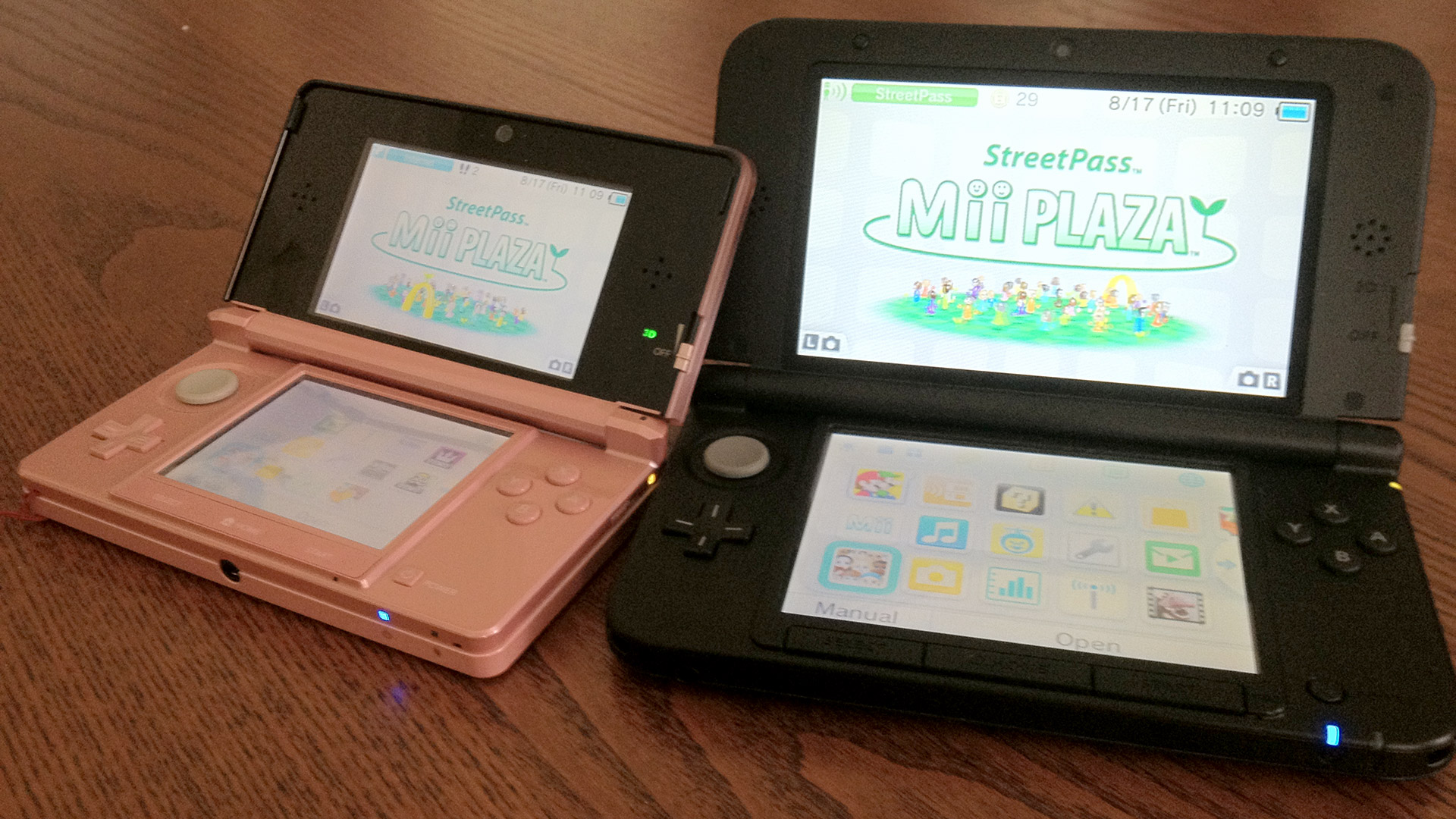
Of course, once you get past the initial difference in overall hardware heft, by far the biggest and most noticeable upgrade in this new revision is its screens. The 3DS XL’s top screen has been bumped up to 4.88 inches, versus 3.53 inches on the original 3DS.  On paper, this may seem like not a huge difference; in practice, it absolutely is. The new screen size—on both of the XL’s screens, but especially its top screen—is almost shocking at first and makes one heck of an impact. When Sony introduced their PlayStation Vita, its 5-inch screen dwarfed the 3DS’ displays. With the 3DS XL, Nintendo’s offering can now go toe-to-toe with the Vita screen size–wise—and that’s before taking into account the bottom touchscreen.

Now, obviously, the 3DS XL doesn’t feature the stunning OLED display that the Vita does—nor does it have the overall resolution. Some have complained about the lack of resolution increase coming along with an increase of the physical size of the 3DS XL’s screens, but it was ridiculous to ever expect such things. Had Nintendo upped the resolution of the 3DS XL’s screens, it would’ve broken compatibility with all 3DS games already released, and it would’ve required developers to start crafting games to run in two different resolutions.

So, we’ve got screens with the same number of pixels, but now due to an increase in physical size, those pixels are also bigger. The result? Compared to the original 3DS, it’s far easier to see each individual pixel of the 3DS XL’s screens, and games that were naturally smoothed by the 3DS’ smaller displays now have more noticeable rough edges. This difference will be easy to see if you’re picky about visual quality on a technical level (like I am), or if you sit the original 3DS and 3DS XL side-by-side to do a comparison.

The thing is, it didn’t take me long to forget about this difference—and, once I did, I came to appreciate the screens on the 3DS XL far more than I ever thought I would. At this larger size, games pop to life more than on the original 3DS, and it’s easier on the eyes to play for longer sessions. Speaking of strain, I’d also swear playing games in 3D is less stressful on the eyes when at this larger size; it could be because on the 3DS XL, that 3D effect doesn’t quite seem as dramatic as it does on the smaller 3DS screens. Instead, it feels more natural—so it both strengthens the overall effect while also making it easier to tolerate physically.

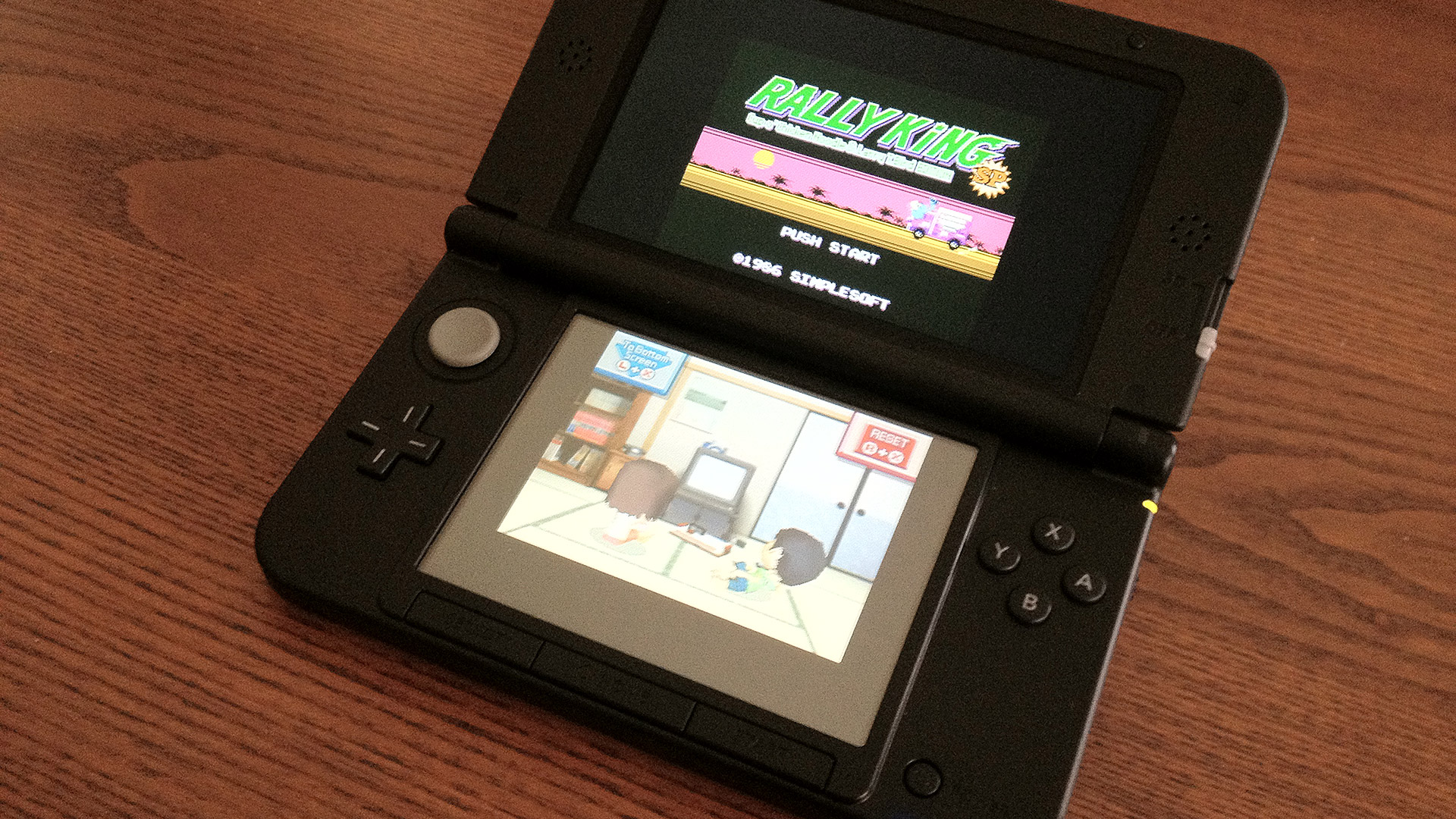
There’s one other important upgrade that comes with the 3DS XL’s larger displays: DS playback. Personally, I wrote the 3DS off when it came to playing DS games—having them blown up to full size on the 3DS’ screens made graphics fuzzy, and running DS games at their original resolution produced visuals that felt positively tiny. With the 3DS XL, size actually does matter. Running DS games fullscreen will still produce upscaled graphics, but if you run them at original resolution, the physical size of the game screens are actually slightly bigger than what we had on the DSi. Yes, you’ll have to deal with black borders on three sides of each screen—but with the 3DS XL, you now have a 3DS that could legitimately replace your old-school DS.

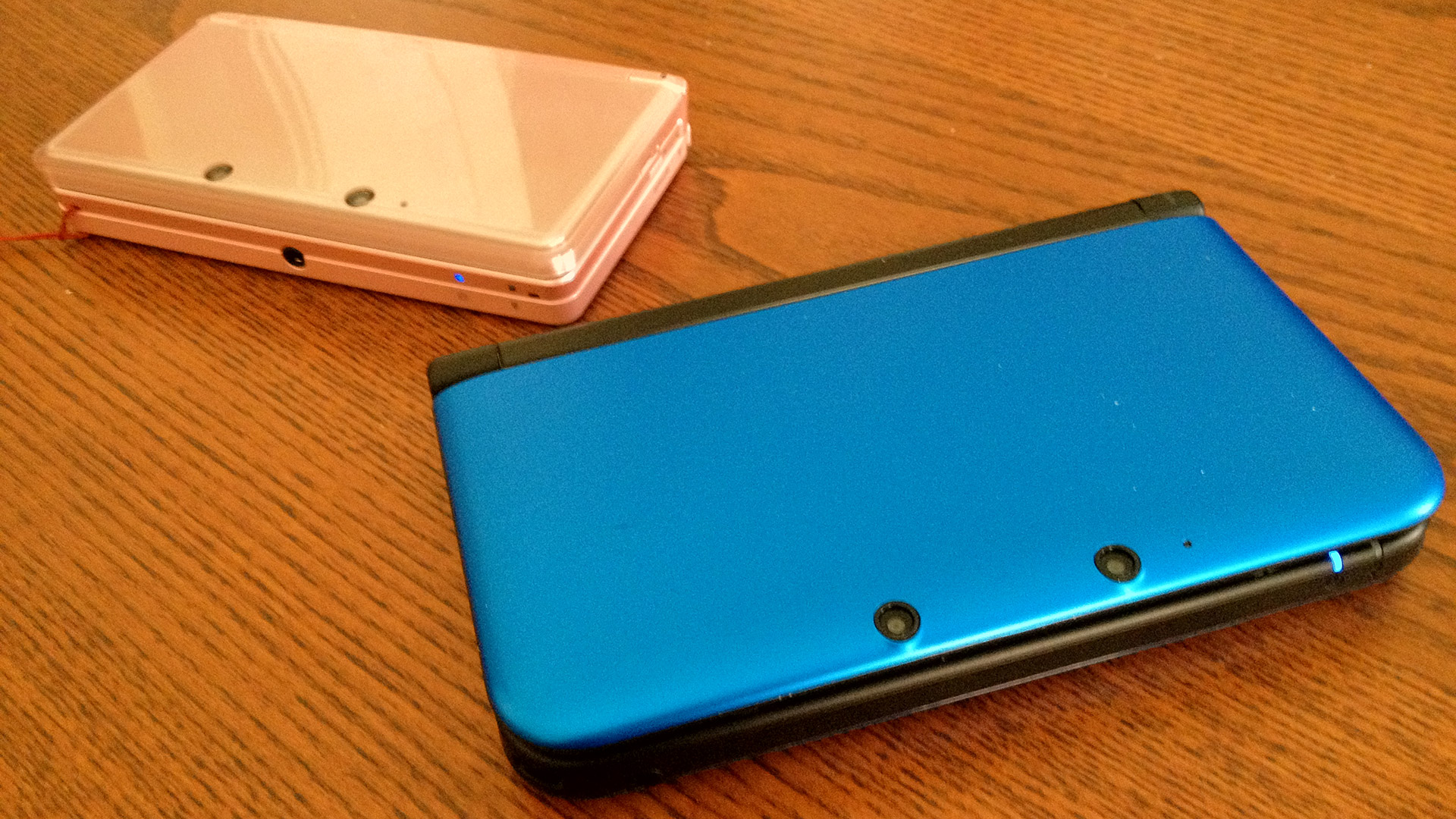
The rest of the 3DS XL comes across as if it was born from a checklist of what people didn’t like about the original 3DS. Corners and edges have been smoothed and rounded, so the overall unit feels better in your hands. The top screen lid now has a few positions it’ll click and lock into, unlike the original 3DS (which has a lid that can easily fall closed unless it’s at its most-open position). The absolutely terrible Select/Home/Start buttons of the 3DS have been replaced by nice, actual buttons on the 3DS XL. The stylus now slides into the system on its right-hand side—back where it belongs. The 3D slider will now lock into the off position, and the circle slide pad has seen a minor upgrade over that on the 3DS.

There’s still those two personal concerns that I had about the 3DS XL, however: the larger size of the system overall, and its design. I thought the noticeable increase in physical size for the 3DS XL would bother me, but surprisingly, it didn’t for long. Yes, it’s bigger, and the system has seen a slight increase in weight over the 3DS. Unless you specifically carry your 3DS around in a pants pocket, however, the negatives of those increases are far outweighed by the positives the 3DS XL brings with it. And its design? I was wrong. In person, the system actually had a nice, polished look to it, I’m glad to have the matte finish back, and, man, did I miss the two-tone color scheme for Nintendo handhelds! Our blue-and-black unit looks pretty sharp, and I’m guessing the red-and-black does as well.

As I said at the start, initially, I didn’t want to like the 3DS XL—but I do. I do a lot, enough to make me wish I had one to replace my 3DS. My poor little 3DS hasn’t done anything wrong, and it’s still a great system—it’s just that the 3DS XL makes the 3DS experience so much better. With the DSi XL, it was an option that was there if you wanted it, but was something you didn’t feel like you needed to have a fulfilling DS experience. Here, the 3DS XL feels like the experience the 3DS always should have been, and I can absolutely see this becoming the “main” flavor of the system.

And, now, the big question: Should you buy one? It’s hard to tell anybody who already has a perfectly fine 3DS to spend $200 to get a replacement system. Here, though, I might just do that. If you’re a fan of the 3DS at all, trading up to a 3DS XL would be a step absolutely worth taking. The upgrades it brings will give new life to your 3DS library, and you’re also getting hardware that can properly take you back to the DS era. Having had this chance to use our office 3DS XL for a while now, it’s going to be painful going back to only having my normal 3DS around—as will the wait for a 3DS XL color variation that’ll make me finally break down and buy one for my own.

If you don’t have a 3DS yet, but are thinking about getting one, there’s next to no situation in which I’d recommend the original 3DS over the 3DS XL at this point. For a measly $20 more, you’ll be getting a system that’s not only better, but will also provide you a far richer experience in the world of handheld gaming.

Dust: An Elysian Tail Review

There are two things I’m not going to mention in this review of Dust: An Elysian Tail beyond its opening paragraph: the game’s particular style of character design and the term “Metroidvania.” For the former, I’m tired of that conversation being a focal point every time discussion of Dust arises; for the latter, plenty of games have built upon or advanced the side-scrolling action-adventure genre, many of them coming before Konami’s Symphony of the Night.

In fact, Dust is less a nod to those two now-legendary titles and more a tribute to the days of old-school 2D adventures overall. Maybe “tribute” isn’t the right word—this is a love letter to that era of gaming. The man responsible for penning that letter is Dean Dodrill, the main face behind development studio Humble Hearts. While Dodrill worked with a co-author on the game’s writing and had outside help for audio elements like voice acting and Dust’s fantastic soundtrack, the rest of what is presented here came from his hands.

Programming. Game planning. Level design. Gameplay engine. Character art. Sprite art. Backgrounds. Whatever was needed to turn Dust: An Elysian Tail from a concept to a finished game was done—and done by one person. Games have been created in the past by similarly small teams, but the absolute care and devotion that Dodrill put into Dustis both utterly impressive and clearly personal.

Dust starts off like many games we’ve seen before: A stranger wakes up, his head clear of all memories, and his knowledge of himself missing save the name “Dust.” Suddenly, he finds himself with two peculiar companions: Ahrah, a mystical, talking sword, and Fidget, a lively pint-sized flying creature who claims to be the sword’s guardian. The sword tells Dust that he must head out into the world to both find himself and his purpose; it wouldn’t be much of a game if we didn’t help Dust heed that call to adventure.

Before anything else, you’ll be drawn in by the beauty of Dust—and it’s no hyperbole to call this game beautiful. The heyday of 2D gaming now seems long gone, with budgets and demands from high-definition consoles typically making such projects unfeasible. Games like Dust buck that trend, and the amount of visual detail in every one of its stages never ceases to impress. In forests, tree branches sway with the wind; on snowy mountains, Dust’s feet disturb the snow as he walks. Character sprites are equally striking—there’s a wide selection of designs with little reuse outside of enemies, and every one of those characters animate beautifully.

With Dodrill’s background in animation, it’s not surprising that Dustlooks and moves well. Making a game look pretty is one thing—making it a competent game is another. This is where I’m most impressed with Dodrill’s efforts, because calling Dust “competent” would be an understatement.

Gameplay starts off simple, yet not boring. Enemies are basic, as is Dust’s repertoire of attacks. Your journey through the game’s world will initially be pretty straightforward, but you’ll start noticing additional paths here or there that you won’t have the ability to traverse just yet.

Of course, like any good adventure, this simplicity doesn’t last for long. New abilities are uncovered, letting Dust reach previously unreachable places. New enemies are unleashed—monsters more capable of presenting a serious threat. New moves are unlocked, giving players bigger and badder ways of dispatching those enemies.

Dust: An Elysian Tail is a rich mix of action, adventure, and exploration, but I have to admit to a particular fondness for that last point: its combat. From the very first additional attack Dust is given, taking on the enemy hordes is a heck of a lot of fun. Once you’ve mastered all of his attacks, there’s a certain sadistic glee that comes from chaining them together in that perfect way to bring merciless death to a cowering group of baddies. Games that build a decent amount of their experience on action live or die by that action—and it can be hard to craft combat that stays exciting for the entirety of their length.

Is Dust a perfect game? Well, no game really is—and Dustdoes have its flaws. Due to a combination of save-point locations and sometimes strangely fluctuating difficulty, the game can be frustrating at times. (When playing Dark Souls, there were times when I’d die, start thinking about the progress I’d just lost from that death, and want to cry—I had a few very similar moments playing Dust.) Boss battles aren’t always as challenging as they could be, with some of the game’s more common foes putting up more of a fight. And no, neither the game’s story nor its voice acting will win any awards compared to many other offerings out there.

And yet, on a personal level, I appreciated the “unpolished, amateur effort” feel of the game’s characters, their acting, the light-hearted and humorous moments they constantly provided, and the story they were all a part of; by the end of the game, I had come to honestly grow fond of Dust, Fidget, and the rest of the cast. Where it counts most, Dust is fabulously executed—but in its other facets, it makes up for perfection with personality. This is a crowning example of why the hopes and dreams of gaming’s indie developers should be supported, and I’ll take a game that feels rough in some areas—yet clearly has heart—over a project so polished that that personal aspect has been completely lost.

Persona 4 Arena Review

At the risk of readers potentially accusing me of having some amount of predetermined bias for the game, I will tell you that Persona 4 Arena is a dream come true for me—literally. As a longtime fan of Atlus’ Shin Megami Tensei franchise—and all its associated properties and derivatives—I would, at times, longingly daydream about the idea of the more popular characters coming together in a gorgeous two-dimensional tournament of combative competition. (An obsession only fueled by the fact that various fan artists around the Internet had the same idea and mocked up numerous images showing what such a game might look like.)

So, the day that word came down that Atlus would be joining forces with Arc System Works to create Persona 4 Arena, my heart nearly couldn’t take it. Sure, it wasn’t exactly what I’d imagined—it would focus on the heroes and heroines of Persona 4, not characters from all across the MegaTen universe—but I was still floored by the fact that such an idea was going to exist at all.

In terms of what it is as a fighting game, Persona 4 Arena is clearly an Arc System Works joint; information sheets and title screens tell you that, and playing confirms it. The projects that the teams at Arc put together have their own unique feel, one that’s helped the studio become a legitimate alternative to names such as Capcom and SNK in the fighting-game genre. Even so, P4A isn’t just BlazBlue with a new coat of paint and a new roster of characters—it’s something that feels new and different, yet also a little familiar and recognizable.

Another interesting contradiction is how I felt when first getting into Persona 4 Arena’s gameplay. In my early hours with it, the fighting engine seemed intimidatingly complex yet strangely simplistic. The systems that Arc has built into the game can, at first, feel overwhelming—you’ve got a wide variety of situation-specific techniques and maneuvers to learn, and those are then complicated even more with Persona-themed RPG-style elements. And yet, pick a character, get into an actual match, start to learn what your chosen combatant can do, and the roster of moves can feel a little sparse.

There’s good reason for this: Two of your four main action buttons are tied to the attacks and skills of your faithful Persona. For those not familiar with the Persona series, a Persona is an ethereal being of sorts that’s born from a person’s inner self—one that can aid their masters in battle against demonic forces. That element is transferred over into fighting game form much like how Capcom integrated a similar concept—Stands—in their 1998 release JoJo’s Bizarre Adventure: Part of a character’s moves roster includes the abilities of their Persona, and inputting a Persona-related command calls him/her onscreen to unleash their associated move. After a moment, the player’s Persona will vanish once again, or additional commands can be entered to keep them active and performing other maneuvers. One twist on this idea is that a player’s Persona can actually be hurt by an opponent’s attacks. Receiving enough damage will cause a Persona to temporarily be removed from the fight, leading to players suddenly finding themselves unable to perform half of their moves roster.

It can be tough to get this idea into your head at first—we’re used to standard fighting games where we’ve got one character who does a bunch of moves, and that’s that. Because of this, it’s easy to become conditioned to expect to handle the entire match with just your character. Here, of course, that’s the wrong way to do things. It takes a bit for your brain to fully grab hold of the fact that you’re controlling two characters; once that concept clicks, the real Persona 4 Arena begins, and you get a better sense for the game’s true depth.

As someone a bit more used to the slower, more focused nature of games like Street Fighter IV or The King of Fighters XIII, Persona 4 Arena can feel almost Marvel vs. Capcom 3–esque at first. While in reality, the game isn’t quite as chaotic as Capcom’s Vs. titles can be, I’m also not sure that this is the perfect option for those who find fighting games as a whole to be somewhat daunting.

It really goes back to that particular type of depth that I was just talking about. A series like Sega’s Virtua Fighter is incredibly deep, but that depth comes from a long journey down the path of mastering your favorite character. The rulesets those characters exist in are relatively simple, and it’s what they can do as an individual that then gives the game complexity. In contrast, Persona 4 Arena is a game of variables. What can my character do at any one moment? What can my Persona do if summoned? How can I combine my character’s ability with those of my Persona? What status effects are currently in play on me and my enemy? Do I use my SP Gauge for a Super, do I save it for a character-specific Skill Boost, or do I save it for an attack cancel? Can I even summon my Persona currently, or are they knocked out? Is my Boost Gauge full, and if so, what should I use it for?

Arc System Works’ other franchises—Guilty Gear and BlazBlue—are certainly popular, but they’re also popular with a particular segment of the fighting-game community. With Persona 4 Arena, their style of fighting game is now going to be given exposure to a lot of other players—players who are coming in because of the brand and not its creator. For those new to Arc’s efforts, I expect a decent amount could be completely overwhelmed by what Persona 4 Arena has to offer at first. Some might even completely give up on the game—but that would be a shame!

Even though my current win/loss record when it comes to online multiplayer will prove that I’ve still got a long way to go, my time spent with Persona 4 Arena so far has been extremely enjoyable. Predicting what a fighting game will become once the community has been able to put serious time into is can be near impossible—for example, I liked Street Fighter X Tekken, but its receptions has been rather lukewarm among the hardcore—but I’ve got hope for P4A in that regard.

I wasn’t really sure at first; as I said earlier, my initial reaction to the game was that it felt far simpler in its game engine than I’d been hoping. Online was where that opinion really started to change, and where my appreciation for what Arc System Works has put together here grew. Even though I was getting absolutely slaughtered in my early goings online, I kept wanting to come back—and I kept wanting to get better. And, even more surprisingly, those feelings weren’t because of my love for Persona 4 as a collection of characters or as a world to host a fighting game. In fact, the character I was sure I’d be playing as (Chie) isn’t who I’ve ended up with (Yukiko).

So, my interest in the game has now progressed from an attraction to the brand to an attraction to the game itself. That’s exactly what Persona 4 Arena needed to do—and why I hope those series fans will give it a real chance beyond those initial first few hours.

What if fighting online against others proves too daunting, or you simply prefer to enjoy fighting games more for the single-player experience? While I can’t exactly identify with that situation—I come to fighting games for the multiplayer, and usually that alone—I can tell you that Persona 4 Arena definitely benefits from Arc System Works’ dedication to solo-focused content. The typical elements are all here—a tutorial, training mode, score attack, character-specific challenges—but it is the game’s story mode that was the most exciting. It’s typically a mode that I spend little to no time playing, but here we get lengthy text-adventure story segments that give you a different look at the events unfolding in the game depending on which character you picked. Persona 4’s cast is a fantastic one, so getting to spend more time with them and see them coming together again for another adventure is something I was interested in. The focus of this mode is clearly that of storytelling—fights are few and definitely feel like a secondary focus—but what plays out is engaging, fun, and fully voiced either in Japanese or English.

(As some will have heard by now, two of Persona 4’s English-language voice actors could not return for Persona 4 Arena—meaning that the characters of Chie and Teddie now have different voices. I loved what Tracey Rooney did with the character of Chie in P4, and while I dearly miss her, Erin Fitzgerald’s take on the queen of kung fu will grow on you; Sam Riegel isn’t bad by any means as Teddie, but he just doesn’t give the character the charm that Dave Wittenberg did.)

Playing through Persona 4 Arena’s story mode, I kept having one specific thought: “Man, is this character portrait art beautiful. I don’t remember it looking this good!” Of course, it didn’t—Persona 4 was on the PS2, and thus was not yet part of the HD generation. For that alone, P4A will be a treat for fans of the series, giving us a small taste of what we could be in store for in Persona 5.

All around, though, this is an attractive game. The menus and interface have Atlus’ trademark stylish flair; in-game, we’re treated to the old-school-but-not-old-fashioned 2D sprite work that Arc System Works has become known for, not to mention backgrounds that are stunning both in terms of design and decoration. There is, admittedly, a bit of a clash of visuals: The serious, detailed look that Atlus artist Shigenori Soejima gives the Persona 4 crew is quite a contrast to the more cartoony style that Arc produces. Yeah, I’m not completely happy with how the cast is presented—but it’s hard to complain too much given the obvious about of time and care that was put into these sprites. With so few companies still putting real effort into 2D fighters, beggars can’t always be choosers.

Beyond the big question—if Persona 4 Arena has what it takes, long-term, to grow into a legitimate fighting-game franchise and if the community will embrace it as such—I’m otherwise left for now with only two real hesitations. The first is the game’s new face, Labrys. (Or, I should say, technically she’s a new face—she’s been referenced as a character before, but this is her first real introduction.) Adding another robot to the Persona mythos just serves to negate the specialness of Aigis even more, which is a path I don’t want to see the series walk for multiple reasons. Plus, her design just seems to pander too much for my liking to a segment of fandom that I typically don’t associate with the various Shin Megami Tensei stuff.

The other is a far bigger concern, one that I hope—and, really, expect—will be temporary: issues with the game’s online netcode. As of this writing, those with access to the Xbox 360 version of Persona 4 Arena have reported some massive issues with lag when playing online, even when fighting against others in the same general area of the world. Arc System Works is known for their amazingly stable and capable netcode, so this comes as a bit of a surprise. However, BlazBlue also suffered from similar issues at launch—issues that were quickly squashed.

So, while I do give potential Persona 4 Arena owners warning about that problem with the Xbox 360 version of the game, I’m also not considering that problem when giving the game a final score—both due to my not experiencing those issues on the PS3 version of the game, and due to my expectation that this won’t be an issue for long. Should that lag not get sorted out for those playing on Microsoft’s platform, then obviously that will be a required point of consideration before picking up Persona 4 Arena. Should we reach that point, though, I’ll honestly be shocked.

Otherwise, there’s a whole lot to like about what Atlus and Arc System Works have given us in Persona 4 Arena, and not a whole lot to dislike. As what will hopefully be the start of a new and fruitful franchise, you know it can—and will—get better. However, as a game to kick off a new series, it doesn’t feel as if it’s missing anything or underdeveloped in any way, like how many other “first attempt” games can come off. As a Persona fan, I’m glad that I could live long enough to see my dream come true—and to a degree probably better than I could have expected. As a fighting-game fan, I’m also happy with the results—and now wait with baited breath to see what the rest of the world thinks.

Street Fighter 25th Anniversary at iam8bit

Deadlight Review

Zombies. For some, the walking dead have become an overused trope in video gaming—but not for me. Were we to believe that the zombie genre was out of style, Tequila Works may never have given us this little slice of survival-horror—and that’d be a shame.

Initially, Deadlight looks as if it could be light in concept, but in actuality, it holds a real depth underneath its surface. Part of that depth is, in fact, literal. While the concept is traditional 2D side-scrolling action-platforming fare, rather than giving foreground characters and elements emphasis—which is usually the norm—it’s the world beyond that action where things really come to life.

As you lead protagonist Randall Wayne through desolate streets, abandoned buildings, and zombie-filled stadiums, the background extends as far as the eye can see, coming to life with signs of the death that’s occurred. It isn’t just the gameplay aspects of what developer Tequila Works has done here that impress; seeing a horde of Shadows—as the undead are called in Deadlight—shamble into your path from their original position off in the distance is awesome, but equally impactful is the richness and detail in all of the stages.

The game built atop those backdrops is almost as equally compelling. Almost. Controlling Randall takes a bit of getting used to, but once you do, his interactions with the world really satisfy as you jump from building to building, cut down zombies with a fire ax, or try to figure out the solution to the latest obstacle-blocking progression. When those three elements—platforming, combat, and puzzle-solving—work, they provide some fantastic gaming. Sometimes, however, they don’t—such as the occasional situation where Randall’s slightly cumbersome nature causes frustration when dealing with a group of Shadows or the start of the game’s second chapter, when, for some reason, we’re overburdened with a glut of puzzles to figure out.

Larger than that, Deadlight is just too short—though its length is padded with an overreliance on trial-and-error segments. The best games are those that provide great challenge but do so in a way where—if a player’s clever enough—they could know how to get past those challenges without ever dying once. When Deadlight allows itself to calm down a little and simply gives us the experience of making our way through the ruins of what we once called society, it imparts an atmosphere that’s not only enthralling, but almost beautiful. Then, it cranks up the “hardcore gameplay” requirements up to 11—and, in doing so, loses some of its focus on what is most important.