Building the Future—Behind the Design of the Xbox One

During Microsoft’s reveal event for their upcoming Xbox One this week, EGM got a chance to speak to Xbox corporate vice president Ben Kilgore about what went into the design of the system.

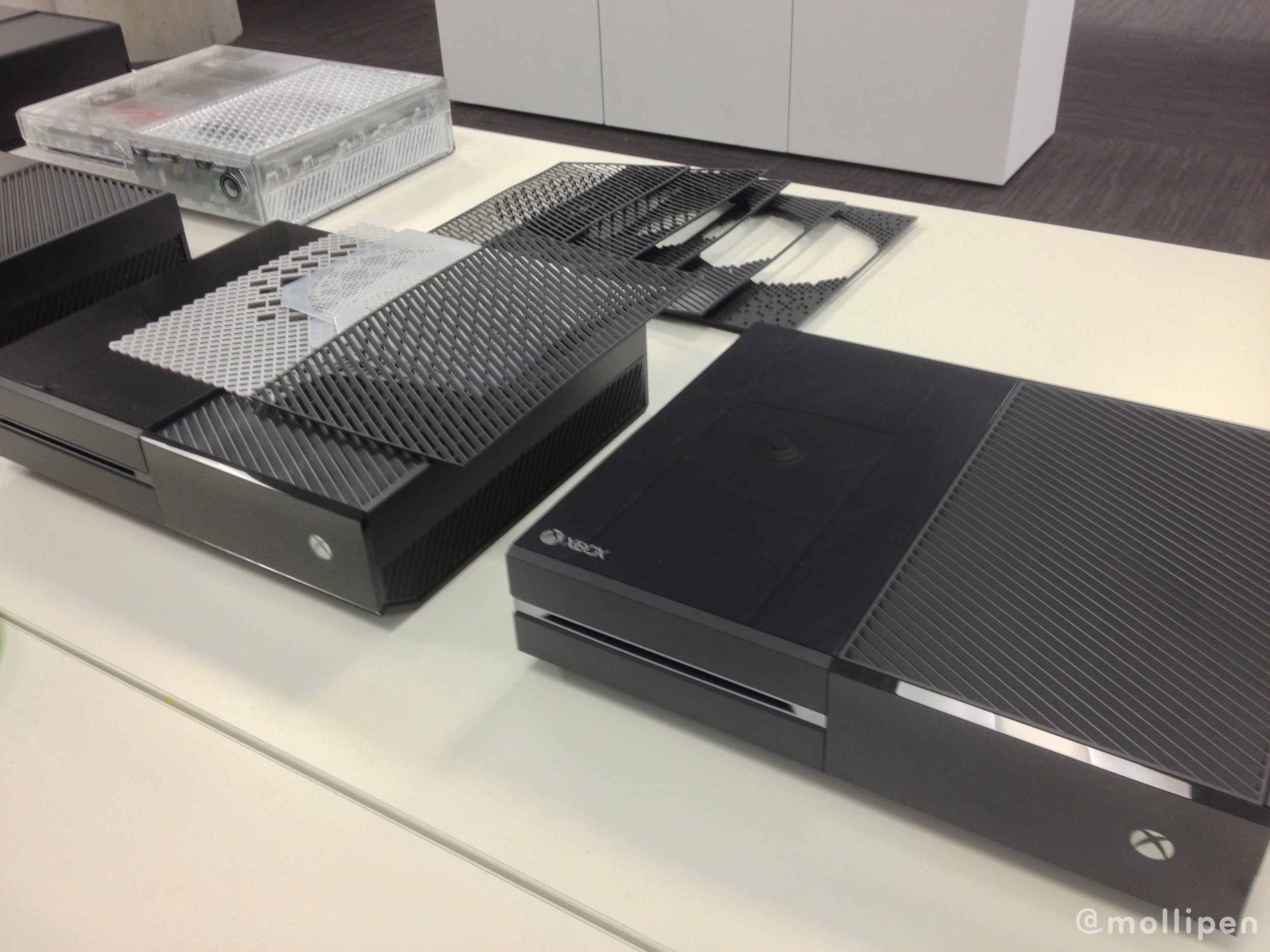
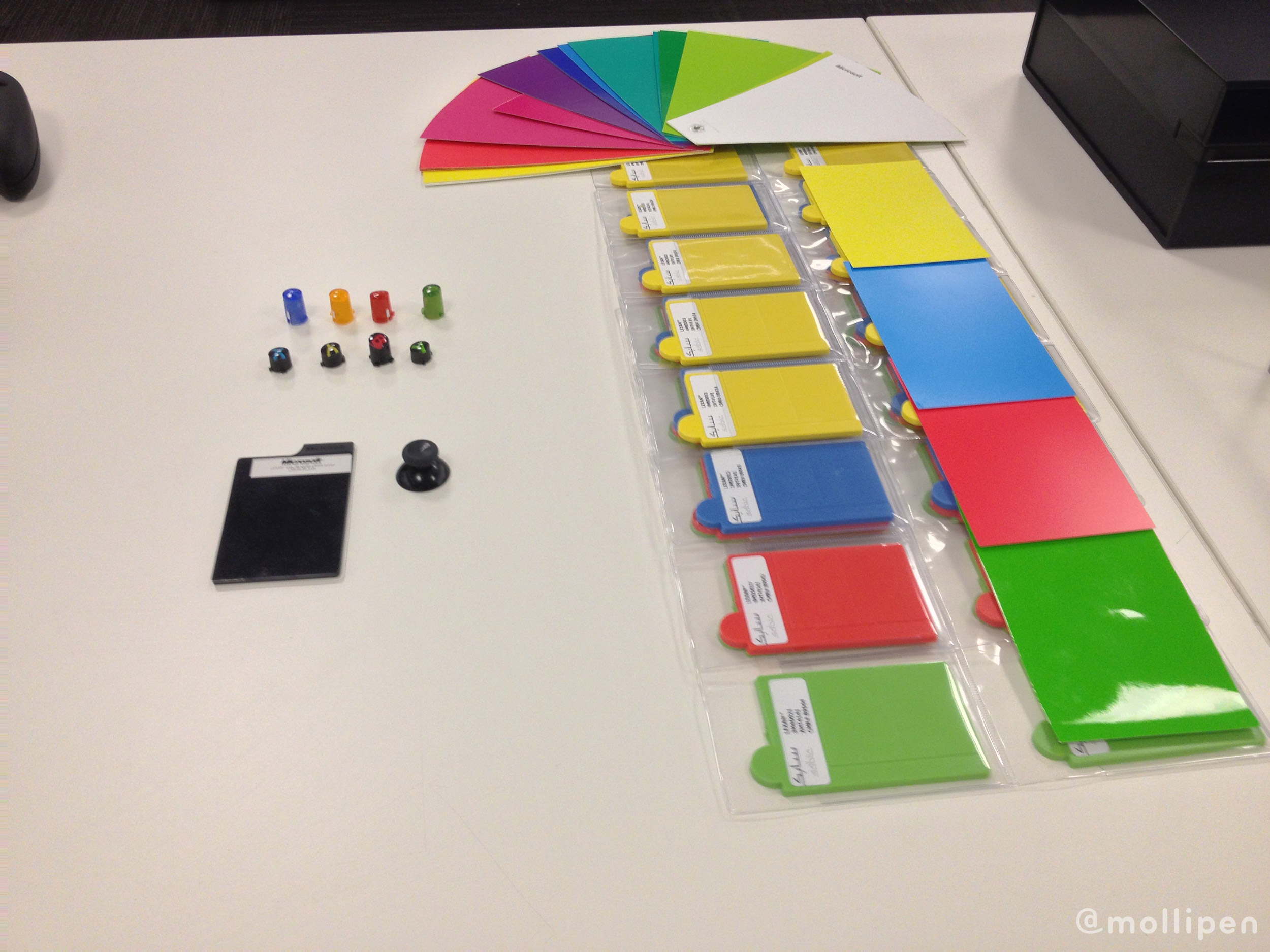
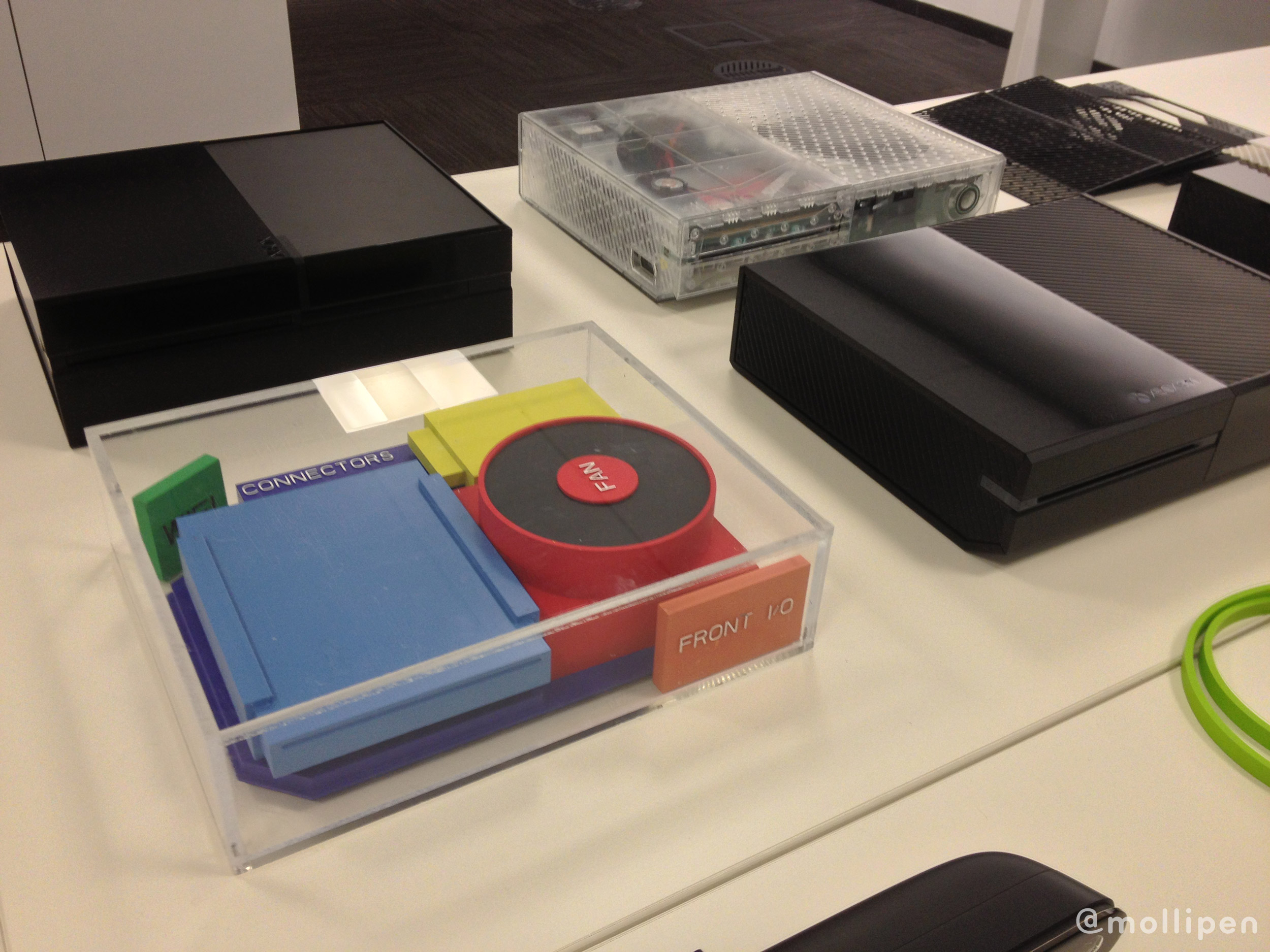
“As you can see from what we have here on the table, you’re literally seeing the evolution of hundreds of different models on the sensor, the controller, and the console itself,” Kilgore told me as we looked across a table containing an array of prototypes. Those prototypes—some of which are shown in the photos below—were just a fraction of what was worked on before the company arrived at the designs they revealed on Tuesday.

“The team starts with a bunch of different ideas for what we call our design languages—which is kind of a brief on, what’s the thing we’re going for, or what is it that we want to communicate,” Kilgore continues. “Part of what we’re trying to get across with Xbox One is this message of, how do we appeal to the core and a broader audience at the same time? We kind of have this interesting challenge. Our industry is based around a lot of core gaming, but our strategy is to be an all-in-one entertainment system.”

With that balance in mind, the team went through a lot of testing and tweaking, all based around that core design language that was first thought up. An example of that language was a 16:9 design metaphor, which was carried through everything from the software and user interface, to the console’s design itself.

One aspect I brought up to Kilgore was the seemingly huge difference in design mentalities between the Xbox One and the Xbox 360. For Microsoft’s current console, we were given a piece of hardware that felt unique, striking, and which came in a color that isn’t always common for home electronics. Now, with the Xbox One—it’s hard to get away from the fact that, essentially, we’ve been given a big, black box.

“Part of what we wanted to accomplish was, while the design is important, we wanted that design to kind of melt away in your living room,” he answered. “We looked at what our mission was, and it was creating this all-in-one system that was simple, instant, and complete. We decided that part of what we wanted to do with the design was have it just melt away with the rest of your electronics, and black kind of fits in with everything you probably have underneath your television—so that it doesn’t stand out.”

There was another, even larger question I had in regards to console design: the question of why we care. I pointed out the fact that I docare what my consoles look like, even if I’m not always sure why. With the PlayStation 4 reveal, we didn’t get to see the system, and that drove a lot of people crazy. Today, we had gotten a first look at the Xbox One, and plenty of people had opinions on it—both good and bad. Why all this concern for how our game-playing machines look on the outside?

Kilgore laughed. “You create this emotional attachment to it. You probably care a lot about the phone you carry, right? I think Apple taught a whole generation of people a lot about how they wanted to think about design on their things. You create emotional attachments to these products. You spend a lot of money on them, and they’re an integral part of your life. And if you’re a gamer, the device that you game on, and that you hang out with your friends on, that’s a really important thing to you. It’s not like the mop in your closet that you pull out every once in a while, and you don’t care, because it’s a chore when you use your mop.

“This is something that brings fun and joy to what you do,” states Kilgore, “and it’s kind of a centerpiece to how you define yourself as a gamer.”

Resident Evil Revelations Review

Porting games from one platform to another makes sense. With the production costs that today’s developers face, why only get one chance to make money off of all the hard work and asset creation that went into a particular project? Give the first release a chance to hit the market, see what other platforms would make sense for the game, and port that puppy over!

The thing is, if you’re asking me which sorts of ports would make the most sense, going from the 3DS to HD-focused consoles is potentially one of the lowest possibilities that could be on my list. Putting aside the extra horizontal pixels it needs to produce its 3D effect, Nintendo’s current handheld is basically running games at a resolution of 400 x 240. Not only is that a far cry from what your HDTVs are having fed to them, but it’s even far lower than most smartphones these days.

And yet, that’s exactly what Capcom did when they decided to resurrect their early 3DS title Resident Evil: Revelations. Looking only at the game itself, I can’t blame them. Revelations was hailed as a fantastic release for the portable both in terms of gameplay and visuals, and as much as I love the 3DS, it didn’t seem logical for Capcom to keep the game exclusive to the system at this point.

In order to have Revelations make the jump, however, Capcom would need to give its visuals a serious makeover—and that’s exactly what they’ve done. While its graphics might not be up to par with the previously released Resident Evil 6, playing this version of Revelations gives few hints that it was once on a platform that was pushing one-fourth the resolution. The game’s stages and monsters dutifully set up that trademark Resident Evil atmosphere, but it’s the character models that really shine, with all of the playable protagonists—such as the beautiful-yet-tenacious Jill Valentine—looking simply fantastic. (I’ve seen some who say that Jill looks “off” in Revelations. Those people are wrong.)

One aspect Capcom didn’t muck around too much with was the game itself, and this was an area where I wasn’t sure how Revelations would turn out on consoles. Given the natural difference in how portables are played, Revelations was designed for shorter, more compartmentalized play sessions. Each chapter starts out with a recap of what happened previously, the next mission is mostly self-contained, characters and locations are mixed up to keep things fresh and interesting, and the whole experience ends on a cliffhanger.

How does all of this turn out when, instead, you’re sitting back on your comfy couch, ready for some more involved gaming? Far better than I would have imagined—to a point where I might actually prefer the game as it is now, instead of what it was originally intended to be. With how things are set up and the length of each episode, at times, I swore the game could instead have been called Resident Evil: The TV Drama. (I say that in a good way.)

That feeling—like I was delving into something different than everything that’s come before in the franchise—was what helped me look past those few aspects where I thought Revelations could have been better. This is far from a bad game; playing on a controller, using the “Shooter” control scheme, I had great fun taking down the various monstrosities that the game constantly threw my way. Still, the reality is that—given the limitations that were in place hardware-wise at the time of Revelation’s original development—gameplay and control options aren’t as deep or refined as other recent Resident Evil projects. The biggest example of this is the lack of any sort of proper run/dodge option, and without it, some enemy encounters end up being more frustrating than they should be.

At the end of the day, Revelations can’t escape its past—and Capcom didn’t go as far as they could have in making the transition as smooth as it should have been. However, the negatives that came along with the game don’t come close to overshadowing its positives. The core of Revelations is not only still as fun as it ever was, but maybe even more so now that it can be played with a proper controller and on a bigger display. As well, Raid mode—the included side missions where players see if they can survive an increasingly difficult set of challenges while upgrading their characters—is as engrossing as ever, especially with the new additional weapons, characters, and co-op options this revision brings.

If you didn’t get around to playing Resident Evil: Revelations the first time around, then this is the chance to finally see what you missed. While what Capcom produced here is, at times, very different from previous Resident Evil games, it also has a number of elements that should make old-school fans of the series happy—including those of you who hated Resident Evil 6. (While I still don’t understand your side of that argument, this time, I’ll at least respectfully agree to disagree.)

If, on the other hand, you’ve never once enjoyed a Resident Evil game before, who knows—this might finally be the one to change your mind.

Deadly Premonition: Director’s Cut Review

Deadly Premonition—the game so bad that it’s good.”

It’s a statement that’s been uttered countless times about the game that became something of a cult classic here in the States upon its 2010 release. Opinions can be divisive, and we’re all entitled to our own judgments—but those opinions were wrong. Deadly Premonition was, at times, unpolished, awkward, frustrating, misguided, and outdated. What it never was, however, was bad.

Bad games lack redemption, they’re broken beyond repair, or they completely fail at what they try to accomplish. That wasn’t Deadly Premonition. Sure, its gameplay could and should have been better, but its missteps there were made up for in spades in terms of storyline and character. The small American town of Greenvale is a place brimming with life and personality, and FBI special agent Francis York Morgan is so interesting and charming as Deadly Premonition’s main protagonist that he’s easily one of the best new characters of this console generation.

I’d actually forgotten how wonderful a character York was until I returned to Greenvale via Deadly Premonition: Director’s Cut—and while he’s only one of the many things that makes Hidetaka “SWERY” Suehiro’s horror drama great, he alone is enough to make you want to play this game. York is intelligent yet innocent, sharp-tongued yet open-minded and accepting. No matter what horrible things happen, he’s always optimistic and easygoing. We don’t have to want to like York, because it’s impossible not to like him—he reassures us that videogame heroes don’t all have to be brooding, macho loners.

Of course, he’s not the only character who brings Greenvale to life. Emily Wyatt, Thomas MacLaine, George Woodman, Harry Stewart—those are just some of the list of residents that make the game special. It’s easy to just interact with them on a base level, seeing the specifics of what the game’s progression wants us to see.

The beauty of Deadly Premonition is that we can dig deeper, learning more not only about those characters, but through them, also about the town itself. Who is Emily when she’s not tagging along on investigations with York? What does Thomas do during his time off? There are tons of little details that are waiting to be found in the game, but they’re only there for people who put out the effort to uncover them. That, I believe, was part of the reason some couldn’t appreciate what Deadly Premonition had to offer: Putting the game through its paces and hitting each storyline note in order, you’re only seeing a slice of the effort and energy put in by the development team.

There’s no denying that the original game had technical issues, however. Control was the classic “tank” style made famous in games such as Resident Evil—games back in an era before we knew how terrible this control scheme really is. Weapon handling tended to be awkward at times, something that really, really sucked against certain enemies. Various other issues persisted throughout, issues that didn’t stop Deadly Premonition from being an enjoyable game, but which did stop it from being the game it could have been.

When the announcement came down of a director’s cut for Deadly Premonition, I was overjoyed. First, it would be nice to finally see an English-language release for the game on the PlayStation 3. In Japan, both HD consoles got the original; when Ignition Entertainment brought it over to North America, they decided to only give us the Xbox 360 version. More important than that, updates to gameplay could elevate Deadly Premonition to a level where people might finally give it the appreciation that it deserves.

Now for the harsh reality: Deadly Premonition: Director’s Cut is both better and worse than the original experience. As opposed to the game’s sub-HD resolution on the Xbox 360, we now get to play Deadly Premonition in high definition. While the difference isn’t the complete graphical makeover some might have been expecting, better textures and improved polygon models do make for a finer visual experience. At the same time, these upgrades bring with them an unpleasant side effect: framerates that aren’t nearly as stable as we saw on the Xbox 360. The framerate almost never dips to a point where it negatively impacts gameplay, but it’s still a disappointing aspect of the Director’s Cut. Also a shame? The smattering of audio problems, from weird volume levels on the audio mixing to random glitches and vocal clips that sound like they’re lower quality than they should be.

Given the minimal impact the new included storyline segments offer to the overall narrative, and the removal of optional difficulty levels for a one-size-fits-all average difficulty—a decision I’m still mixed on—the balance between the improvements in visuals and the downsides to the Director’s Cut’s audio and video could have left this release feeling disappointing. Ah, but there’s a big footnote attached to that statement: the controls. Gone is York’s impersonation of a piece of heavy war machinery, as now he’ll simply run in whatever direction you press the left analog stick. And that right stick, the one that controls the camera? Moving it around locks the camera to wherever you position it, instead of snapping back to the default position the original Deadly Premonition camera seemed to love so much.

In theory, the changes made to control here are pretty minimal. In practice, on a gameplay level, they made a gigantic difference in my enjoyment of the experience. This is how the game should have always played—and I’m definitely on the bandwagon of “better late than never.”

Sadly, as a complete package, this isn’t what I wanted from Deadly Premonition: Director’s Cut. There’s a chance that a future patch could come along, and the framerate and audio issues could be cleared up (or at least improved). If that were to happen, then this would be, without question, the definitive version of SWERY’s much-beloved masterpiece. Until that day happens, however, it’s hard to recommend that those who already own the original Xbox 360 version run out and double-dip. On the other hand, let me be clear: The downsides of Deadly Premonition: Director’s Cut are unfortunate, but they never tarnish what elevated Deadly Premonition to the superb experience that it was in the first place. If you’re a PS3 owner who’s never played the game before, then you’ve finally been given a chance to find out why many of us fell in love with the story of Francis York Morgan—and you’ll be able to do so with enhanced graphics and drastically improved controls.

Dragon’s Dogma: Dark Arisen Review

At this year’s Game Developers Conference, I attended a panel by Dragon’s Dogma director Hideaki Itsuno, where he talked about the origins of the game and its AI-controlled teammates (called Pawns). It was a very interesting 45 or so minutes of presentation, as Itsuno-san discussed how the project was originally referred to as “BBS-RPG,” how “Pawns” started off as “Custom Multiplayer Characters,” and how—at one point—players would find their adventures taking them to the Moon.

At the end of the presentation, Itsuno-san opened the floor to questions. I was the first up to the microphone—or maybe I was the second. I looked across the room, yielded the introductory question to the guy at the other mic who’d gotten up at around the same time as I had, and waited for my turn. When it came, I started off my question with this statement:

“Itsuno-san, I hope this doesn’t hurt your feelings, but while I really liked Dragon’s Dogma, I did not at all like the Pawns.”

Saying directly that you don’t like something is kind of a messy situation in Japan. Typically, you either just lie and say that you do, you avoid having to answer the question, or your response is little more than a simple “Well…”

That was the truth, though: I did not like the Pawn system in Dragon’s Dogma. As engrossed as I became in the world that Capcom’s development team had put together, key elements of my NPC partners drove me crazy to no end. It wasn’t the concept of computer-controlled partners that I had a problem with, as that’s something that I’m actually am a big fan of. I like the feeling that my band of adventurers aren’t just, well, pawns—pawns who have little life beyond those commands that I give them.

No, my problem with Dragon’s Dogma was that I felt it tried too hard to be different and unique in what it did with its Pawns, and in doing so, ended up with characters I could make no emotional connection with. For those not familiar with the original Dragon’s Dogma, when you create your customized characters, you’re also given the ability to craft your personal Pawn—strange beings born of the Rift, living only to serve the Arisen (you). This is a computer-controlled character that will always be with you; he or she will level as you do, learn new skills along with you, be there from the very beginning until the bitter end.

To fill the other two slots of your party, you must continually “borrow” other Pawns, and these on-loan teammates are stuck in time at whatever level and with whatever skills they had when you recruited them. Instead of having a team of characters customized to your particular play-style, you must make do with whichever options are available around your current level—and because you’re continually swapping old Pawns out with higher-level ones, there’s no reason to care about them any more than you would the sword you just picked up or the armor that you’re planning to soon replace.

As I battled through the depths of Bitterblack Isle—the most prominent new chunk of content that’s been integrated into Dragon’s Dogma: Dark Arisen—those bitter feelings I held toward Pawns suddenly came welling back up. With time, I’d forgotten some of my frustrations with this piece of Dragon’s Dogma, and instead only looked back in fondness at everything I’d loved about the experience. Yeah, sure, sometimes Pawns and their existence in the game had rubbed me the wrong way, but really, I’d enjoyed so many other things—including the good times that I’d had battling alongside my otherworldly friends.

But now, as I struggled against what awaited me on this mysterious island I’d never traversed before, I remembered. I remembered that Pawns being disposable can be a pain in the ass when you don’t have a Riftstone convenient for replacing them after they’ve gotten themselves permanently killed. I remembered that having half of your party comprised of characters who you can’t control in specialty and skills can be very annoying when you’re in need of a lean, mean team of individuals who perfectly complement one another. And I remembered that, while normally the AI for your Pawns can be pretty darn good, when they fail, they can fail to epic proportions.

Speaking of that, let me present to you a reenactment of one of the turns that I took engaging in battle with one of Bitterblack Isle’s deadly bosses.

“All right, team, we’re ready to fight this giant lich dragon thing…again. Let’s keep it together better than we did last time. Deneb, as our main healer and the only Pawn in this group I actually care about, I want you to stay back, keep the heals coming, but also make sure you keep yourself safe. Warrior…whatever your name is…get in there with me and go all-out against this thing. You, Sorcerer, stand back and pummel it with some of them high-powered spells you have in your arsenal. Ready? Let’s go!

“Now, let’s…waitaminute. Why is he suddenly flying around the ceiling and not coming down? He didn’t do this any of the last eight tries we made at him! Come…come down! Seriously, this is stupid! I have no actual way to reach you up there! Sorcerer, use your magic to knock him down! Sorcerer…where are you going? Don’t run over there! Cast spells against him! Warrior, be careful of that red circle on the ground; it means the dragon is going to turn you to stone. And, wait, where’s Deneb? She’s dead?! Oh, my lord. Fine, let me go over and revive her. There, now you’re back, Deneb. Now, please… Deneb, honey, what are you doing? Why are you standing RIGHT NEXT TO THE THING THAT JUST KILLED YOU when you’re trying to heal yourself?! And…Warrior, why are you doing that? You can’t…you can’t hit him like tha… Sorcerer, for f***’s sake, CAST SPELLS AGAINST HIM! And Warrior is… Warrior got turned to stone?! Are you freakin’ kidding me? I gave her items to use to cure herself if that happened, and all she had to do was avoid the BIG RED CIRCLE! And where the hell is Sorcerer?! Wait, Sorcerer isn’t even on my status screen anymore! She’s… OH, MY GOD, DENEB, I JUST REVIVED YOU FOR THE EIGHTH TIME! STOP STANDING NEXT TO THE GIANT POISON-BREATHING DRAGON WHEN YOU’RE TRYING TO KEEP YOURSELF FROM DYING AGGGGHHH!”

If money were no object, that would’ve been the point where I picked up the Xbox 360, lofted it over my head, and brought it down to my knee, breaking it in half just as Bane did to Batman.

There were times like these in my return to Gransys, times when the insane difficulty of Bitterblack Isle punched me in the gut with those reminders of how Pawn AI can be drastically stupid, how the inability to properly customize my team is infuriating, or how cheap a giant boss creature with an overinflated amount of lifebars can be when half the time I’m fighting it, I’m also having to basically herd the group of cats the game calls my backup.

There’s something more to Dark Arisen—and Dragon’s Dogma in general—however: better, happier moments, moments when everything did work, moments when my Pawns supported me in the ways that I hoped they would, moments when I once again found myself lost in Gransys’ sprawling meadows or craggy hills. In fact—much to the chagrin of our managing editor, Andrew Fitch—I’d even go so far as to argue that Dragon’s Dogma was one of the most exciting releases of 2012.

What the original game did to make me feel that way is still alive and well in Dark Arisen. It’s the big things, like the game’s outrageously fun battle system, where fighting back a random group of goblins in the ruins of a once-great castle can be as exhilarating as facing off against a gigantic beast of legend. It’s also the smaller things, like taking the time to stop and watch the sun rising from behind the distant horizon, appreciating the work that has gone into not only crafting Gransys on a technical level, but also making sure it feels active and alive.

And that’s why—even as I’m so vocal about and so frustrated with the parts of Dragon’s Dogma that I don’t like—I think you should try Dragon’s Dogma: Dark Arisen. Although, to be honest, I don’t totally understand Capcom’s rationale behind the release. At its core, it’s the original Dragon’s Dogma that we received before, bundled together with the various DLC releases that came out, new refinements and interface updates, the added hardcore-focused Bitterblack Isle content, and other additions or changes, such as new skills, equipment types, and main-world encounter refreshes.

I mean, I do understand Dark Arisen—if viewed as Super Street Fighter IV to Dragon’s Dogma’s Street Fighter IV. For fighting games, that’s a very Capcom thing to do; for an RPG, it’s a somewhat bizarre choice. If you’re an owner of the original Dragon’s Dogma, there’s absolutely no DLC upgrade path present here—if you want the new content and updates, you’re going to have to shell out for the entire release.

That’s a suggestion that it’s hard for me to make. New skills and spells, expanded equipment, the addition of stat-boosting rings, the masochistic pleasures of Bitterblack Isle, they’re all nice to have, especially if you want to give Dragon’s Dogma another runthrough. The problem is, they might not be nice enough to justify the upgrade cost.

Instead, I’d pitch Dark Arisen to those who never played the original. Maybe you missed out on the game the first time around, back when it was an unknown, untested property that cost $60 and which some people—mistakenly—compared to The Elder Scrolls: Skyrim or Dark Souls. Maybe you always meant to get around to picking it up, but you never did. You’ll be getting a bigger, better, and—at times—badder (as in threatening) experience than you would have originally, all for a price that makes taking the chance less of a risk. For you, this release won’t be about bullet points marking off the list of features that separate Dark Arisen from its predecessor—it’ll be about taking in the experience as a whole.

Dragon’s Dogma: Dark Arisen isn’t the full sequel or major makeover that many of us would’ve loved to have seen the game get, but I’m not sure that’s what it was meant to be. Instead, I think this was a way for Capcom to both make a second attempt to introduce their huge new RPG project to the gaming masses, and convince previous purchasers to make an additional investment in the franchise beyond just another DLC pack. In at least one of those two goals, I think their efforts will be a success.

For me, Dark Arisen has been a nice chance to go back and revisit a game I both loved and hated—and it’s been a comforting, compelling, yet also somewhat disappointing and exasperating reunion. From here, I now set my sights on a potential Dragon’s Dogma 2. I’d love to see Capcom make a change to their lofty goals for the Pawn system and just let us have a full team of custom companions. I’d also love the see the development team go back and play Final Fantasy XII again—and hopefully learn the wonders of programmable partner AI.

Shin Megami Tensei: Devil Summoner – Soul Hackers Review

Part of me didn’t want to play Shin Megami Tensei: Devil Summoner – Soul Hackers.

When the game was first released for the Saturn back in 1997, it was an awesome-looking Japanese RPG that I hoped would somehow make its way to me via an English-language version. Then, two years later when Atlus re-released it on the PlayStation, I once again held out that hope—only to find out that the game was something Sony’s American division wasn’t interested in having available for their home console.

Time moved on, gaming platforms came and went. The words “Shin Megami Tensei” finally became something gamers outside of a select hardcore group of MegaTen loyalists recognized, and we got to a point where it would be shocking if the latest title in the franchise wasn’t released here in the States—not if it was.

And yet, there sat Soul Hackers, an eternal reminder that there would just be some Shin Megami Tensei / Devil Summoner games that were destined to remain lost to the outside world forever. At some point, people like me just gave up hope that we’d ever see it released in English beyond a fan translation that started up for the PS1 version back in 2009.

However, as a wise man—Justin Bieber—once said, “Never say never.” A similar fate had once befallen Persona 2: Innocent Sin, and yet, in September of 2011, we finally, officially received that game in English thanks to its PSP re-release. Prayers were whispered, hands were clenched in hope, and then, the unthinkable happened: almost exactly one year ago, word came out that Atlus would be reworking Soul Hackers for the 3DS. Here it was—our chance to finally get the game outside of Japan.

The problem is, 15+ years can change a lot about a game. Elements that were groundbreaking or cutting-edge at the time could now come across as out of date or cheesy. As much as I love going back to older MegaTen games such as the original Persona, I know how tough it can be—and that’s with having first experienced them properly back in the day. With Soul Hackers, I would be coming into it totally new and without nostalgia to fall back upon, and the 2013 me has come a long way from the 1997 me in terms of what I can and cannot put up with in my games.

So, as excited as I was to finally get the chance to experience it, part of me didn’t want to play Shin Megami Tensei: Devil Summoner: Soul Hackers.

Jumping into Soul Hackers’ Amami City, some of its elements and ideas do now come off as adorably quaint. In this sci-fi and cyberpunk-inspired look into the near future, we’re given a fantastical world where everybody has a computer in their home, those computers are connected together via a high-speed network, and part of that power can be used to create a virtual world where a massive amount of people can come together and interact with one another. I mean, such ideas are madness!

The thing is, Soul Hackers is another in a long line of examples of why I’ve become such a fan of Atlus’ MegaTen efforts. Once you get past those little elements where you can laugh at how silly they now seem, you’re reminded that the reason you play these games is for their story and characters. The cast of protagonists at the heart of Soul Hackers—a group of computer experts known as the Spookies—are interesting because they don’t just exist to fall into a set of stereotypical roles. They’re presented as real people living real lives, and when outside of the craziness of what happens as the story progresses, we get to learn that about them. My favorite member of the Spookies is Hitomi; set up to be your classic soft-spoken female member of the group, it isn’t long before her body is invaded by the spirit of a demon named Nemissa. Having a brash and vivacious other-worldly being as your main partner is really interesting, and the banter she has with the softer-spoken and more cautious Hitomi is alway fun to read.

(As a quick note: there’s a character in Soul Hackers who is somewhat obnoxious in his portrayal as the “effeminate gay” stereotype. While I’m not totally happy with the character, I’m also very aware of how progressive Atlus as a company has been over the years when it comes to making attempts to more legitimately portray LGBT characters. Also, the discuss of Japan’s handling of such characters in popular media also makes the conversation way more complicated than could be discussed in the midst of a review such as this.)

Soul Hackers’ storyline is also skillfully crafted. If you’ve played at least a few MegaTen games in your life, it won’t exactly be original: strange events are going down, main character comes into the ability to befriend and summon demons, and you work to unlock a series of mysteries until you find out the truth of what’s happening in your city. The key to these games is always how that story is executed, and Soul Hackers does a really great job of continually presenting new situations to keep things moving and keep everything feeling fresh. Some elements really surprised me—such as the “Vision Quests” you go on, where you get to experience brief moments in the lives of previous Summoners—but a few other pieces of the game, such as the in-game virtual world Paradigm-X, do feel a little under-developed from what I was expecting.

Give the age (and original platforms) of Soul Hackers, I went into the 3DS remake really expecting to enjoy its drama and dramatis personae, but not its gameplay. These games—and the genres they inhabit—have greatly evolved since 1997, and I was afraid that Soul Hackers wouldn’t feel as fresh as it would have during the era of its original release. To my surprise and delight, that actually wasn’t the case. Being fair, this is definitely a game that was made many years ago, and there are parts where you feel like modern-day game design would allow for a better overall experience. Still, I was taken aback by how well Sol Hackers stand up not just in terms of storytelling, but also in its gameplay.

That great balance I talked about before in keeping things moving and interesting also comes into play here. While Atlus’ MegaTen efforts are often accompanied by copious amounts of trademark dungeon crawling, here the first-person 3D mazes aren’t the core of the games—they’re just one of many pieces that build that core. Exploration and survival are both key components of Soul Hackers, but the dungeons serve their purpose without ever being too long or exhausting. If you’re the kind of person who loves the crazy challenge of games such as Shin Megami Tensei: Strange Journey, the dungeon crawling here might feel almost anemic; for me, it was a nice change of pace.

That’s not to say that you won’t find plenty of challenge. I’m absolutely not one to reminisce about the “good old days” of random battles, but damn if I didn’t get a kick out of Soul Hackers’ combat. Like many a MegaTen game, your success (or failure) in battle will come down to your skill at recruiting and utilizing a menagerie of demonic friends. 

I’ve always liked the idea of being able to talk to monsters instead of fighting them, ever since I was first introduced to the idea back in the original Phantasy Star. That’s become a big component of Atlus’ RPG output, and in Soul Hackers, four of your six party slots will need to be filled with those demons that you can convince to help you out. Successfully charm a demon (or pay them off), and they’ll become available as a party member. Demons can be summoned or dismissed at will, or—once they’re starting to be too weak for your current adventuring—you can cart them off to be fused together to make stronger and even stranger companions.

In Soul Hackers, there’s a few twists on these common MegaTen ideas. Partnering with demons will rely on Magnetite, a mysterious energy source that is spent whenever calling forth, traveling with, or healing demons. Run too low on Magnetite, and you and Nemissa will be heading off into battle on your own. Another very cool aspects of the game is COMP software, where you can purchase and install new apps for your computer that will change or modify various aspects of the game. Some of these new options will make life easier for you, while others can be absolute lifesavers—such as gaining the ability to save anywhere you like, instead of just at the game’s pre-determined save points.

Even if you’ve got plenty of Magnetite reserves and a COMP full of powerful software, you’ve still got another important resource to manage: the demons themselves.

Probably the most compelling aspect of Soul Hackers is something that one might actually consider to be a gameplay element that works against the player: each demon you recruit will have a personality type, one which indicates how they do—and do not—prefer to act. For example, Kind demons don’t enjoy hurting others, and would rather act as healers; Sly demons, meanwhile, will happily fry your foes with a well-placed casting of Maragi, but don’t want to do anything that might get themselves up close to danger. As their master, you’re presented with one of two options: let them decide for themselves what to do every turn, or directly tell them what do to, running the risk of giving them an order that’ll drop their loyalty to you if they’re unhappy with the command.

Taking the route of avoiding the micro-managing of the every turn of your demons will make battle go faster—well, outside of specific fights that might need a bit finer strategy—but it also creates a really intriguing atmosphere to the entirety of Soul Hackers. Associating with a wild bunch of demonic entities shouldn’t always be an easy process, and the set-up really makes it feel like you’re teaming up with living, thinking beings instead of just a bunch of random AI partners. If you want that finer control, it’s there, and items exist which will help you convince your brood to do things they normally wouldn’t want to do. That’s not how I wanted to play, though—because it’s not the exciting way to play.

At the same time, my experience with Soul Hackers wasn’t what it could have been—and my biggest complaints came not from gameplay relics of a bygone era, but instead from things that cropped up during the process of bringing Soul Hackers back. For example, not enough was done to update the interface in ways in which the 3DS and its dual screens could make the game better. As many MegaTen games as I’ve played, I can’t always keep my tarukajas and sukundas separate in my head, so why not let me touch on the spell name on the bottom screen and get an explanation? The touchscreen is woefully under-utilized, with its only real touch function being the option to bring up a menu that easy could have been mapped to another button. Also, this is easily one of the sloppiest translation efforts I’ve seen from Atlus USA in a while—the English dialog is great, but on numerous occasions I saw examples were text or numbers were overflowing from the boxes in which they were supposed to be contained.

Still, for a game that I was originally afraid would fail to live up to the expectations I had created for it in my head, I got an enormous amount of enjoyment out of Soul Hackers. Sure, it wasn’t as polished of a remake of a long-released 32-bit RPG as I’d like to have seen, but those hiccups don’t ruin what otherwise ended up being a really great game. I’m really quite astonished that, 15+ years later, Soul Hackers has held up as well as it did. It still won’t be for everyone—and it indeed might be too old-fashioned in comparison to other 3DS MegaTen offers such as the upcoming Shin Megami Tensei IV—but not only am I glad that we finally got the chance to experience this game in English, but I’m also glad that all that time spent waiting ended up being worth it.

Jean-Maxime Moris – Remember Me

At PAX East 2013, I got the chance to speak to Jean-Maxime Moris, the creative director from Dontnot working on his studio’s upcoming project, Remember Me.

Mollie: I wanted to ask about Remember Me’s combat system. From what I expected the game would be before I played it, this aspect—the combos, the Pressens, and the depth that they hold—was probably the most surprising. Where did the idea to do combat in this way come from, and was it something that was always going to be part of the game?

Jean-Maxime Moris: It was an idea that actually came very early in the development process, but which went through so many iterations that it’s now totally different from what it was in the very beginning.

The idea was, we were going to do a third-person action-adventure game that was about telling the story of a strong character, and we wanted to differentiate ourselves as much as possible from other action-adventure titles. That meant not going for third-person shooting. So, I wanted to do a melee combat system, and that meant going combo-based. At the time, Batman: Arkham Asylum was very successful, and we didn’t want to copy its mechanics. That would have been a rip-off, and that wasn’t what we wanted to do.

I looked at combos—and with combos, most of the time they’re about learning sequences of inputs, learning the timing, and then being able to reproduce them. I thought, let’s try to do something that’s more accessible and, in a way, deeper. Let’s have it so that the player teaches themselves their own combos, and learns their own combos. In the beginning, you could actually change the inputs of the combos any way you wanted, but that created so many possibilities that it was not manageable.

So, we went for fixed inputs, and the idea was that the customization element would be put on the managing the effects of your combos, managing the powers of the Pressens that you can put into those combos. The idea was that, each of these four combos—because eventually you get four in the game—they would act like, you know, four weapons that you would carry in a third-person shooter. So, for an example situation, I have my combos, one to quickly gain health again, and I have this combo that is more suitable to this type of enemy, and I have this combo that’s more likely to help me in this particular situation. Then, as you progress through the game, we keep challenging your management and strategy by presenting you with new situations that are going to ask you to re-think the way you’ve build your combos.

Mollie: There are plenty of games out there now that allow you to create your own custom characters, or games like Call of Duty which allow for customization of weapons—very few games, however, let you customize combos. It’s an interesting concept. Do you think that that customization will help players connect more with Remember Me’s combat? Because, unlike characters, it can be hard creating that connection to fighting systems for players.

Morris: Exactly. Remember Me is a linear narrative experience; it has linear level design, and we decided—very early in the development process—to have as much control as possible over the events and emotions that the player would go through in term of narrative.

But, I definitely wanted that level of freedom within the combat system, and when you play the game for hours, you start to realize how free you are, and how even though the combo inputs are set, there are millions of different combinations of Pressens, and there are more advanced rules that we introduce. For example, you need to dodge inside a combo at some point, because otherwise you’re always going to get your combo interrupted. The fact that the further a Pressen is in a combo, the bigger its effect is going to be, you’re going to have to think with that rule in mind. Then, later in the game, we introduce the fact that six-hit combos and more give you an additional PMP bonus—which are those orbs that you can gather—which unlocks more Pressens.

So, there are so many ways to play the game. Some people will complete Remember Me using just two combos, but they won’t get the full experience. Some will use three, some four. It’s very interesting watching people playing it, and playtesting it, and seeing journalists playing it, because no one is playing it the same way in terms of combos. I think that’s a really cool thing.

Mollie: I was going to ask about that—that different play style people will have. If I’m playing the game, and I set up my combo, and I like how it works, and I don’t continually update them, is that okay? Do you want people to be continually updating their combos?

Moris: No, not continually. It’s a tough balance that we’ve had to reach, that I think we’ve reached. It has to be challenging, the way players are thinking about their combos, but at the same time, not wanting them to have to stop in the same fight to go to the interface to update them—because then you lose the whole momentum of the game.

For instance, if you build a five-hit combo, at some point we’re going to introduce an enemy that, basically, damages you when you hit him. The only way you’re going to be able to beat that guy is by building combos that are only made of regen Pressens. So, that’s going to ask you to rebuild that combo, because chances are it was most likely built of several different types of Pressens. You can keep a combo for quite some time in the game, but as some point it will need to be changed.

Mollie: Is there any danger in making a fighting system too fun in a game that’s supposed to be about storyline? Is there ever a balance between “this is a game about fighting people” and “this is a game about telling a story”?

Moris: I think that’s one of the key questions videogames have to answer. Is Nathan Drake believable as a cool guy when he has killed 800 people in the past eight hours.

[pauses]

That’s an incredibly deep question, and… this game was build with the idea of keeping some arcadey fun to it, while also exploring some pretty serious themes throughout the game. We have some very heavy narrative stakes, and we’ve tried to say, this is not a comedy or a pulp movie—this is something that is more serious. So, we really wanted to have that counterpoint of pure fun, but in terms of games in general, yeah, it can pull you out of the experience. I hope it doesn’t pull you out of Remember Me.

Mollie: I do find it interesting that, I feel like I can see some inspiration taken from fighting games in the combat system for Remember Me—and then the game ends up being published by Capcom, who is known for their long history of fighting games. Was there any inspiration taken from games such as Street Fighter?

Moris: Actually, no—we didn’t come from fighting games at all.

I think there are a lot of themes in Remember Me that are appealing to a Japanese company, such as cyberpunk. The Japanese have been eating cyberpunk for breakfast for 25, 30 years. It’s still hard, with some Western publishers, to tell them that sci-fi or cyberpunk can sell. That was one side—that I think the game has some Japanese DNA to it. 

And then, when it came to the combat system, one game that had done it before and that we looked at was God Hand. That’s not a fighting game per se, but he whole game was about just that. The game was extremely hardcore, and you had to balance the height of your hits, things like that. We definitely looked at God Hand, but we didn’t copy it by any stretch of the imagination.

It’s like, if you imagine the first-person shooter genre, there are so many games you can list in the genre. And then you take third-person shooters, and there’s so many that you can list there. But, then you’re a melee combat game, and you do your thing, and many people compare you immediately to Batman or something—and there are only five games in that spot. You do one thing different in an FPS, and people are like, “Oh, wonderful”; you have a totally different system in a melee combat game, and people will still find it too similar to the next one. There’s kind of a double standard thing that keeps amazing me. I don’t know why I’m talking about this, but… [laughs] We did study God Hand, we did study Batman, these are amazingly great games.

Mollie: One thing that’s definitely noticable while playing is that you’re doing interesting things in communicating information to the player. There are a lot of games that have very similar UI elements, but you’re doing some really cool things in this regard. Do you think there’s more potential for games to connect with players than what we’re seeing a lot of the time? Like, a movie can only do so much to connect with a viewer, books can only do so much, but games have so many different layers and possibilities.

Moris: We’re like the pilgrims discovering the new world; this is just the beginning. Who knows where this will all go. Currently, videogames are still very much about your nervous system reacting to stimuli. For instance, in play testing, so much of the information is lost on the player. There’s this rule that, 1/3rd of the center of the screen is looked at, and then the rest is almost like it doesn’t exist. You’re so focused on beating the machine, and so focused on that that it’s hard sometimes to create emotion, it’s hard to create interesting narrative. The games that create the most emotion to me are the simplest ones, the ones that require you to focus less on what’s going on on the screen. Games like Flower, like Limbo, like Journey, all those kind of games. It’s a very different way of creating games, but I can see what people like David Cage are trying to accomplish, and it’s very interesting to me.

In Remember Me, we have a new team, and we wanted to do this game that was a third-person action-adventure game that had a well-anchored recipe that people could relate to. It has action, it has big enemies, and then we wanted to build upon that with the memory remix mechanic, the combo lab mechanic, and the message about social networks and the way they might expand in the future. I definitely know that we will try to do things that are pushing the envelope forward, because it’s just the beginning.

Mollie: I want to ask about the main character, but I don’t want to take it down the route it’s been going down lately. There just seems to be a lot of drama created around the main character—and not just Nilin, but in games in general. Any time you feature a main character outside the norm it’s a really big deal, but, should it be a really big deal?

Moris: No, it’s not a big deal. If people can connect to female characters in books, comic books, or movies, why couldn’t they in a game? It’s as simple as that. And more and more women are playing videogames, and I have no trouble connecting with a female character.

I just think, I don’t know, that topic just amazes me. I don’t know why we’re talking about it, but I guess the fact that we’re talking about it so much these days means that people are changing in a way, and the fact that it’s on the table means that people are not avoiding it anymore. What I’ve heard lately, first of all, Tomb Raider being released with a new Lara Croft, and the Assassin’s Creed guys saying that they would have no problem having one of the next installments of the franchise feature a female character—which they have actually done in the Vita version—I think that’s great news. I’m not going to sit here and say that we’re the ones leading it with Remember Me. Not at all—many other people are doing it, and I think that’s great.

I just want more diversity in games. I want to be able to play a male character if I want to, or an alien if I want to, a little kid if I want to, and I don’t want it to all be boiled down to pure marketing segmentation realities, which are just self-fulfilling prophecies, and many times just bullshit.

Mollie: Another thing I think is interesting in your alignment with Capcom is that they have a strong library of female characters. To me, had this been a Capcom game from the start, I never would have given Nilin a second thought—but there’s still this conversation out there.

Moris: In our game, it was very simple: answering that question is just post-rationalizing something that was not even a choice in the beginning. The way I post-rationalize it was that we were doing a cyberpunk game that was about social networks and how they can impact memories and intimacy and identity—as most cyberpunk games are about physical augmentation and physical strength—and it was like the ying and the yang, the body versus the soul. Most of those games are done with male characters, and for some reason, we went to the female character to go to the other side of that ying & yang. Yeah, I don’t know—it was just her. It was her. It was Nilin.

Mollie: Another question I have about connection to players is the setting of Paris. A lot of times, games and movies not only focus on Western settings and people, but America and Americans specifically. With Remember Me, you have the setting of Neo Paris, signs written in French, etc. Kind of like Nilin, was there ever any, “Oh, we have to worry about these elements,” or was it always a thought that you wanted to make what you wanted to make?

Moris: No. There was much more debate over the setting, because we didn’t want to be seen as the French guys doing a French game with French concepts about the French capital. As Remember Me evolved, and we went through many iterations of its early concept, we decided that it was just the city to go for.

In terms of sci-fi and exterpolation, one strong point was the traditional architecture of Paris, and the way we could build upon that architecture—because the skyline in Paris is so flat. The way we could build upon it, and the fact that we had all of the reference materials just in front of us, and thinking back and just saying, “it’s one of the most visited cities in the world.” It’s like a brand, and everyone knows about Paris.

So, you know what? Let’s do it. It’s seldomely been done, but that didn’t stop people from watching Ratatouille, that didn’t stop people from watching Inception—where a lot of it is based in Paris—so why not in a video game? In the end, we were just very confident, and we went with it.

Mollie: On the lighter side—or, perhaps not—Remember Me deals heavily with the loss and regaining of memories. If you had the choice, would you remove the bad memories you hold inside you, or do you think it’s important that you retain those?

Moris: One of the messages of the game is that, definitely, we’re more than the sum of those memories. I wouldn’t take anything out, no. No. Everything that you live, good or bad, brings you to the point that you are today. That’s pretty cheap philosophy right there, but I think it’s true.

Atelier Ayesha: The Alchemist of Dusk Review

When Atelier Ayesha was first announced, the game was said to be bringing with it an older protagonist and a more mature feel. I loved the idea, and my mind raced with images of what we might get.

Could this be a return to the Atelier of old, back before the franchise got twisted to the levels of pandering it reached in the series’ more recent offerings? Would this be akin to Christopher Nolan stepping in to save the day and bringing Batman back from the ridiculousness it had fallen into at the hands of Joel Schumacher?

OK, so Atelier Ayesha: The Alchemist of Dusk isn’t quite Batman Begins—and, if you aren’t a longtime fan of Gust’s Atelier efforts, you might not even see much of a difference at all. I’m one of those who can appreciate those changes, and I walked away from Ayesha both pleased with what it did differently, and frustrated over its similarity in other areas.

Before we get too much further, let me refer you back to my review of last year’s Atelier release, Atelier Meruru. If you’re unfamiliar with the franchise, then that review will serve as a good primer on what these games are all about. It’ll also set the scene for where my feelings on this series were a little under 12 months ago—and the progress I wanted to see from future Atelier games.

If you absolutely refuse to go read that review and still demand that I give you some sort of frame of reference for what an Atelier game is, then here’s a simple breakdown: Girl decides to learn alchemy, girl starts to learn alchemy (where “alchemy” equals “using materials to make new items in a way that often has nothing to do with actual alchemy”), girl has wacky-yet-heartwarming adventures as a part of that pursuit.

One thing that continually bugged me through the Arland trilogy (the previous three PS3 Atelier chapters) was a reliance on heroines that excelled in being bad at alchemy. Sure, everyone has to start somewhere, but there would inevitably be scenes where our main character couldn’t pay attention and would screw something up, or the item they were trying to synthesize would blow up, or some other air-headed happening would crop up to endear the sweet alchemist trainee to lonely male gamers who like their women moronic.

It’s here that, instead, Ayesha endeared herself to me. When we first meet her, she knows little of the world of alchemy, and the road to becoming a master won’t be an easy one. However, she makes her living as an apothecary—meaning that the basics of mixing and measuring are common knowledge to her. We aren’t convinced how utterly adorably cute she is via scenes of her being a klutz, or immature, or suffering from mental deficiencies so severe that she shouldn’t be able to function in normal human society (aka every moe character presented in anime in recent years).

In an entertainment medium so often filled with nothing but hulking male heroes, one of the things I’ve loved about the Atelier series is that it offers fantastic potential for female characters who can both be strong and independent, yet also fun and girly. While it’s still obvious that some of Ayesha’s character traits were written specifically for male fans, I feel she’ll be a better fit for the female audience than some of the previous series heroines. She’s be no means perfect, to be clear—she’s something of a milquetoast at times, and she doesn’t have the infectious personality that previous characters such as Meruru did. Still, she grew on me as the game progressed, and I found an appreciation for her soft-spoken nature—as well as her innocence that comes simply from a lack of personal experience, and not from still being little more than a child.

Ayesha’s duality stands as a fitting metaphor for the game itself. I love the Atelier games, but I also can’t excuse their numerous examples of an overall lack of polish and ambition. Cranking out a new Atelier every year has to limit the amount of effort that Gust can put into each, and that’s still evident in this latest volume. While the graphics here are better than previous iterations in both overall quality and design—the character models especially are utterly gorgeous and some of the best executions of cel-shading I’ve seen—many environments are woefully underutilized, and it’s almost embarrassing how often they cause Atelier Ayesha’s engine to chug.

The feeling of cheapness also blends into the game’s battles. Atelier Ayesha provides fewer enemy models (and more recolored cloning of the ones we get), certain attacks could really benefit from more frames of animation, and when both friends and foes disappear during attacks, Atelier Ayesha comes off more like a prettied-up PlayStation 2 RPG than something worthy of the current generation of consoles.

And yet, strangely, I came to really appreciate Ayesha’s battles. Even as recently as that Atelier Meruru review I linked earlier, I wished Gust would drop battles entirely from this series. I haven’t changed that position—but so long as we are going to have combat mucking up my dreams of a life of nonviolent crafting, I’d like to at least enjoy it. I did indeed enjoy it here, probably more than I have in Atelier games in a long time. In Ayesha, the system for defending or backing up teammates has been improved, and a new option lets players change the position of characters in order to unleash more effective attacks.

Of course, the reason I like the Atelier games is the story and alchemy, not the combat—and both are as good as always. I play these games because they’re light-hearted and positive alternatives to the dark, dreary RPGs I’m usually drawn to, and Atelier Ayesha retains that atmosphere while also being built around a stronger storyline. It’s that story that ties into one of the game’s most fascinating new elements, the diary system. Ayesha can write down memories of events that have happened to her if she’s got the required points, and unlocking those journal entries will provide additional bonuses and skills. I’d actually say that the diary system isn’t given enough prominence as it should have—but for what it is, it’s a great idea.

Additionally, using alchemy to craft items and fulfill wishes is as enjoyable as ever, but it’s also still just as confusing. After so many games featuring alchemy, I can’t comprehend how Gust can’t figure out how to fully explain their functions by now. Finding quests isn’t as straightforward as it used to be—you now have to track down NPCs in different areas to see if they have something new for you, instead of going to a centralized location as before—and for the first Atelier release under Tecmo Koei (versus previous publisher NIS America), we’ve lost the option for Japanese voices.

That seems to be the fate that the Atelier franchise simply can’t escape: good games kept down by an assortment of small faults. For every step forward a new chapter makes, it takes a step backward at the same time, resulting in a series that just keeps progressing sideways instead of ahead. So, once again, I’m left wishing that Gust would have put more effort into one of their games—but I also have no hesitation in saying that Atelier Ayesha could be the most I’ve enjoyed a PlayStation 3 Atelier release. Fans of the series will already have Atelier Ayesha on their radar, and for those who’ve always wanted to try an Atelier game but weren’t sure where to begin, this is probably the best place to start.

Hidetaka “Swery” Suehiro – Deadly Premonition PS3

Deadly Premonition stands as a fantastic example of Japanese gaming. On a purely technical level, the sandbox adventure of an FBI agent called to a small American town in order to investigate a bizarre murder often seems rough and quaint when compared to the mammoth open-world releases we’re used to from Western developers. And yet, what Deadly Premonition lacks in power it makes up for in charm. While some wrote it off, those who really gave a chance to the project Japanese creator Hidetaka “Swery” Suehiro poured his heart and soul into found a game overflowing with personality, attention to detail, interesting characters, and a style of storytelling that you won’t find coming from any other country.

While the original Deadly Premonition only saw release in the West via its Xbox 360 incarnation, those PS3 owners who felt left out of the fun will now have an even better experience to look forward to. Coming this April to our shores is Deadly Premonition: The Director’s Cut, a new remixed version of the game where Swery and his team have gone back and tweaked various gameplay elements and improved the quality of the game’s graphical elements and textures. During a recent press tour with the game’s publisher Rising Star Games, I had the chance to sit down with Swery—along with Toybox vice president Tomio Kanazawa—to talk Deadly Premonition.

Mollie: At GDC last year, I had a chance to attend Yasuhiro Wada’s presentation on the development of the original Harvest Moon. Near the end, he suddenly mentions, “Swery is working on a director’s cut for Deadly Premonition.” Of course, I and a few others in the audience were surprised to hear this announcement—especially given the circumstances under which it was being mentioned. Did you know that he was going to say that, or was that a surprise?

Swery: Of course I knew.

Tomio Kanazawa: However, I asked Wada-san not to mention the platform the director’s cut would be released on. So, he didn’t say it on stage. But, after that, you and some other media talked to him, and said, “You mentioned a director’s cut for Deadly Premonition.” And Wada said, “Oh, it’s for PS3.”

After that, I told him, “Wada-san, I read the articles, you said PS3! [laughs] But, we haven’t gotten the proper approval yet, so you shouldn’t have said that.”

So Wada replied, “Oh, did I say that? I don’t think I said that.”

“No, it’s in the article,” I said. [laughs]

“Oh, sorry… I may have said that.”

So, yes, we planned on Wada-san mentioning the Deadly Premonition director’s cut, but not the platform it would be on or other information—just that Swery was working on the game. That was it; that was our plan.

Mollie: Of course, a lot of PS3 owners were happy to hear that a PS3 version of the game would be coming to the West, as it didn’t originally. However, the way the game gained the popularity it has in countries such as America was via the Xbox 360. Do you worry if those fans will get upset that they can’t play the director’s cut?

Swery: I’ve received some feedback from Xbox 360 owners, saying that it’s a pity that the director’s cut won’t show up on that platform. But, the main purpose to release this version of the game is to deliver Deadly Premonition to those players who didn’t have the opportunity to play it previously. So, that’s why we chose the PS3. The additional work that I could do for Deadly Premonition was completely up to the kind of chance that I was given to do so—and, in this case, that chance was for a PS3 version. If I had the chance to do an Xbox 360 version as well, I probably would—but my goal was simply to develop the director’s cut on the platform that I had a chance to.

Tomio: Actually, I decided the platform, because I wanted to bring the game to PS3 owners in countries outside of Japan. The problem is, sometimes doing a game cross-platform isn’t a reality. You have costs, development time, and other factors. So, I made the decision to do the director’s cut for the PS3—and, also, I wanted to try using the PS Move as well.

Swery: If I was feeling selfish, and demanded, “No, I want to develop the director’s cut for the Xbox 360 as well,” Kanazawa-san might then say, “Fine, let’s not make a director’s cut then.” That could mean I’d completely miss the chance to make this updated version. So, I feel like my job is to concentrate on doing the best with the opportunity I was given, and not be selfish.

Mollie: When you go back and change the controls, or map, or whatever, do you feel like the original game was wrong, or was it that that was your opinion of how things should be, and the fans ended up having a different opinion?

Swery: Of course, when I did what I did in the original version, I thought the decisions that were made were good at that time. Now it’s two years later, and I’m also two years older—so now I feel like this “two-years-older Swery” must go back and make these changes. [laughs] Looking at the game again after two years of reflection, maybe my feelings about certain decisions have changed, or maybe I’ve had other experiences that impact the way I feel. For the director’s cut of Deadly Premonition, it’s now me going back to do what I can for the game after two years—for myself, and for fans.

Mollie: Are you familiar with the Japanese horror game Rule of Rose?

Swery: Hmm. I’m not sure I’ve heard of that.

Mollie: Yoshiro Kimura worked on the game.

Tomio: Kimura-san?

Mollie: Yeah. He was a designer on the game.

Swery: Really? I don’t know it! [laughs]

Tomio: He’s our friend! Why don’t we know that game? [laughs]

Mollie: I was sitting with Kimura-san during Wada-san’s GDC presentation, and before it began, we were talking about Rule of Rose. I really loved it, but a lot of people thought that the gameplay had some serious problems. It reminded me a bit of the reaction that Deadly Premonition got when it was released over here.

Tomio: Was Rule of Rose popular in America?

Mollie: Not really—but I think it does have a small cult following. While it wasn’t received as poorly as Rule of Rose, with Deadly Premonition, the reaction was very mixed. Some like myself understood and enjoyed it, yet others thought it was a terrible in a number of ways. When you were reading those initial comments about the game, from people who didn’t really “get” it, how did you feel? 

Swery: I never get hurt when I read comments from people who actually played the game. When you have people who bought the game—who paid money for it, and who are spending their valuable time playing it and beating it—I want to hear the feelings of those players. If there are players who spent their money, played the game, and for some reason the game made them give up, I feel like that’s my responsibility.

Mollie: On the other side, via Twitter, I often see people sending you kind message about the game, or fans showing you photos of their coffee or cosplay or whatever—how does it make you feel when you receive that kind of love from fans of Deadly Premonition?

Swery: I remember when I first started receiving fan comments about Deadly Premonition. It was shortly after IGN reviewed the game—giving it a 2 out of 10—and yet, I was starting to receive some wonderfully nice comments from players. It was a Saturday morning; when I checked my Twitter, I had received so many comments that I thought maybe I was hacked. [laughs] When I started reading them, I saw that they were about Deadly Premonition, but I didn’t believe that they were actual player comments. I replied with things such as “Are you teasing me?” or “Please don’t hack me.” [laughs] But then, the commenters said, “No, we’re actual fans!” So, at first, I was totally shocked—however, once I realized that those fans were indeed out there, I understood that I had to be better at showing them that I cared about them as fans.

Mollie: Twitter has really opened up the chance for players around the world to talk to Japanese developers. Do you think it’s good for those in Japan who are making games to be able to hear those voices from other countries?

Swery: Of course, I’d had some chances to speak to people in American media, or in the UK, or other examples like that. But, I’d never really had the chance to get feedback from people in places such as Sweden, Denmark, or Finland. Now I can. Personally, I think things like Twitter are a really good opportunity to receive comments from other countries.

Mollie: One of the things people love most about Deadly Premonition is its main character, Francis York Morgan. When you were creating York, did you go in with a feeling of “I want to make a cool character people will love,” or were you surprised by the attachment many have come to feel to him?

Swery: My initial thought was that I wanted to make a character who was kind of strange, a geek, and fitting the “kuuki yomenai” style of personality. (ED: Literally translates to “cannot read the air”, as in a person who doesn’t notice the atmosphere in a room. Somebody who may often be unmindful to the feelings of others, or the current situation beyond their own attitude or point of concentration.) I wanted him to be very unique, and somebody who would say what they were thinking no matter the situation. But, I also wanted him to have kind of a “cool” look that the players would hopefully take to.

Mollie: In a recent interview, you talked about how you had originally considered making the main character female—but that you had received some push-back to that idea from some on the Western side of things. Do you feel at all that it’s a problem that there seems to be this fear of basing games around female characters?

Swery: Originally, making the main character female was indeed my request, and at the beginning of the project, the team agreed on that.

Tomio: Your original image for the character was Angelina Jolie.

Swery: No no no. Jodi Foster! [laughs]

Tomio: That’s right. And I wanted Natalie Portman. [laughs]

Swery: But, after talking to our Western publishers, and others who had experience with such things, they recommended that we not use a female main character. At this point, I feel like that was probably good advice, because we ended up with the character of York. I’ve talked to a lot of people in the media or whatnot, and when they find out York was originally female, they say, “Oh really? No, York has to be male! That’s why we like him!”

Mollie: For me, I love the character of York, but maybe for your next game, I’d like to see you try a female character.

Tomio: Really? Do you think such a game could be a success in the Western market? Because, so many people were against that idea.

Mollie: I think maybe companies are just too afraid of taking the chance. Of course, you have some examples of successful leading females—games such as Tomb Raider, which is a popular action series built around a strong female character.

Tomio: Other than that, though, I can’t think of any other popular games with female main characters.

Mollie: Well, of course there’s also Metroid, with Samus.

Tomio: Metroid! Of course.

Mollie: There’s another character that I want to ask you about, and that’s Thomas. When you first really find out about his character, it’s easy to write him off as a total weirdo. By the end of the game, however, you realize that he’s taken seriously as a character in a number of ways, and York doesn’t look down on him due to who he is. Often times, characters like Thomas are used either as comic relief, or for the “creepiness” factor—but I never really felt like either of those was the intention here. Can you speak at all to your intention with Thomas?

Swery: I think that York has a very “real” way of thinking; he has the capacity to accept everything. Part of what I wanted to express through Thomas was the idea of “love”—that love isn’t just something between a man and a woman. People who are gay, lesbian, or in other situations, they are all forms of love. When I come up with expressions of love, I don’t need to stick to just one way of exploring that idea.

Mollie: In Japan, this game was called Red Seeds Profile, and in the West, Deadly Premonition. How do you feel about the name Deadly Premonition?

Swery: Actually, I think Deadly Premonition is a good title—it kind of feels like it could be the name of a new James Bond movie. “James Bond 007 stars in Deadly Premonition!” [laughs] The name has kind of a “cool” feeling to it, I think. However, in Japan, the word “Premonition” would be very hard to pronounce, and not many Japanese people would understand its meaning. A friend of mine came up with the name “Red Seeds Profile” for Japan, and in the West, the promotional team helped come up with “Deadly Premonition”; for me, both are okay.

Mollie: So if the next game had an English title more easily understood by Japanese players, would you use that name in both territories, or would it be like “Red Seeds Profile 2” for Japan?

Swery: I do personally prefer titles that are a little hard to pronounce in Japanese—I think it’s kind of a trend in Japan. For example, you have a movie like “Minority Report”, where when you use that title in Japan, the word “minority” isn’t exactly understood.  Or you have “Catch Me If You Can”, which isn’t so hard to pronounce, but the actual meaning might be lost on Japanese people. Maybe both of those movies kept their Western titles in Japan because it was Spielberg’s rule. [laughs] I feel that, if we had a title that as “Deadly [Something]”, and that other word was easier for Japanese people to pronounce, that might be best.

Darkstalkers Resurrection Review

In 2013, the idea of Capcom having a wide variety of fighting games under their belt is nothing to find surprising. In 1993, however, they were known for one—and only one—fighting franchise: Street Fighter.

The Japanese developer had made the genre an overnight sensation with Street Fighter II, and everyone from SNK to Atari tried their best to come up with next big thing in 1-on-1 martial-arts combat. No doubt hoping to convince gamers that they weren’t a one-hit wonder, Capcom went on to launch an entirely new series a year later: Darkstalkers.

While Street Fighter II always held some level of larger-than-life psychic powers, such as fireballs of focused chi or body-generated electrical shields, Capcom really went all out in this new project. Characters were based on popular B-movie monster stereotypes, with their attacks consisting of fantastical, over-the-top abilities or body movements. The result? A game that was bright, loud, distinct—and very, very weird.

I’ve always had a love/hate relationship with Darkstalkers, along with its sequels Night Warriors and Darkstalkers 3. On a personal level, the games have never completely clicked with me. A huge part of it, I think, is the character roster. Capcom’s cast of horror homages are creative and unique, and the colorful, detailed sprite work that brings them to life still looks fantastic today. However, outside of a few choices, the roster holds little appeal to me and my sometimes-picky preferences.

Sticking points on character designs aside, what matters most is the gameplay itself—and here, I give full credit to both how groundbreaking the Darkstalkers series was, as well as how Capcom’s efforts still stand up to this day. That lasting quality is why they’ve always had faithful fans, and why those fans have continually asked Capcom to resurrect the series. Enter Darkstalkers Resurrection (pun perhaps intended). While it might not be the new chapter that many have hoped and begged for, Capcom—via ports done by Iron Galaxy Studios—has brought back the arcade versions of Night Warriors and Darkstalkers 3 for a new generation of platforms (and fans).

Darkstalkers Resurrection builds upon the work previously done in Marvel vs. Capcom Origins, and it’s once again an example that Capcom cares about bringing back their classic fighting games in a proper way. The collection’s interface is stylish and easy to navigate, and I appreciate little touches such as the series trivia that continually pops up or the unique color schemes depending on which game you’ve selected. Presentation of the games themselves can be customized with visual filters, scanlines, and other options, and you’ll also have access to Capcom’s now-customary array of border options. While I can’t say that I’d ever use the choice that presents the game as an arcade cabinet seen from an off angle, I love that the choice exists.

Of course, what’s most important is how Resurrection handles the multiplayer experience—because, really, that’s why you own games like Darkstalkers. The collection is built upon the now-infamous GGPO (“Good Game Peace Out”) networking library, so it’s unsurprising that the netcode was typically solid and smooth during my online outings. Even better, the options screen allows for tweaking the level of GGPO delay (to set your preferred input-delay balance), along with what level of ping you find acceptable in opponents. In addition to all of the expected multiplayer options, players can also set up their own tournaments, and replays—an area that Capcom’s been especially good about supporting in their fighting-game releases—can not only be saved and viewed but also uploaded directly to YouTube.

However, I missed one feature here that’s present in other Capcom efforts: the ability to receive challengers while playing through single-player. Thankfully, we’ll be getting that ability via an upcoming patch. What probably won’t be patched is one of the other hitches I found in multiplayer: It can be very confusing to figure out which character selection reticule you are when starting up an online match. There’s no clear indication of which side you’ll be playing on until a round starts, and if you begin moving your selector when your opponent does—a common occurrence—it can take a moment to clarify which you are. Really, it’s a small complaint, but I’d love to see a clearer indication of whether you’re on the 1P or 2P side before making your character choice.

Obviously, your appreciation for Darkstalkers Resurrection will come down to one question: Do you like Darkstalkers? The series isn’t one of Capcom’s most casual-friendly experiences, but for those who can connect with the games, this is a great effort in bringing the series back into the spotlight. Sure, there’s some discussion that could be had about the scope of this project—and whether it should have also tried to incorporate some of the arcade and home variations for the included games. That argument aside, taken for what it is, Resurrection does a fantastic job of presenting these Capcom cult classics. Fighting games—outside of the few that go super-mainstream—live or die on the competition you can find to play against, and Darkstalkers has often been one of those titles where you’d end up always stuck playing alone because none of your friends had any clue the series even existed. So, with Darkstalkers Resurrection, another deserving fighting-game universe has been given a new lease on life via the power of our current batch of consoles and their online capabilities.

Next-gen is (Not) Doomed

Though I hate to admit this—and potentially call myself out as being “old”—I’ve lived through every console-generation change in the history of our industry. I was a young child during the age of the Atari 2600, and I remember the dire need to get a Nintendo Entertainment System when I saw how amazing it was. Eight bits turned to 16, sprites gave way to polygons—which then gave way to tolerable-looking polygons. With every console upgrade, graphics got better in quantifiable, tangible ways, and we looked forward to a future of games that hadn’t been possible before.

Lately, though, there’s been some skepticism to the thought of what would be wait- ing for us on the next PlayStation and Xbox. The argument is that the graphical upgrades won’t be enough of a jump for the casual gamer to be able to see the difference—or to feel that need for cutting-edge hardware that I felt so long ago for Nintendo’s official launch of a new home-console era. To be fair, I indeed felt some of that as I sat in the audience of Sony’s recent PlayStation Meeting. Killzone: Shadow FallinFAMOUS: Second SonKnack—they all looked impressive, but I didn’t get that sense that I was looking at some fantastical new generation of digital delights unreachable on my current consoles.

Of course, all those games I mentioned will probably be launch-window titles—and, as we all know by now, what developers are able to do with a system at its beginning and how they can push the console a few years down the road are hugely different things. Next-gen graphics will look awesome and amazing, and we will get games that present us with worlds that our current systems could never have conceived. That’s how the cycle works.

Unlike previous generations, however, graphical upgrades are going to be harder and harder to use as a selling point for new hardware. Thankfully, Sony showed that they’re fully aware of that fact at the Play- Station 4 unveiling. Sure, we heard talk of system power and saw videos of what the games will look like, but the PS4 developers also spent plenty of time going over the platform’s social aspects, cloud-powered features, and other details that had nothing to do with how pretty the next Uncharted or God of War may look.

No matter what you personally feel about the execution of their ideas, Nintendo has, for years now, been clear in their belief that the experience trumps impressive visuals. They built the Wii U around the additional gameplay that a tablet-esque con- troller could provide, but another big part of that system is the expansion of community aspects. Like them or hate them, sites such as Facebook, Twitter, YouTube, and Instagram have proven the power and importance of community. For as much as it improved over the life of the console, the PS3’s social aspects were, at times, pretty abysmal. Sony isn’t just trying to fix those missteps; they’re going overboard to give us exciting new ways in which we’ll be able to connect with one another—and man, oh man, I couldn’t be happier.

Whether it’s discussions on message forums or watching people livestream their gaming sessions on TwitchTV, connecting with other gamers around shared interests will be one of the most powerful new components next-gen consoles can bring. There’s plenty of bad when it comes to dealing with other players online, but with the options Sony, Nintendo, and—we can only assume—Microsoft will bring us in the coming years, we’ll have more and more chances to build upon the good.

To be clear, graphical complexity and fidelity will also play an important part in the games still to come. However, the push shouldn’t be simply for more realism—that would do nothing but squander the poten- tial new technology brings. Games such as the Dreamcast’s Jet Set Radio were only able to exist thanks to more powerful GPUs and coding platforms that allowed develop- ers like Smilebit to push graphics in ways never before imaginable.

So, while it’s important to rally behind those features and options that will expand and enrich gaming in other ways, let’s also remember that graphics are important—it’s just all in how we use them.

Tomb Raider Review

TThrough the words of those working on this rebooting of the adventures of Lara Croft—and due to my own, perhaps foolish, assumptions of what that undertaking would bring—I held lofty expectations for Tomb Raider. I envisioned a Lara that had not yet become the superheroine of previous games, and I looked forward to an experience where exploration and survival would trump pistol-powered confrontations. A story of a girl fighting desperately to survive a battle with nature in a harsh land, at a point before she’d come to learn how to win that fight.

That isn’t the game we get in this incarnation of Tomb Raider. Hints of those aspects are scattered throughout its length, moments that seem to reveal a project originally intended to be far more ambitious. In the beginning, it is Lara versus the island. She must learn to hunt in order to feed herself. She is attacked not by men with guns and swords, but by the wind and rain. She is alone, uncertain, and in need of confidence. We’re presented a character who feels real—and so unlike those heroes who typically dominate the action genre. In these early goings, I felt like Crystal Dynamics had been able to fulfill the promise that they’d made to me—or, at least, the promise that I believed they made.

However, that all changes. Hunting and foraging come to play no part in the game outside of XP collection; the island’s threats, both living and natural, take a backseat to the squads of hostiles that inevitably inhabit every location. Lara’s transformation from inexperienced young girl to unstoppable powerhouse comes far too quickly. The first time she kills another human, it’s an emotionally powerful moment too rarely seen in videogames. Soon, her body count rises exponentially—as does the power of her weaponry. (In fact, on more than a number of occasions, Lara enters into battles with the island’s ragtag inhabitants where she greatly outguns them; it’s easy to feel some level of moral ambiguity when you’re using an automatic rifle to mow down men carrying nothing but bows and arrows.)

It wasn’t long before I found myself comparing the Lara here to late-era John McClane. Obviously, we know that our main character will never not pull through—but the ease in which Lara overcomes every danger she faces makes it hard to appreciate the journey she’s supposedly struggling to survive.

How is it that Lara is able to dispatch all foes who confront her? Why is there so little struggle for her in overcoming the physical challenges she comes across? That post-first-kill outpouring of emotion is so well done that you want to connect with Lara on that level on more occasions and really feel how mentally, emotionally, and physically exhausting everything she’s going through really is. We want to be reminded that Lara is an inexperienced young woman, and we want to sometimes believe that she just might not make it. Instead—outside of cutscenes or in-game conversations she has with herself—Lara too often simply moves through her adventures as your normal videogame character would.

Of course, there’s good reason for that. The unfortunately reality is that Tomb Raider isn’t some ground-breaking experience—it’s a game, one that still falls prey to the trappings of our hobby. The upside is, when taken as a game, it’s quite often an impressively good one. Yes, there’s inspiration taken from Uncharted—just like Lara herself once influenced Sony’s famed “Dude Raider”—but Crystal Dynamics has crafted Tomb Raider in a way that genuinely attempts to chart its own territory.

As much as I may complain about the concept of Lara laying waste to scores of villains, the truth is that the execution of that concept is both well developed and fun. There’s a satisfying feel to the various weapons—especially after some well-chosen upgrades—and that also goes for Lara’s non-combat equipment. As with any action-adventure game, new paths and hidden treasures will open up thanks to gadgets you’ll receive at key points, but what’s nice is that most of those earned items provide gameplay elements different than those you’ve come to expect.

Then there’s Tomb Raider’s island itself. It initially seems like a collection of path-following segments based around cinematic needs, but these sequences end up intertwining to create a more open-world environment. Among the island’s beautifully rendered mountain peaks and sprawling forests are the ruins of a lost Japanese civilization, interspersed with bonus hidden tombs for raiding. Strangely, Tomb Raider’s standard structures are much better developed in terms of design and challenge than those ancient burial grounds—even though they give a nod to past chapters of the series, the puzzles found within are simply too easy.

I must also take a moment to mention Tomb Raider’s multiplayer. At first, I felt like it was a superfluous addition existing simply because somebody somewhere decided that games these days are supposed to have multiplayer. Matches were a chaotic mixture of clunky gameplay, unexplained objectives, and completely random terms being tossed at me without any explanation as to what they meant. After four hours of prelaunch multiplayer sessions, however, I was actually having some fun teaming up with or taking out other players. I still don’t think the multiplayer here is great—but it takes nothing away from the game’s single-player storyline, and it isn’t totally without merit. I do have one personal beef with the mode: the complete lack of selectable female characters for one of the two factions presented in multiplayer. In a series built around a strong female protagonist, a lack of gender equality in one of its included portions is unacceptable.

More than male-dominated multiplayer or scalable cliff faces or ancient Japanese sun goddesses or anything else, the real star of Tomb Raider is Lara—as she should be. Even with my complaints about how her evolution is handled here, she’s still a fantastic character and displays a level of depth and personality never previously seen in the series. Before, Lara was a caricature; now, she’s a character, one primed to legitimately move the franchise forward from here on out.

And—no matter how much I think Crystal Dynamics squandered the potential they had when rebooting the series—that is what matters most. If this new vision of Lara’s best days are still ahead of her, then I’d say the same for this reworking of the Tomb Raider mythos. When taken for what it is—and not what it could have been—this game serves as a fantastic opening act. However, it’s also clearly just the first step in what will be an arduous journey.

My Favorite Games of 2012

Alright, let’s get something out of the way before I ever say another word: this is going to be a list full of niche games.

If you’re looking to EGM staffers to gush about Far Cry 3, Halo 4, Call of Duty: Black Ops 2, Assassin’s Creed 3, Sleeping Dogs, Dishonored, or any of the other mega-blockbuster releases that hit this year, we’ve got nine other editors that’ll be covering games such as those as part of their Best of 2012 awards.

As for me, I love the smaller games, the weirder games, the games that sometimes go un-appreciated and under-loved, or the games from outside the usual circle of big-name Western developers. Last year, I dedicated my list to those types of games, and by Santa’s beard, I’m doing it again this year!

When it comes to the year itself, it was an odd one; it was clearly evident that we’re in a period of transition for our industry. Everyone is still waiting for the launch of the next generation of high-definition consoles, and until that happens, we’ve all been put into a holding pattern. The biggest excitement for me were handhelds—not necessarily because the 3DS or the Vita had the best games, but because they were providing me with the freshest experiences.

Then there were the games that didn’t win me over enough to make my list, yet were special enough to have made the year that was 2012 better for me. Dragon’s Dogmais high up on that list; I still don’t like the whole Pawn system, but man was that a surprising and enthralling game otherwise. I also received Persona 4 Arena in 2012—proving that crazy fanservice-y fever dreams really do come true sometimes!

05 Style Savvy Trendsetters

We’re not even past my first entry yet, and I can already sense the bewilderment you hold for what you’re reading. Yes, I said it: Style Savvy Trendsetters, as in Nintendo’s 3DS game about the world of fashion and fashion shop-management. I’ve always had a fascination for all of the elements of design and imagination that exist in the world of fashion, a fascination that was only multiplied due to my time living in Japan. (If you’ve ever seen Japanese street fashion, you’ll understand.) I also have to give credit to any game that can actually make working retail seem like a fun and rewarding experience—something my brain tells me is a damn dirty lie. Sure, for many of you, simply looking at screenshots of Style Savvy Trendsetterswill send you into fits that can only be cured by a healthy dose of fragging opponents and teabagging noobs—but for those who love exploring games that offer up new and different experiences, this under-appreciated handheld adventure in virtual dress-up from Nintendo might offer you far more fun than you’d expect.

04 Xenoblade Chronicles

Different people have different opinions, and I am mature and rational enough to understand that just because the opinions of others might conflict with my own at times does not mean that they’re wrong. Except in cases such as Xenoblade Chronicles—where the entire staff of EGM outside of myself are unequivocally wrong. I was the only person in our offices who enjoyed Monolith Soft’s epic Japanese RPG for the Wii, and that makes me nearly as sad as the moment I hear Sarah McLachlan’s voice singing “In the arms of an angel…” coming from my television. How could I not love Xenoblade Chronicles? In so many gameplay-related ways, it felt like a spiritual sequel to Square Enix’s Final Fantasy XII—and given that that’s my second-favorite Final Fantasygame ever, more RPGs like that are exactly what I’m hoping for.

03 Tokyo Jungle

I love Tokyo Jungle—not just as a game, but also as a concept, and as a symbol of the creativity that can still exist in our industry. When people ask why I’m still such an ardent fan of the Japanese gaming industry, projects like Tokyo Jungleare what I point to. It’s simply impossible to play this game and not constantly have a huge smile on your face due to its sheer ridiculousness—and the pure, simply joy of Tokyo Jungleis a wonderful escape from the flood of other games that demand so much of our time, commitment, or attention.

02 Persona 4 Golden

Persona 4 is one of the best role-playing games to ever come from Japan. Typically, when making sweeping statements such as that, I tend to wonder if I’m being a bit hyperbolic—not in this case. Its gameplay is exciting; its system for fusing and leveling your spiritual supports called Persona engrossing. More so than any of that, however, Atlus really came to understand what it takes to makes players connect with and care about a game’s cast of characters. In Persona 4 Golden, nearly everything that was good about the original PS2 release was improved, enhanced, polished, or smoothed out. Sure—there are a few elements of fan-pandering that I would rather have done without—but as a complete experience, Persona 4 Goldenis the definition of what a fantastic role-playing game should be.

01 Gravity Rush

I always stress over which games to put on lists such as these—what to be sure to include, what I should leave off, what goes where, all of that. From the very moment I knew I’d be doing this list, however, I knew that Gravity Rushwould be my top game. No other title released in 2012 had the effect that Sony’s gravity-bending adventure had on me. Kat is a fabulous addition to Sony’s stable of home-grown heroes, and even hours and hours into the game, Gravity Rush‘s flight mechanics still felt as impressive and immersive as they did at its beginning. This is reason enough to own a Vita—but even in saying that, Gravity Rushis as epic and exhilarating as any console game you could put it up against.

EX The “Didn’t I Used to Love This Franchise?” Award
Mass Effect

I’m not going to be one of those people who take glee from trashing Mass Effect 3because it’s currently the cool thing to do, but somethinghas definitely changed in my attitude toward the series. I loved the original Mass Effect; I enjoyed—but didn’t like nearly as much—its sequel. And now, with the final chapter in the trilogy of Commander Shepard, I haven’t been able to stay interested for long enough to beat it. I miss what the game was, back before it became so mainstream and action-oriented. I miss exploring alien worlds that existed simply for exploration. I miss the sense of discovery that’s been lost over time. I think Mass Effect 3is a fantastically-produced game—but it’s a shadow of the experience that the original Mass Effectwas.

EX The “I Love You, I Hate You” Award
Silent Hill Downpour

I could not—in good conscience—give a slot on my top five to Silent Hill: Downpour. I thought some parts of the game were broken, other parts under-developed, and still other parts simply terrible. And yet, at those times when it wasn’t doing something that drove me crazy, it was giving me a gaming experience that was one of the most fantastic I had throughout the entirety of 2012. I have no idea where my beloved Silent Hillfranchise will go from here—but if there’s any justice in this world, it’ll be a project that takes everything done right in Downpour,while leaving behind those elements that worked hard to pull the game down.

EX Topic of the Year
Women in Gaming

At this point, I don’t even totally remember how the topic of women in gaming started up this year—just that it became a huge, hotly-debated, and at times frighteningly messy conversation. It’s an issue that our industry absolutely should have dealt with more than it has by now. Unfortunately, seeing the pushback by some in the community against the idea of even bringing up such topics clearly showed why there haven’t been more serious discussions on how we can make the industry a better place for women both real and virtual—and how far we still have to go in that regard.

EX Most Surprising Gaming Experience of the Year Award
Dikembe Mutombo’s 4 1/2 Weeks to Save the World

While the rest of the EGM staff are off enjoying some hard-earned holiday vacation, I’m sneaking into the inner workings of our site and cheating by adding a fourth award to my list! I just couldn’t help it; given that they just finished up yesterday, I have to do so now that I’ve played and experienced the entirety of Old Spice’s series of Flash-based games. Dikembe Mutombo’s 4 1/2 Weeks to Save the World is a collection of short games—each produced in around five days’ time—meant to promote a line of deodorant. However, they were also some of the funnest, funniest, and most charming gaming experiences of the year. The talent and care on display here is nothing short of phenomenal.