Ultra Street Fighter II: The Final Challengers Review

Last year while visiting a retro barcade in downtown Los Angeles, I built up the courage to put a quarter down to reserve my turn on the Street Fighter II machine. It’d been a long time since I’d actively played the game, but I had a whole lot of fun trading blows with some of the bar’s other patrons that night.

To be honest, though, that is where Capcom’s legendary fighter exists for me at this point in life: as an occasional experience to be had in smaller, more casual bursts. There’s no downplaying what Street Fighter II meant to the world of gaming, from single-handedly establishing the fighting game genre to being an incredible hit both in arcades and at home (the entire reason I wanted a Super NES was because it was the sole place you could play the game at first). Still, fighting games have advanced by leaps and bounds over the years, and it’s really hard to go back to a lot of older releases that existed before some of the niceties of the modern era. Samurai Shodown II I’ll always be able to return to, but Street Fighter II has been tough at times.

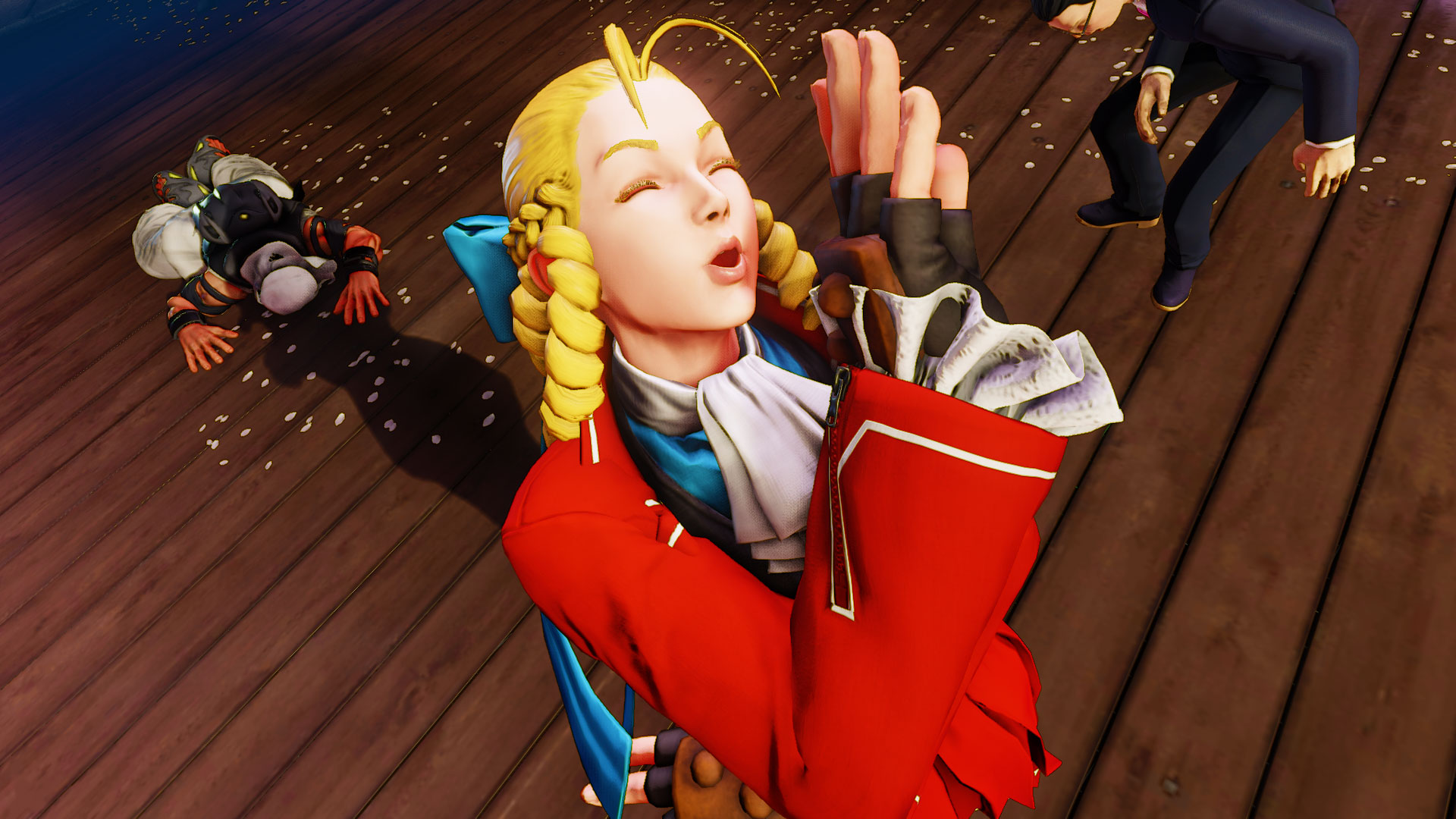
Which is why, in part, I was skeptical of Ultra Street Fighter II: The Final Challengers. It seemed like a weird choice for a full retail Switch title, and after digging into my review copy, I still wasn’t sold. As yet another release of a game we first got in 1991, the basic features you’d expect—Arcade mode, local Versus, Training—have been paired up with a few notable additions. First off, two new character variants have been added since the game’s last iteration: Evil Ryu, who has shown up in a number of titles starting with Street Fighter Alpha 2, and Violent Ken, who exists because Capcom felt like I hadn’t been punished enough by players of regular Ken.

Two major new modes have arrived as well, starting with Buddy Battle, a new take on the “Dramatic Battle” idea where one or two players can team up to take on a CPU rival in a handicap fight. The other, Way of the Hado, is probably the most-touted inclusion—yet it’s also near worthless. In this totally new minigame that uses assets from Street Fighter IV, players use the Joy-Cons as motion controllers in first-person battles where certain hand movements will perform Ryu’s signature moves. Even if the motion tracking wasn’t chaotic and frustrating, the game itself gets old after mere minutes of playing. Way of the Hado is what you break out when you’re hanging out with friends, you’re all slightly tipsy, and you want something to provide a short burst of hilarity and embarrassment. (If that isn’t your current situation, then I wouldn’t even bother.) Finally, Ultra Street Fighter II includes a surprisingly nice gallery option that replicates the out-of-print Street Fighter Artworks: Supremacy, as well as a Color Edit option for giving the cast your own awesome (or hideous) new alt colors.

While it’s not a new feature per se, Ultra Street Fighter II does also include the Udon-crafted visuals that were produced for 2008’s Super Street Fighter II Turbo HD Remix. Personally—and I mean no disrespect to the folks at Udon, who have done some artwork that I’ve loved—the upgraded visuals aren’t something I’d ever use, as they just look far too awkward for my tastes. (I stick to the original arcade visuals, which—like many retro games—are presented in their original 4:3 aspect ratio with borders on each side). Still, I’m never against players having more options than less, and I know that some out there will appreciate having the choice.

Modes and options only excite you for so long, however, and I was left somewhat soured at the idea of Ultra Street Fighter II pretty quick. I just wasn’t having fun with single-player arcade, soon returning me to my bafflement at Capcom for thinking that this release made sense. Still, before I reviewed it, I wanted to hop online and get some games in—something that was unavailable for the earlier reviews that hit, as the game’s servers weren’t online until days after embargo. I’m glad I did; playing online, and having some proper human competition in the game (in those matches where lag wasn’t a problem), Street Fighter II’s lasting qualities won me over once again. I won’t change my opinion on it being a fighting game whose time has mostly come and gone, but that simpler fighting style still offers some legitimate depth and strategy if you’re able to dig below its surface. Ultra Street Fighter II isn’t a game I’d break out on a regular basis—like I would Street Fighter V or other modern-era offerings—but I can see myself picking it up when I’m looking for something a little different, and finding some real enjoyment in doing so.

The downside, though, is that both options for proper multiplayer—online and off—each have their own limitations. The basics of what you need for versus play over the internet exist here, but I couldn’t help but wish things had been a bit more robust. After Street Fighter V’s data-intensive profiles, Ultra Street Fighter II is barren in comparison, and both Ranked and Casual Match modes give you enough to make games happen but not much more than that. Also, what’s up with Ranked Match? The standard for Street Fighter has long been best two-out-of-three, but here, you’ll always have the option to play three matches no matter who has already won what. Locally, the problem the game has overall becomes more pronounced: controllers. Using both Joy-Cons, I can get things done and reach a decent level of competitiveness, but I found myself wishing I had a proper controller or arcade stick the entire time. On the other hand, if your friend doesn’t have their own Switch and copy of the game, or you don’t have additional controllers on the ready, then it’ll be one Joy-Con per person—and, at that point, don’t expect to have any “real” matches.

The biggest problem with Ultra Street Fighter II hits on a subject we here at EGM tend to try to avoid when reviewing games: its price. Simply put, this is not a $40 experience. I was honestly wrong in how much enjoyment I thought I’d get from this release, and I’m legitimately glad that I now have it as an option to pick back up whenever I feel like it. Still, all of that should have come in an, at most, $19.99 digital download, not a higher-priced released getting into brand-new-game territory. If Capcom really wanted to go that route, this should have been like “Street Fighter Memories” or something, offering Super Street Fighter II Turbo bundled together with Street Fighter Alpha 3 and Street Fighter III: Third Strike. That would have given far better bang for the buck, and would have played better to the Switch’s “come together and play” strengths.

Whatever I may wish it had been, however, Ultra Street Fighter II: The Final Challengers can only be what it is, and that’s one of the most groundbreaking fighting games brought back in a package that’s sadly underwhelming and overpriced. If you’re a casual fan, this is a nice choice to have on your Switch when getting together with friends or jumping online, but you might find yourself wishing there was more. Meanwhile, if you’re a hardcore fighter fan, having a slightly upgraded and rebalanced version of Street Fighter II might be more than enough, but you still could be left frustrated at the current lack of controller options. Either way, you’re sure to have a great experience—but one that comes with one or more conditions attached.

Puyo Puyo Tetris Review

My family is a bit of a split-puzzle household—I’m a longtime fan of Puyo Puyo, while my wife is more of a Tetris player—so when Puyo Puyo Tetris came out in Japan in 2014, I made it my mission to pick up a copy on my next visit to the country. It was an incredibly curious attempt by Sega to bring two legendary puzzle games together into one, and at the time, I swore it’d never make it over to these shores.

Well, Puyo Puyo Tetris has indeed come our way—albeit only on two of the seven platforms it’s been released for. While there’s pretty much no video game that needs an introduction less than Alexey Pajitnov’s block-dropping challenge of speed and skill, Puyo Puyo is far lesser known to Westerners thanks to scattered English releases and varying branding. (Early games were reworked into Dr. Robotnik’s Mean Bean Machine on Genesis and Kirby’s Avalanche on Super NES, while some later games were retitled Puyo Pop.) Puyo Puyo is a similar concept to some other puzzle games—pairs of colored icons drop down, and matching four or more together make them disappear—but Compile’s series has always stood out thanks to a combination of well-crafted gameplay, an impressive level of multiplayer competitiveness, and a cast of colorful characters.

Both Tetris and Puyo Puyo build themselves around the “simple yet deep” concept, and that’s part of why the bringing of both games together in Puyo Puyo Tetris works as well as it does. This idea working wasn’t a foregone conclusion—sure, they’re both puzzle games, but they play very differently—yet there’s a nice level of balance that comes out of the meeting. Tetris tends to allow for faster gameplay while offering up smaller payoff; Puyo Puyo is more complicated to set up your strategies, but can result in chains that throw far more garbage blocks at your opponent in the end.

The default play style in Puyo Puyo Tetris is simple—two to four players face off, and each can pick whether they want to play Puyo Puyo or Tetris—and that balance keeps things fair for everyone no matter who picks which. Of course, these days, that alone wouldn’t be enough for a release like this, so Sonic Team has included a number of other modes as well. Either solo or with opponents, you’ll be able to pick from Fusion (both types of pieces fall onto the same playfield), Swap (you’ll play both types of games at once, swapping back and forth between each), Party (items that cause different effects to appear as you compete for the highest score), and Big Bang (pre-set patterns are continually offered up, and if you can clear them without messing up, you’ll earn points to damage your opponents). Meanwhile, when playing on your own, you’ll have access to the Challenge mode, which gives you Endless Fever, Endless Puyo, and Tiny Puyo for Puyo Puyo, and Sprint, Marathon, and Ultra for Tetris.

The standard Versus mode is highly enjoyable—no matter if you’re playing a combination of the two games or simply concentrating on either one—and Challenge is a nice way to mix things up for yourself, but the other modes are hit and miss. Swap is easily the best, as the pressure of switching back and forth and having to keep track of both playfields mentally provides for some frantic yet fun action. Big Bang will probably end up being the most mixed in opinions, but I honestly liked it, especially as it helps train your mind on possible strategies and techniques. Party, on the other hand, I came away luke-warm on, while Fusion is just a gigantic mess. I understand the desire to directly combine Puyo Puyo and Tetris in a game called Puyo Puyo Tetris, but it simply doesn’t work.

For any of us with a competitive spirit, both Puyo Puyo and Tetris are at their best when played against others, and Puyo Puyo Tetris supports multiplayer both locally and online. When in the same room, up to four players can either connect together with their own Switches, or up to four Joy-Cons can be linked to the same Switch for playing on the small screen or a television. Herein lies the biggest problem with Puyo Puyo Tetris on Nintendo’s latest console: quick and easy multiplayer anywhere is such a perfect feature to have, but the Joy-Cons absolutely fail the game. Analog sticks of any type are simply not precise enough for two games requiring minute piece placement, while the SL and SR buttons are a nightmare to hit while trying to hold your controller steady to have that accuracy. If you delve into the options, you can change around the configuration to use the buttons for movement and analog stick for rotating/dropping; it works much better, but get ready for some serious retraining of your brain, and don’t expect more casual players to be able to use that set-up. (Meanwhile, when using both Joy-Cons together, those d-pad replacement buttons are a godsend.) If you’re on the PlayStation 4 instead, you’ll obviously have less options for playing anywhere, but with four DualShock 4s, you’ll no doubt end up with the far better “serious play” experience.

If online is more your style, Puyo Puyo Tetris has a nice selection of features. If you’re hungry to crush foes under falling Tetriminos/Puyo, Puzzle League gives you ranked matches where your Rating and Regional/Worldwide leaderboard placements will rise or fall depending on your success (or failure). As per usual, playing ranked games doesn’t offer up much in the way of options beyond quick match, but you can thankfully set filters for which mode types you do—or don’t—want to play, along with opponent connection strength. If you want to keep things a little friendlier, Free Play lets you set up public or private rooms with customized rulesets, and you can even lock your room to either Puyo Puyo or Tetris. Finally, there’s a built-in system for saving, watching, or downloading replays, and while that may seem like a strange idea for a puzzle game, trust me, it’s not. Whenever you get totally trounced by an opponent, take my advice: save the reply, and watch their field instead of your own to learn from them. In my time playing online both pre- and post-launch, I got the chance to go against players from the U.S., Japan, and Europe, and everything seemed to go perfectly fine on my end throughout.

Puzzle games live or die on their core gameplay, so the “fluff” that’s added beyond is typically just that to me—fluff. Puyo Puyo Tetris has a single-player adventure where you’ll meet the cast of the game while going through a variety of trials or versus face-offs. If you’re the kind of person that likes that kind of stuff—like those out there who demand that fighting games have arcade modes—it dutifully serves its purpose. In terms of the actual narrative, however, outside of a few legitimately charming moments here and there, the back-and-forth conversational cutscenes felt like textual vomit. Nothing these characters are saying matters in the slightest most of the time, and like some other Japanese-developed games, you’d swear the writers were getting paid by the word given how much unnecessary chitchat there is. (Continuing down the Sega/Atlus path of sharing-hating stupidity, Sega of Japan doesn’t want you to spoil the Adventure mode in this game by streaming it—which makes me laugh and laugh.) The characters as well just held little charm for me, a far cry from the earlier days of Puyo Puyo when I looked forward to all of the between-match skits and cast interactions featuring Arle and crew. When you look at games such as those, or Tetris DS with its lovingly-integrated Nintendo elements, Puyo Puyo Tetris feels like a hugely wasted opportunity tossed aside for more continuation of the annoying anime-ification of Puyo Puyo. Also, it really would have been nice to have had the Japanese voices as an option, if for no other reason than the Puyo Puyo attack call-outs sound to strange to me in perfect English.

Again, though, those things are of little consequence in the long run for a puzzle game that’s focused on being a puzzle game, and neither Tetris nor Puyo Puyo have been tainted here. A few of its modes may not click, and I wish there had been a higher level of imagination in its modes and personality, but Puyo Puyo Tetris is strong where it needs to be, offering enough to do both solo or multiplayer to make you want to keep this release around for years to come. I’m really glad this game is finally getting its chance here in the West, and if nothing else, maybe tagging along with Tetris will get Puyo Puyo more of the recognition that it deserves.

Wonder Boy: The Dragon’s Trap Review

While the name Wonder Boy will mean little to nothing to a lot of younger gamers these days, to those like me who came to the hobby in the 8- and 16-bit days, it can bring back a lot of memories. Crafted by Japanese developer Escape (who later became Westone Bit Entertainment), the Wonder Boy franchise grew from its arcade roots into a deeper, more complex adventure series whose challenges were only topped by trying to keep track of which games were which (thanks to confusing name conventions and ports that at times changed graphical elements or even the main character).

The game to come in that transition from quarter munchers to password-powered adventures was Wonder Boy III: The Dragon’s Trap. In an interesting twist, it kicks off during the ending segment of the previous chapter—Wonder Boy in Monster Land—as our hero is battling its predecessor’s end boss, the Meka Dragon. Killing him, however, results in an unexpected side effect: you’re placed under a curse, turning you into the reptilian Lizard Man. In order to break the curse, you’ll need to defeat the other dragons ruling over the land to obtain a holy relic called the Salamander Cross. Of course, doing so isn’t going to be easy—and to get to each successive dragon, you’ll have to master other animal forms and their special abilities: Mouse Man with his small size and wall-walking powers; Piranha Man, who can move around much more easily in water: Lion Man, with his more powerful attacks; and Hawk Man, who can fly to previously-unreachable areas.

To be honest, I’m not sure I’ve touched Wonder Boy III much since I first played it back on the Master System in 1989, and I was honestly surprised when LizardCube announced that they’d be doing a remake of the game. I remembered enjoying it for what it was, but couldn’t help wondering why they hadn’t instead picked one of the later games in the series (specifically Wonder Boy in Monster World or Monster World IV). After playing this updated version of Wonder Boy III, however, I now understand why: because trying to put this amount of work into a bigger game might have been overwhelming for a team this size.

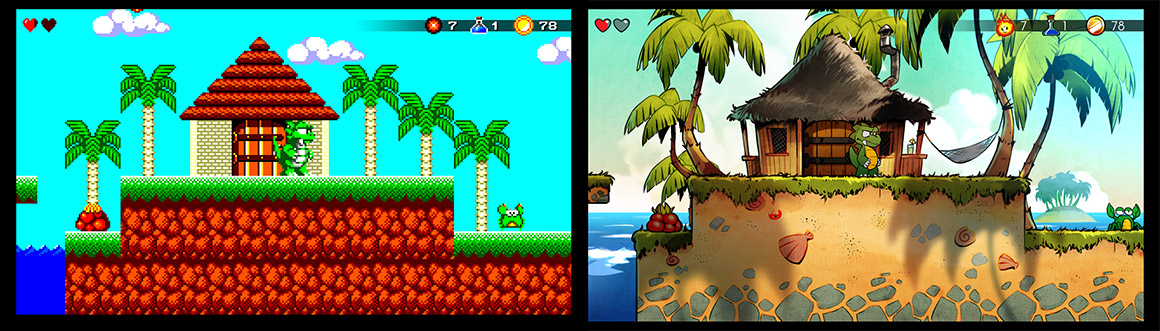
Simply put, the amount of love and attention that’s gone into this remake is staggering, and that starts with its gorgeous art style. We’ve seen plenty of attempts to HD-ify older sprite-based games at this point—all to varying degrees of success—but I’m being honest when I say that Wonder Boy: The Dragon’s Trap (the Roman numeral is dropped from this version for clarification) is easily one of the best efforts I’ve ever seen released. Below, you can see a visual comparison between the 8-bit original and LizardCube’s version, but it’s not simply a case of “more” in terms of the graphics here. It’s the choices that were made, the imagining of what these areas would look like had the hardware been more capable, and the artistry of filling in the blank spaces or replacing the pixels that previously existed. Studio MDHR’s upcoming Cuphead has shown us how beautiful and full of life 2D gaming can still seem in an era of cheaply-produced and poorly-animated offerings, and I think Wonder Boy: The Dragon’s Trap deserves to stand right beside it. (By the way, while I reviewed the game on PlayStation 4, I also tried the Switch version—and it looks fantastic on that smaller screen.)

Audio-wise, the game’s soundtrack has been reworked wonderfully, with orchestrated pieces that pay homage to what came before while raising those tracks to another level. Of course, should you want to remember how things were in the good old days, both the visuals and audio can be independently swapped to their original versions at any time. While much of the game remains exactly how my brain remembered it, the team at LizardCube did make a few slight tweaks for the better. I don’t want to spoil things too much for returning players; just know that what was kind of a cumbersome element in the original has been swapped out for a more interesting set of new content. Plus, while it doesn’t affect gameplay in any way, the team added a Wonder Girl that players can choose instead of the default Wonder Boy, which was a really nice (and appreciated) touch. I also can’t forget to mention that—in a crazy twist—Wonder Boy: The Dragon’s Trap was coded so that it could not only accept passwords from the 1989 version of the game, but even generate passwords in the new game that can be used in the original. (Not every consumable item will transfer over in the same quantities, but all major unlockables will be there, which is just so ridiculously cool.)

What’s interesting is that, in the end, it’s the original game that at times fails the team updating it for a new generation of players, and not the other way around. There’s no two ways about it: Wonder Boy: The Dragon’s Trap is very much a game from 1989, warts and all. While it remains an extremely playable game—to the point that I was legitimately surprised by how fun it still is—it’s also not as friendly as projects made in the modern era. So, those who didn’t grow up on this kind of stuff may feel that it’s at times unfair in its difficulty or expectations of skill.

There’s a nice diversity in the places you’ll be exploring (especially with their fresh coat of paint), but the game is also relatively short and small in scope. (I beat it in seven hours, but I’m expecting it’ll be more around four to five unless you fall into the completionist mentality like I did). One of the best parts of the game—the animal forms—continues to be a nice twist, and I’d swear most of them feel better gameplay-wise thanks to the game’s updated character sprites and animations. Unfortunately, though, Mouse Man and his near-worthless attack range continues to be rage-inducing garbage.

Even if I didn’t understand LizardCube’s desire to bring back this middle chapter of the Wonder Boy saga at first, I came to really appreciate their decision, even beyond the “it was actually doable” part of the equation. While Wonder Boy: The Dragon’s Trap does feel like a relic of a bygone era more than I wish it did, more often than not, it’s an adventure that’s held up far better over the years than it had any right to. With the effort that LizardCube has put into freshening the game up, you could even at times believe that it was actually an indie project conceived at some point in the last few years as a tribute to similar classic platformers. While it isn’t always perfect, and it may not be a good fit to younger players who have now come to expect certain luxuries, Wonder Boy: The Dragon’s Trap is not only proof that a nearly 30-year-old game can still be worth going back to play, but how special and worthwhile games like those can feel when put into the hands of people who care.

Persona 5 Review

Spoiler note: Care has been taken to avoid spoilers as much as possible throughout this review, but in order to properly discuss what players should expect, a few gameplay-related elements will need to be brought up that some may consider minor spoilers.

A short time into my first real job as a writer about video games, I got to take an early look at the English build of a Japanese RPG called Revelations: Persona—and from the moment I played it, I fell in love. Compared to other efforts of the time, it was crude in some places, obtuse in others, and pretty darn difficult all of the way through. And yet, it felt so unlike everything else out there that I’d played, giving me settings, characters, and mechanics that I hadn’t found in any RPG before it.

When Persona 5 first starts up, players are presented with a screen honoring the franchise’s 20th anniversary, and there’s a lot of emotion held in that simple animation for me. We’ve both grown up and changed so much in those twenty years, the Persona series and I, and I can’t fully explain how much these games have meant to me both as a gamer and simply as a person.

There’s a lot I have to say about Persona 5, and while it might not be the best place to start for a review, I’m going to begin with the thing that first really hit home for me: the game’s visuals. Back in 2011, the Persona team released Catherine, an intriguing side project that turned out to be a testing ground for what was to come in the next major Persona chapter. There’s a lot of influence felt here from that game, but none more so—or with such impact—as the overall style and graphics. Gone are the more cartoony-proportioned character models from the previous games, the more two-dimensional style of town areas, and the simpler presentation of other elements that could at times make the games feel more limited in scope or budget. Here, the cast comes off as more realistic-looking, the streets of Tokyo—the first time a Persona game has been set in a real-world place—come to life like never before, and even the smaller details have a care and artistry put into them. Atlus has long been known for having menus and user interfaces that ooze class and cool, but now every detail of Persona 5 shows off that flair to an amazing degree. What Atlus was able to craft here is completely beyond almost every other JRPG that has come in recent years, and now that the entire game is dripping with that style, the series has been elevated to a class all its own in the genre.

The reason all of that is so important is that Persona 5 is an example of how looks can then have a deeper effect on attitude. The game’s presentation sets up a more mature and serious tone for what’s to follow, which of course includes the main story. Unlike the previous two chapters, things kick off pretty quickly here, and it’s not long before the stakes are raised for our main character. I don’t want to fully spoil how that’s all set up, because it’s a fantastic twist that both gives us foreshadowing for what’s to come while also making us want to see how we’ll get there. For the story itself, it starts with a familiar theme: people are suddenly becoming shells of their former selves, falling into an apathetic or even catatonic state, and nobody can figure out why that’s happening.

Those events begin right around the time that our main character—who I’ll refer to by his in-game nickname Joker to avoid confusion, given he has no set real name—is sent to live under the care of a cafe owner named Sojiro Sakura. After an attempt to be a good samaritan goes wrong, he’s branded as a delinquent, and the only school that will now accept him is Shujin Academy in Tokyo’s Minato ward. The set-up is simple: be a good student and stay out of trouble for a year, and he won’t be sent to juvenile detention.

Unfortunately, Joker’s plan gets thrown into chaos pretty much right away. After befriending fellow “problem child” Ryuji Sakamoto, the duo somehow find themselves in a strange, distorted castle on their way to school one day. The place is overrun with bizarre monsters controlled by a distorted doppleganger of one of their teachers, and none of it makes any sense until the guys meet a talking cat-like creature named Morgana. Morgana explains that when people’s hearts get too corrupted, Palaces can manifest around them, and the only way to destroy those aberrations of the Metaverse (the alternate dimension in which they exist) and return the people back to normal is to steal that person’s “heart” from their Palace.

After another student, Ann Takamaki, accidentally gets involved, the three form the Phantom Thieves—a group determined to find people whose hearts have become corrupted and then “steal” those hearts away. Of course, being a Persona game, that is neither a short nor easy task. Along the way, the group grows in size, with additions such as the student council president Makoto to the eccentric hacker wunderkind Futaba. So, too, does the responsibility the Phantom Thieves find placed upon their shoulders, as the team evolves from one that simply wanted to fix a situation at school to a force for change that encounters ever-growing popularity. Persona 5’s story is definitely heavier and more serious at times than the last game—which some fans have lovingly dubbed “Scooby-Doo and friends”—but don’t take that to mean that this is a return to the early days of the series; I’d put it somewhere between the more light-hearted fun of Persona 4 and the gloominess of Persona 3. There’s some legitimately interesting situations and twists found all throughout the story, and though the “Phantom Thieves” idea initially seemed a bit cheesy, it grows into something that offers up both moments of smile-inducing silliness and more complicated contemplation, mostly to success.

“Mostly successful” is also how I’d describe Persona 5’s cast. The characters you’ll be spending the game with are essential in a Persona game, and while I became far more endeared to the team here than the one in Persona 3, they didn’t win me over quite as much as who we got in Persona 4. There wasn’t a main character I didn’t like in the previous game, and as opposed to the P3 crew, P4’s cast felt like regular, everyday people. Here, every character slightly falls back into that “anime trope” mentality in terms of their personality and development, and I wish that hadn’t been the case. However, by the end, I had grown much closer to this cast than I had initially expected—especially the talking feline mascot Morgana, a character type I usually loathe in JRPGs. Well, everyone except Ryuji, who was kicked off of my main roster as soon as I was able. I’m actually a little surprised by the lack of growth that he shows, especially given he’s around for pretty much all of the game. At the beginning, Ryuji is a loud-mouthed moron who keeps causing trouble due to his quick temper; by the end, he’s a loud-mouthed moron who keeps… well, you know. Then again, I also hated Junpei from P3, so it could be that I just have zero tolerance for these kinds of characters.

One of the biggest twists that Persona 3 brought with it was Social Links, which return once again in the form of Confidants. By spending time with specific characters, you can build up your relationship rank with them, which results in a variety of support benefits the higher you go. While persona-fusion buffs still exist according to the tarot arcana each character falls under, the “other” benefits you get from maxing out relationships are particularly important this time—especially when it comes to non-teammates. For example, becoming closer to doctor Takami will open up a bigger selection of healing items at better prices, while your teacher, Miss Kawakami, can help you with chores or let you slack off in class. Though Persona 4 flirted with the idea of Social Link bonuses, the system is far more robust here, and it’s a pretty great addition to the game—especially in how those bonuses are logically tailored to who they’re coming from. Just, be warned: if you’ve played the previous Persona titles, Persona 5 comes to an end before you’d expect it to. The game is still plenty long—my playtime clocked in at over 105 hours—but you won’t have the amount of in-world time that you may think that you would. I was kind of shocked when I learned this, and a number of Confidant relationships I had meant to finish up went unresolved.

Really, though, we all know what’s most important in those relationships: finding a sweetheart. Romance has felt a tad shallow in Persona, because the process has always broken down into “help girl with problem/situation -> get far enough to choose between staying friends or becoming more -> have a scene or two of being a couple.” Persona 5 thankfully expands things somewhat by offering a variety of date spots around town, and while they can also be visited with other Confidants to help improve relationships, they do at least offer some options for a little extra time with your girl of choice. However, there’s plenty that Atlus could do to help make it feel like you’re in a relationship with only minimal effort. Why not have your girlfriend waiting with you for the train on some mornings, or change up team meetings so that they’re sitting next to you? Why not use the new text-messaging system to engage in more non plotline-focused conversations with them—especially given that the team made a game built around people in a relationship texting each other right before this? And what’s up with not being able to give presents to our loved ones on those holidays when we receive them, even if there’s no in-game benefit to doing so? (Look, I’m bitter that I bought a $880 necklace that I never got to give.) I appreciate that Persona 5 does give us more than we’ve had before, but come on Atlus—BioWare at least offers up naked-rolling-around-together time. I cared more about the girlfriend I ended up with here than any previous game’s choices, so I wanted a little more, you know?

There’s something else I need to bring up on the topic of characters, and it’s a subject I often try to avoid. There are two homosexual NPCs that appear throughout the game, and I was taken aback by their portrayal. Now, I want to be clear: I don’t think gay characters always have to be “good” characters, and giving such NPCs negative qualities isn’t instantly a cause for protest. However, the pair were overbearingly stereotypical in design and portrayal, and more importantly, their conversations repeatedly centered around their attraction to the game’s teenage boys. Japan has some complex cultural opinions on LGBT issues, but how a company like Atlus—a studio known for putting care into more “fringe” types of characters—could so blatantly portray gay men as child predators bothered me. It’s especially disappointing because Persona 5 features one other prominent LGBT character, and I found them not only to be a fun foil for another NPC, but also pretty spot-on for people I’ve actually met in Japan. Atlus is the Japanese company I look to the most with hope for some well-written and developed LGBT characters, and yet, this is now three games in a row where we’ve gotten examples of queerbaiting and/or gay panic from the studio.

Under all of the story and the visuals and characters, of course, is the core gameplay, and Persona 5 is probably the freshest and most polished that the last 10-plus years of the new era of Persona could have felt. The basic gameplay is still the same—balance a life of being both a student and a persona-wielding warrior—but there’s a number of improvements in ways both big and small.

Even the “small” really isn’t when you consider what it means for the game, as there’s a ton of new convenience features now integrated to make things smoother and more enjoyable. One example is the return of the locational quick-jump from Persona 4, but now, you can scan across a map of Tokyo, select a new area of the city, and even hone down to a specific spot there all in just a few menu clicks—and even get indicators for which Confidants are where and who is ready to rank up with you in the process. (However, don’t always use this option: the dev team has really built up some of the smaller elements of the city, so it’s nice sometimes to appreciate that effort as you weave through Shibuya station to get to your platform.) Meanwhile, if you’re ever lost on what you should be doing, you can poll other players via the internet to get a breakdown of what percent of players challenged dungeons, hung out with other characters, or worked on building up their social stats that day. Speaking of improving yourself, there’s a far bigger variety of things to do to spruce up your charm or make you smarter, so that you aren’t always doing the same thing over and over at a specific time of day. Also, if you’ve already figured out a particular demon’s elemental weakness, a simple button press will instantly cue up that skill—and once you’re done with battle, another button will use any available Skills to heal your party back up to full.

While on combat, the past few Persona games weren’t at all broken in that regard, offering a simple-yet-deep battle system that remained enjoyable across hours and hours. So, that core isn’t heavily changed here, but it does have a few new twists. Standard melee slashes have been joined by gun-based projectile attacks (in a nod to the earlier days of the series). As well, two new elementals join the fray: Psio, or psychic skills, last seen in Shin Megami Tensei: Devil Summoner, and Frei, nuclear attacks that were previously in the two-part Persona 2. For the most part, the game seems good about balancing out demons so that they have multiple weaknesses, so having two extra elements to worry about isn’t the headache that it could have been—plus, it’s nice that every team member gets their own unique element to specialize in, instead of having to share. If you do strike an enemy’s weak point, you can now do a “Baton Pass,” giving you the chance to switch out to someone who might be better for following up. As per usual, get every enemy into a weakened state, and you’ll be able to perform an all-out attack by first “holding up” the enemies with your firearms. Now, however, not only can you instead demand they give you money or items, but even engage in demon negotiation. Yes, after both Persona 3 and Persona 4 did away with the tradition of talking to demons in order to get them on your side, it’s back in Persona 5—and I’m glad that it is. Negotiations were a part of the original Persona, they’re a part of the Shin Megami Tensei universe, and while they can be a little frustrating when you just can’t figure a particular demon out, they’re way more enjoyable than the more random-focused methods we’d gotten in previous chapters.

Once you’ve got a handful of demons, it’s off to the Velvet Room to have Igor and his new assistants Caroline and Justine help you fuse them into more powerful personas. At first, the options available will feel a bit sparse, because the complicated multi-demon fusions are gone save for a select list of special choices. However, instead of just making the process more complicated, Persona 5 gives us a wider variety of choices. You can now sacrifice one demon to power up another or craft a specialty item, or hold a public execution through a special online-powered procedure that causes them to be reborn as a completely different persona. Playing with the theme of being prisoners trying to escape from their bonds, you can put one of your personas into lockdown, where after a while they’ll learn a new resistance. Oh, and since the Velvet Room is a perfect place to appreciate this aspect, mention has to go to how fantastic all of the game’s demons—both new and old—now look. The team at Atlus had to go through and completely remake them all, and between the bump in resolution and the updated models, it’s almost like meeting some of those names and faces you’ve known for years again for the first time.

Above all other changes that Persona 5 has implemented over its predecessors sits its dungeons. When Persona 4 went with separate randomized dungeons that each had a specific theme to them, it was a welcome change from Persona 3’s generic one-tower-for-everything Tartarus. And yet, that was nothing compared to what we get here: fully-developed Palaces that trade the randomization for specially-designed locales that tie into each of the corrupted people you’re trying to reform. From the very first dungeon that you enter, this change felt almost unbelievable as someone who had gone through the last two games, and only really falters in the final two dungeons, when it feels like the imagination train is starting to run out of steam. For us long-time fans, it’s nice to finally get dungeons that feel as if they have reason and purpose, and the little extras like being able to sneak around foes or solve simple puzzles add an extra layer of enjoyment. The bigger winner, however, will be more casual players. The hardcore dungeon-crawling could get boring and overbearing for some, so these more “standard” dungeons will be much more inviting for those types of players. If you do enjoy exploring level after level of dynamically-generated catacombs, Persona 5 offers up a second option in Mementos. Basically the game’s take on Tartarus, you can head in and just grind or hunt down treasure chests, but that’ll also be the place where you’ll accomplish most of the game’s sidequests.

In so many ways, Persona 5 is a fantastic game—but it’s also an incredibly safe one, and that makes me a little sad. Both as a fan and as a reviewer, when I take the game we’ve been given and consider it in terms of what the Persona team tried to do, they were absolutely successful. I’ve got a list of minor gripes a mile long—some of which I’ve expressed here—because it’s inevitable that the better a game is, and the more that you like it, the more that the flaws will bug you. If we look at what Persona 3 and Persona 4 tried to accomplish, it’s not even a question that this is in most ways the better experience. However, when I fell in love with the first Persona all those years ago, I did so because if offered me something new. When Persona 3 came along ten years later, it was a fresh take on what we’d had before. Now, another ten years gone, Persona 5 is evolution, not revolution. Part of the problem, really, is Catherine—it was hard to come out of that not hoping that some of its daring ideas and attitudes would be part of the next Persona. I kind of fear that the series is now going to be “stuck” as something that too many fans won’t let change, and I’m not happy about that thought. There’s almost nothing broken about where Persona 5 has taken the ideas that were first presented in Persona 3, but we didn’t get here in the first place by thinking that things don’t sometimes need fixing. (Speaking of fixing, it’s really time that we either get a main character with more personality, or we players get more customization options for them—the wishy-washy in-between just doesn’t work as well anymore.)

There’s one other major criticism I have about Persona 5, but this one is something that I think can legitimately be levied against the game. Once again showing the bouts of paranoia that Atlus Japan can sometimes suffer from, the PlayStation 4’s Share button is completely non-functional throughout the entire game—no screenshots can be taken, no video can be recorded. I can only imagine this was done to “protect” the story from being revealed right after release, but that’s a pointless step to take given the ample amount of streams that have the equipment needed to get around such blocks. What we’re left with is a game that stops the majority of people who are playing from saving any of their favorite moments, and that’s an unbelievable insult to Persona fans on Atlus’ part. There were so many screenshots I wanted to take of characters or locations or scenes, so many relationship-building meet-ups that I wanted to record as Joker’s friendships or love life blossomed. Atlus, your choice here was disgusting, it was appalling, and it’s shocking how little you think of your fanbase to do something like this to them.

If a broken Share button and the wish for more ambition are the biggest complaints I can levy against Persona 5, then that seems like a pretty good outcome. Atlus’ revival of one of its lesser-popular MegaTen branches back in 2006 has grown into something bigger than any of us could have imagined, and this latest iteration offers up those engrossing ideas and situations with the best presentation and polish that the series has ever seen. Returning fans will find more of what they loved before made even better, and new players will find a perfect jumping-off point for the series even if they have no prior franchise experience. I still worry for where the franchise is going to go from here, but I also know that I just sat through a 100-plus hour RPG and kept wanting “just one more hour” the entire time.
NieR: Automata Review

Note: While I’ll be making every attempt to avoid spoilers as much as possible, I will be talking about a few gameplay elements that may spoil some level of what players can expect in their playthrough.

Yoko Taro is an interesting man when it comes to the games he dreams up—a fact I knew without ever having played even one of them to completion before Nier: Automata. In the few hours I’d experienced of the original Nier and Drakengard 3—the third part of the series the Nier games spun off from—it was already clear that Taro likes to take his projects in interesting and unexpected directions. Plus, hanging out in the gaming circles that I do, it’s been impossible to not hear the overflowing love that exists for his weirdness expressed over and over. (I honestly have meant to get farther into the first Nier, but I just couldn’t stand the main character of Nier: Replicant, the version of the game we got over here in the West.)

So, Nier: Automata looked to be the perfect way for me to finally experience the mind of Yoko Taro—even if it would come in a package that was more like a traditional PlatinumGames “stylish action” release and less like its older sibling.

Well, chalk that up as the first chance Nier: Automata took to throw me for a loop. While the game’s opening area very much plays out like it could be a more linear adventure akin to Bayonetta or Metal Gear Rising: Revengeance (mixed in with a dash of shoot ‘em up segments), get past that and you’re tossed into an open world that gives you a number of options for what to do next. At first, I wasn’t sure what to think about it all, in part because it doesn’t take long to realize that Automata’s world is relatively small on the sandbox scale—and I worried it wouldn’t be enough to make up for the lack of constant action I once had hoped for. I’d come out of last year’s demo a little worried, and my first hour or so with its finished form wasn’t exactly calming those concerns.

Like many games, however, Nier: Automata simply needs a chance to fully kick into gear. When it does, it does in part thanks to the quick ramping up of the overall story, an element that is nearly impossible for me to talk about in much depth without drowning you in spoilers. Essentially, some time ago, aliens attacked the Earth, and went to war with us humans using an army of machines. The remainders of mankind escaped the ruins of their home and fled to the Moon, where they created YoRHa, a specialized team of androids tasked with destroying the machines and taking back the Earth for their creators.

One such team member is 2B, a black-clad female android with short platinum blonde hair that initially serves as the game’s main character. As a battle type, 2B is sent down to the Earth’s surface to assist in the war that continues to rage. Shortly after the game kicks off, she meets another android, 9S—a friendly yet slightly naive boy whose job it is to do reconnaissance for YoRHa and hack into enemy networks. When 2B’s mission suddenly goes awry, the pair work together to try to deal with the growing threat they’ve uncovered.

As I said, I’ve heard a lot of people say so many good things about the original Nier, and how it’s a so-so game on a tech and mechanics level that is then elevated much higher thanks to its narrative and thematic twists. While I’m not at all saying that Nier: Automata is weak in the gameplay department—more on that in a moment—what weaknesses it does have can often be overlooked thanks to how engrossing the adventure is. Even in its lower moments, I still found myself caring so much for 2B, for the world she exists in, for the other beings that she meets along the way, and for finding out what’s going to happen next. At one point, Nier: Automata requires that you go back and re-play a huge chunk of what you’ve already been through as 9S, a decision I rather hated at first. However, even that—the weakest part of my 37-hour playthrough—still gave me reasons to keep pushing forward through the plot.

There’s something else story-wise that really hit home when I was deep in the game’s later hours. Video game foes oftentimes exist because they simply have to, and if you’re lucky, at least a few of the bosses or antagonists along the way will be compelling enough to offer joy from fighting (or foiling) them. Here, though, I grew to hate the enemy on a mental and emotional level, to a degree that I haven’t seen a game accomplish in a long time. Many times, when running off to take care of a particular quest or head to the next story location, I’d stop and take out some of the random groups of machines that were hanging around. Not because I had to, but because I wanted to—I wanted to see those machines die.

When it comes time to bring down justice upon the machines, you really remember that this is a PlatinumGames production. 2B has a number of weapon options to choose from—from swords to spears to even her bare hands—and every one of them feels great when used for either light or heavy attacks. Though it doesn’t get quite as deep as the studio’s best offerings, combat in Nier: Automata is still hugely satisfying, and really shows just how much a well-developed battle system can improve games that might be weaker in other areas. 2B slices through enemies with almost a beautiful grace as her swords twirl and spin through the air at opponents—but there’s also a wonderful brutality to it all.

In those times that you play as 9S, gameplay shifts to a more defensive nature. He can still equip any weapon that 2B can, and get into the thick of battles like his partner, but 9S only has one attack strength (light) and can only wield one weapon at a time. Instead, his focus is more on hacking. When targeting any enemy, he can hack into them, switching things to a retro-style top-down shooter where blowing up a defended core will either do damage to the enemy or be an insta-kill if they’re low-level enough. It’s an interesting and quite powerful ability—one that plays well into the idea of robotic life forms fighting robotic life forms—but it can get a little tedious at times. 9S’s hacking ability slows down battles quite a bit, and while that’s fun in bursts, at times I found myself wishing I could just get back to 2B and her more direct approach. Nier: Automata’s final playable character—the mysterious female android A2—definitely gave me that, though. While she plays very similar to 2B, she comes with one extra feature: she can overload her systems to give herself a temporary boost in power, perfect for unleashing a cathartic bout of rage.

Expanding your offensive abilities are Pods, little floating robotic assistants. 2B’s companion, Pod 042, can fire an endless stream of bullets to help manage those harder-to-reach foes, but can then be outfitted with an array of special abilities. Some of these are simply damage dealers, some assist in crowd control or locating hidden items, while still others can directly enhance 2B’s fighting methods and combo potential. The other important area of customization in terms of combat are Plug-In Chips, which are essentially an array of skills that can be equipped, removed, or fused together for better stats. Again in keeping with the theme of technology, these are represented as chips that literally plug into the android’s motherboard, and there’s a maximum amount of “bandwidth” you have to use them at any one time (the more powerful a chip is, the more it requires).

Plug-In Chips are an important part of the game, and between the wide array of options to choose from, and the ability to have four different chip sets that can be swapped in and out on the fly, you can really tailor things to how you want to play style-wise. However, there is a catch: you can lose all of the chips you have equipped if you aren’t careful. In a very Dark Souls-esque fashion, your corpse will remain wherever it was that you died. If you can get back to it without dying again, you can recover and re-equip your previous chipset; if you can’t—or if you wait too long to do so—those Plug-In Chips will be gone forever. In an interesting twist, instead of just recovering your body, you can also repair it, bringing it back to life as an AI-controlled partner. As well, you’ll also come across the bodies of other players if you’re online, and after deciding if you want to send them a supportive boost or not, you can reclaim some of their chips or resurrect them as that same kind of partner. I’ll be honest: playing on normal, there came a point where my Plug-In Chip loadout helped assure that death wasn’t something I had to fear on that level. So, this whole thing will probably be more of a worry when playing on harder difficulties, or if you’re not as adept at what the game throws at you. Still, it’s a neat idea.

No review could be complete for Nier: Automata without mentioning the game’s soundtrack, which is nothing short of fantastic. Once again I go back to the idea that quality in the proper places can make up for rough spots in others, and my travels through the game were made more memorable by having haunting melodies or emotionally-charged tracks playing during key scenes or moments. Even now as I write this, I’m listening to the Japanese version of “The Weight of the World,” a song I didn’t care for too much at first but which now has stayed on repeat for days at this point. In terms of dialogue, the game is playable with both Japanese and English voice acting. After trying both, I tended to like the Japanese voices more, but the localized version is thankfully equally great. A warning, however: not every moment in the game has translated subtitles, so if you do play in Japanese, there will be a few moments where you’ll miss out on what’s being said unless you speak the language.

Still, as I’ve mentioned a number of times now, Nier: Automata is not a game without weak points. The smaller style of open-world the dev team went for does work out in the end, and it has more complexity to it than you’ll originally think, but it feels under-developed at times—especially given how much more of this world you may end up wishing you could see. There’s also a feeling of cheapness to how it was designed in some ways, with environmental elements such as buildings sometimes feeling more like Hollywood props than actual structures. (When you’re trying to figure out why you can enter one hallway of a building but not another, when both of them have the same size of openings, you’ll understand what I mean.)

Side quests offer up some really great conversations and character building—par for the course with the wonderful script and localization—but they can also get bogged down in tedium. One particular quest had me talk to one character, then have to talk to three different characters, then deliver items from them back to the original character, then go back to each character again and tell them the original character’s response, then go back to him yet again to finish things up. The amount of travel that you’ll need to do for quests like those—or simply for progressing through the game—can get frustrating due to a teleportation system between checkpoints that is constantly taken away from you or neutered for seemingly no good reason. And, while there are some great boss battles at times, I was left wishing there had been more—especially since we know the kinds of stuff that PlatinumGames is capable of.

Finally, let me get one final jab in at 9S. In all fairness, by the point that he needs to be a compelling character to help carry the story along, he does indeed become one. Still, I think he’s given too much focus in the game, and I wish some of the abundant time spent playing him had instead been divvied up between 2B and A2.

Even given those complaints, when I think back to my time with Nier: Automata as a player instead of a reviewer, it’s so hard to dwell on its weaker points. I’ve played so many Japanese games over the years that were technically or mechanically imperfect, yet which became unforgettable classics thanks to their stories, or their characters, or their creativity—and Nier: Automata could indeed join those ranks as we get a better chance to look back upon it. The tragically beautiful tale of an android named 2B and the world she fights for may not satisfy those raised on a diet of triple-A offerings, but it’ll be one hell of a ride for anyone who can appreciate the artistry of imperfection.

Nioh Review

When writing reviews, it’s always tempting to compare the game you’re talking about with others that have come before it to give a better picture of what to expect to readers. However, that can quickly put you into a position where you aren’t judging a game on its own particular merits, so it’s a practice I typically try to avoid—except for today.

Team Ninja’s latest handiwork, Nioh, is a game inspired by From Software’s Souls series. Heavily inspired, to be fair. From early previews talking about the change in direction for the resurrected Nioh project, to three hands-on betas that gave players a direct sampling of what was to come, it was easy to see that familiarity in terms of more strategic combat, world progression, and boss battles.

In fact, Nioh’s kick-off will instantly feel familiar to Souls veterans. A ruggedly handsome Irish rogue named William Adams sits in an English prison, where breaking out of his captivity and escaping to freedom serves as your introduction to basic gameplay elements. Before long, William runs into the man that will be your main antagonist—Edward Kelley—who kidnaps William’s guardian spirit Saoirse while summoning up a first boss to test your skills.

The true Nioh starts once William reaches the shores of Japan, a land as foreign to him as he is to it. After meeting up with the legendary ninja Hattori Hanzo, William sets off on a dual-purpose quest: hunting down Kelley and Saoirse while helping his new friend defeat the demonic Yokai that are terrorizing the countryside. Unsurprisingly, those two things end up becoming interlinked, leading players on a trip that crosses Japan and introduces William to a variety of historical Japanese warriors. In fact, William himself was a real person in the country’s history, though it goes without saying that his story—along with everyone else’s—has been exaggerated just a bit.

Nioh had much more story than I was expecting it to, and this is where the Koei side of the game shows through. Personally, I loved it, because I’m a sucker for the company’s historical offerings, but it might be hard to follow all of the names, faces, and locations that keep popping up for those not as up on Japanese history. Even so, there are some legitimately entertaining exchanges of dialog in Nioh‘s cutscenes, supported by a colorful cast of characters that are interesting all of the way through—with the exception of William himself. To be fair, I came to like him more than I had first expected to, and he does have some moments of brilliance when being the foreigner who doesn’t have time for Japanese political and social etiquette (I’ve been there a few times myself, Will). Still, he’s sadly under-developed given the potential he had story-wise, so while he made me soften on my feelings that I’d rather have seen a Souls-style character creator, he didn’t completely change my mind on wanting that for a potential sequel.

Where William never let me down is in his skills at demon-slaying. While the game definitely builds on that more deliberate, thought-out, every-swing-matters fighting style that From Software helped popularize, Nioh is also a faster, more offense-oriented experience that feels appropriate given the heritage of Team Ninja. The first reason for that is the game’s three stances—High, Mid, and Low—which change up things like the speed of attacks, the damage you can deal, the way you swing your weapons, and how easily you can evade what your foes throw at you. These stances are relevant for every weapon type in the game, and they legitimately give you more tactical options for dealing with particular situations, when they could have easily been more of a just-pick-the-one-you-like-and-stick-with-it gimmick.

The other major element that helps push you to take the initiative is the Ki Pulse. Ki is Nioh’s stamina, which gets eaten up whenever you make major actions like swinging weapons, blocking, running, or dodging, until you calm down long enough for the Ki bar to refill. Here, you can tap a separate button after attacking to regain some of the Ki you just spent—and that little action causes a huge mental shift in how you approach encounters versus the more traditional attack-back off-attack-back off nature of Souls games.

I don’t want to say Nioh’s combat system is better—because it’s different, not better—but it’s one of the pieces of the game that made me glad Team Ninja wasn’t simply content at making a wholesale Dark Souls clone. Fighting enemies throughout the game is mostly a joy, from the English guards you initially encounter in the prison, to the walking undead that have taken over the first Japanese village you come across, to the hulking Yokai monstrosities that appear more and more often the closer you get to reaching your end goal. (I say “mostly” because there are a few enemy types in the game that are cheap little bitches.) Then, of course, there are the boss battles, which serve up those familiar feelings of utter despair at first, only to be followed by an amazing sense of accomplishment when each falls to your blade. There’s some really great boss design on display here, with a few particular fights being especially fantastic (not to mention gutsy). Throw in a whole assortment of weapons to choose from, deep skill trees that open up an array of new techniques, Ninjitsu (projectiles, poisons, and so on) and Onmyo spells (healing, status effects, and more), and Guardian Spirits—selectable familiars that give you passive boosts while also letting you charge up the ability to temporarily become super powerful—and there’s a ton of depth that may help attract players who wouldn’t normally be down for this type of game.

Nioh’s depth can be somewhat off-putting if you aren’t ready for it, however. The first tutorial missions don’t open up until after you should be putting those techniques to practice—but make sure to go back and clear them out whenever they show up, trust me—and Team Ninja doesn’t spend a lot of time explaining the game’s more intricate details. Even for the Souls faithful, there can be a lot to swallow here because Nioh is filled to the brim with information. Your Status screen alone has five pages of numbers and data and percentages, and the game has two crazy-long lists of additional achievements that offer up points to spend on unlocking a completely new set of passive bonuses separate from the skill trees. You can also spend a ridiculous amount of time deciding what weapon or armor to wield next, because Nioh throws a lot of loot at you, and every piece has its own page of numbers and data and percentages. It really is a lot to take in at first, but as I got deeper into the game, I came to appreciate the stats overload that Nioh is so proud of. If you just want to kill monsters and look cool, for the most part you can just equip the items with the highest attack or defense numbers and call it a day. If you’re ready to dig deep into how much low stance guard break percentage or Yokai equipment drop rate your current gear will give you, then obsessing over minute numeric differences can become almost addictive.

One other element to that design complexity in Nioh is its graphical options. Right at the start of the game (and changeable at any time), you can pick from three visual modes on a standard PS4: one which prioritizes higher framerate, one which prioritizes higher resolution graphics, and one that tries to find a balance between the two. Then, if you’re playing on a PS4 Pro, standard HDTV owners can choose between 1080p visuals with higher anti-aliasing, or 1080p visuals with a solid 60fps. Playing on a 4K HDTV? You can have 2160p resolution at 30fps, or 1080p resolution at 60fps. These are the kinds of options one would normally expect only from PC gaming, but I appreciated Team Ninja’s efforts here. To me, framerate is king, but for you, maybe the game’s overall appearance is the bigger deal. I played on both a PS4 and PS4 Pro via a 1080p HDTV, and while I did notice the resolution bump when playing on the Pro, I never really felt like I was getting the “worse” experience running through most of the game on my launch PS4.

Another area that Nioh takes a different path from Dark Souls is in the overall world structure. Here, every area is its own singular space, experienced as “missions” that are initiated and completed separate from one another. After finishing your first mission on Japanese shores, you gain access to a map of the country, where you can pick the next campaign mission, re-attempt the one you just completed, challenge a sidequest or two, or head to the main base, which offers services such as a shrine for levelling up, a blacksmith for buying/selling items and making new gear, the practice dojo, and more. Nioh’s regions are usually dotted with more side missions than there are story ones, and one interesting twist on that is, at times, they’ll take you to locations or let you experience events that you won’t even see in the course of the campaign. I liked that, because it made that extra content feel more important, and less like thrown-together filler to pad out the playtime. Other times, you’ll also be able to attempt Twilight Missions, which take you back to previously-visited areas that are now bathed in a blood-red sky and filled with far harder Yokai than they were before. I had knocked out about a fourth of the side missions when I beat the game around the 67-hour mark, so you can use that extra content to either provide for a much longer trip to the game’s ending, or as a reason to go back once the credits have rolled.

The various stages you’ll explore across those missions is the one place where I found myself a little disappointed with Nioh. After the first few locations, the game throws you into two cramped, boring, visually unappealing areas in a row, and they’re both just terrible—feeling more like what you’d expect from a more generic ninja game and not what Nioh is setting itself up to be. At that point, I was getting worried that was going to be the norm for the game’s world design, and that thought was utterly depressing. Thankfully, the further into the adventure you get, the better crafted stages are, leading to certain locations that are a delight to explore thanks to their complexity, beauty, and secrets to be found. And yet, as good in concept and layout as many of the world sections ended up being, there was still just something missing. If there’s any one place where I’d directly compare Nioh with Dark Souls, it’s here, because I think From Software really has a knack for making worlds that are artistically beautiful while also feeling threatening in atmosphere. If we get a Nioh 2, I’d like to see Team Ninja think a little more about that artistry, play with a bigger variety of the landscapes and locales that a country like Japan has to offer, and try setting stages at more differing times of day.

There’s one other part of Nioh that I don’t want to speak too much on, and that’s its multiplayer. Part of the reason is that, given most of my time came in the days leading up to launch, the servers were either not even running yet or barely filled with other players. And, also, because I don’t really come at these kinds of games for the multiplayer, because the more dynamic “suddenly getting invaded” moments or the sharing of hints via scribbled messages. One thing I did think was cool was that, much like the Souls games, you can see markers where other players died. Instead of giving you a hint to what killed them, however, Nioh’s version calls that player’s vengeful spirit into your game. Defeating them earns you equipment and items, and there’s even a built-in faction-based meta game, where you can earn rewards if your faction claimed the most glory (through killing those spirits) during the course of that week.

If you want to actually play together with friends or strangers, you can, but things work a little different than you may be expecting. There’s an item you can use to call in other players if you’re needing help with a particular mission, or you can go out into the online world to help others, but in both cases, the helper needs to have completed the mission before they can join the helpee. Then, there’s a separate “companion” mode where two players have one shot at completing missions while using a shared life bar. It’s definitely an interesting idea that I’m looking forward to giving a proper go now that there are some people to team up with, but it’s something more for players who have finished the game and want some extra challenge, and not for those hoping to co-op the campaign with a friend.

I went into Nioh hugely excited at the idea of a Samurai Souls, and in a lot of ways, I did indeed get that. However, as much as you can compare what we’ve been given here with From Software’s efforts, Nioh quickly moves past those similarities and comes into its own. By the end, I wasn’t loving this game because I love Dark Souls, I was loving it because I was loving Nioh. When the final cinematic played, it really hit home how much the game had grown on me, and how special the result of 13 crazy years of development had turned out when it so easily could have just been a more run-of-the-mill action adventure that came and went. Hopefully, Nioh will have the same kind of success that the Souls series has had, because I’d love to see where Team Ninja can take these ideas now that the groundwork has been placed.

Gravity Rush 2 Review

As EGM’s resident hardcore Vita fan—though my co-worker Ray might change that to “only existing left in the world” Vita fan—I’ve had to come to terms with seeing some of the portable’s best exclusives get ported to other platforms over the last few years. One of the biggest of those instances for me came early last year, when the PlayStation 4 was given Gravity Rush Remastered, an updated version of Sony’s Japanese-developed action adventure game. I’d fallen deeply in love with the story of a young girl named Kat who, unable to remember her past, tries to make a new life in the city of Hekseville, becoming its protector of sorts as she learns to fully harness her ability to control and manipulate gravity.

As much as I didn’t want to see the Vita lose one of its most unique and engrossing reasons for people to give it a chance, I knew the move would be better in the long run for Kat and her newfound home. And, after playing and completing Gravity Rush 2, there’s absolutely no doubt in my mind that the move was worth it.

The game opens up with Kat and her friend Syd having found themselves stranded in a strange place far from home, where the duo work in a mine to make money to survive. Between their hard labor job, and the ramshackle village that they’re currently calling home, the scope of the game felt relatively small. Soon, Kat, Syd, and some of this new place’s other residents travel to the city of Jirga Para Lhao, and what the game truly has in store for players finally comes into view.

When Kat first steps into the Lei Colmosna district of Jirga Para Lhao, the area is a visual delight. As opposed to Hekseville’s dull, muted colors, things are bright and lively here, with far more NPC residents than we ever saw before going about their lives, shopping, relaxing, or manning the stalls of the marketplace. Everything on display is of so much higher resolution and texture detail now, from the architecture to the cobblestone streets, or even the smallest of objects scattered around the city. And then—because I couldn’t hold back any longer—I sent Kat shooting up into the air, and I felt a sense of awe when looking out upon the horizon.

Size-wise, the area I was just in wasn’t all that different from one of Gravity Rush’s four city segments, but surrounding it were floating buildings and airships and other types of places to explore of all sizes and types. Having played the original game multiple times, I’d been taught to not go exploring out too far until it’s the right time, but Gravity Rush 2 demands that you unlearn all of the habits you gained the first time around. See a building far off in the distance? You can get to it whenever you’d like. Fly higher than you think you should be going? Why look, there’s more city up there. Let Kat fall far enough that she would have been vaporized in the first game? Congratulations, you’ve discovered yet another area. In the first Gravity Rush, Kat was a character who had been unshackled from the normal rules of direction, but the city itself still remained a relatively 2D space. Here, places to go existed no matter which way might go rocketing off into the distance, leaving Gravity Rush 2’s world feeling like what I’m sure Keiichi Toyama and his team had always wanted to give players in the first place.

While you’ll be free to explore Jirga Para Lhao (and the other places you end up travelling to) to your heart’s delight, you can also sit back and let the storyline push you in those various directions. One of the things I loved most about Gravity Rush 2 is that the campaign is constantly asking you to go to new places and partake in different activities, which keeps things progressing along at a good pace, while remaining interesting to boot. As many fond feelings as I have for the original game, there were a few points at which it became a bit of a slog gameplay-wise (even if the accompanying narrative in those segments was rewarding). In Gravity Rush 2, the team did a better job of mixing up exactly what it is you’re tasked with at any given moment to a point that, at times, you’ll swear you were clearing out more creative side tasks instead or required story-focused missions.

As much as I think the gameplay in the campaign was nailed in Gravity Rush 2, I do have to give Gravity Rush the edge when it comes to the story itself. It’s not bad here at all, don’t get me wrong—but there are times when I felt like certain events were happening a little too suddenly, or when certain elements didn’t get their proper chance to be fleshed out before becoming major plot points. The best way that I can describe it is that Gravity Rush 2 comes off sort of feeling like it was originally meant to be two games that were then condensed into one—I can tell you exactly where and how they would have been split—with some story arc smoothness being lost in the process. Still, it’s hard to complain too much about that occasional roughness given how much of a joy the story is in so many other ways, and a lot of that is directly riding on the back of the game’s cast of characters.

Kat is easily one of the best characters Sony has at their disposal, but everyone else around her is also interesting—from her formal-rival-turned-best-friend Raven, to the badass leader of Bagna Lisa, to the mysterious yet honorable young man Fi. There’s plenty of other cameos from returning characters and nods to the first game to be found as well, and due to that, Gravity Rush 2 comes as an impossible recommendation to anyone who hasn’t played through its predecessor. While you could play the game and still get joy out of it from beginning to end, there’s just so many connections that you’d miss out on, not to mention some major plot revelations that might fall flat with you due to your lack of context on why they were important. Gravity Rush is still absolutely worth playing, so please, go do that first if you already haven’t.

For those of you who have, one of the biggest love-it-or-hate-it elements to the original game were the movement and combat systems. If you didn’t like how the battles and falling—remember, Kat falls, not flies—worked in the original game, then things aren’t going to be different enough in Gravity Rush 2 to win you over. The good news is, if you did like how the previous game played, then there have been a few improvements. The camera reset feels snappier this time around, you can actually change course to a decent degree after sending Kat soaring in a particular direction, and some harder-to-perform moves such as the Gravity Kick feel a little easier to get right this time around. Strangely, I did find one change that I wasn’t sure I agreed with: it seems that you can no longer use motion controls when aiming to shoot projectiles that you’ve collected in your stasis field. I can understand why that would work better defaulted to the right analog stick, but not even having the option (that I could find) to choose feels like a mistake.

By far the most major change to come to Gravity Rush 2’s combat is the addition of two new gravity “styles,” Lunar and Jupiter, which can be switched to at any time once unlocked. Lunar causes Kat to be lighter on her feet, jump much higher or farther than normal, or automatically lock onto enemies when attacking—which helps reduce the frustration of trying to hunt down harder-to-hit aerial foes. Jupiter, meanwhile, makes Kat heavier and slower, but her attacks are far more powerful, she can break through enemy shields, and she can power up her Gravity Kick to take out a whole group of enemies at once. (Trust me, some of the most satisfying moments in the game are when you switch to Jupiter style and have Kat just punch the holy hell out of enemies that have earned your ire.)

Going into Gravity Rush 2, I was a little worried that the two styles could end up feeling more like “we need something new” gimmicks than worthwhile additions to the gameplay, but that’s absolutely not the case. I found myself switching back and forth between Kat’s three modes on a regular basis—not because I had do, but because I wanted to. A bit more gimmicky are Talismans, special crystals that you’ll find throughout the game that can give you certain buffs depending on which you choose to equip at any given time. They provide a benefit and they definitely don’t make anything in the game worse, but they also feel like an option that really wasn’t needed at the end of the day.

One other change of note is that, unlike the first game, you’ll only be upgrading Kat’s combat styles using the pink gravity gems you find scattered around the world, and not other attributes like health, shifting speed, or recovery time. (Those other attributes instead automatically upgrade while you complete the game and the various side missions.) It’s not a bad change, or a good change, but simply a change. Personally, I liked the other method for doing things, because I could better focus on what specific improvements I wanted sooner; however, this new method is probably the better choice for more casual fans, and means less having to hunt down gravity gems to avoid falling out of gravity shift or dying every five minutes.

Finally, the Project Siren team has built a few online-focused elements into the game—and while that statement could easily have filled me with fear, the result was actually pretty neat. As you play, you’ll come across Treasure Hunts that send you looking for hidden apple-shaped chests filled with gems or special items. Once you find one, you’re tasked with taking a photo (using Kat’s new camera) to serve as a hint, and that photo is then sent out to other players to help them find the same chest. Doing that—or taking photographs in general and having them rated by other players—earn you Dusty tokens, which will help you unlock new outfits, props to use when taking pictures, or decorative elements to spruce up Kat’s home. If you want something a little more gameplay-related, you can now send or accept challenges from other players for the different types of missions, where you’ll then race their ghost, try to get the better time than they did, or see if you can beat their high score. These online additions don’t change Gravity Rush 2 into some deeper experience it wouldn’t have been had they not existed, but they’re a fun Dark Souls-esque “multiplayer” addition that adds to the overall experience for anyone who finds them fun.

The original Gravity Rush flew in and swept me off of my feet when it first arrived on the Vita, and now, almost five years later, I’m left with a bit of sadness having finished its sequel. Gravity Rush 2 is a fantastic game, one that reaches the heights its predecessor was always reaching for, and every one of the twenty-five hours I spent playing it was spent with a smile on my face and warm feelings in my heart. Sure, it isn’t perfect, but it’s probably the best follow-up to the original that I could ever have hoped for. And yet, even as much as I enjoyed going on another adventure with the Gravity Queen, I’m worried that this might be the last time we go flying through the skies together.

Hatsune Miku: Project DIVA Future Tone

When the original Hatsune Miku: Project DIVA was first released as a PSP exclusive in 2009, it sounded like a combination that was right up my alley: a button-pushing rhythm game mixed with music from the burgeoning Vocaloid community. It didn’t take me long to fall madly in love with the game, and with the exception of its spin-off Project Mirai, I’ve played and own every game in the Project DIVA series.

As someone who became a fan of the games long before they were released outside of Japan, I’ve come to lose a little faith in the direction Sega was taking things over time. The first title we got on these shores was Hatsune Miku: Project DIVA F, which served to both move the franchise from the PSP to the Vita, while also finally giving the games proper console versions. Unfortunately, at that point, we also saw the introduction of Star notes, which I came to loath because they relied on gimmicky interactions—such as touchscreen swipes or analog stick taps—to keep up your combos. Also, some of the games were becoming a bit bogged down by “other” content that would get in the way of those players who weren’t there for the fluff (such as Project Diva X’s story mode and its process for unlocking songs).

Enter Hatsune Miku: Project DIVA Future Tone, a new digital- and PS4-only home release that’s fashioned after the franchise’s arcade offshoot. Having played the arcade games both here in the States and over in Japan, I always thought that they were fun additions to the music/rhythm section of your local game center, but that they weren’t much more than casual distractions to the “real” (i.e. home) releases in the series. Except, Future Tone has become something more in its arrival on a home platform: it’s become the savior of the series for a fan like me. This is, without question, the best Project DIVA release we’ve ever been given—to an almost ridiculous degree.

Future Tone is Project DIVA stripped down to its most core elements. Gone is any sort of storyline or campaign mode. Gone is the option for decorating the rooms of the various Vocaloids and then watching them lounge around partaking in various activities. Gone is even the requirement to unlock the game’s music tracks, as they’re all ready and waiting right from the start. (I know some of you, when reading that, may be resistant to the idea of having less “stuff to do”—but trust me, it’s for the better.)

Going into Future Tone’s Rhythm Game mode offers up an interface that indeed feels like it shares a lot of DNA with the arcade releases. Scrolling through the list is quick and easy, with filters available for only listing tracks that start with a certain range of letters, sorting everything by singer, saving songs to a favorites list, and more. The overall interface is beautiful, filled with personalized cover and background art for every inclusion of the soundtrack, and song previews play automatically without needing to press a button. Choose a song, and you can jump into playing it, go for a practice run, or simply watch it like a music video without any interface or note markers in the way.

Playing Future Tone will feel familiar to series fans, but there are a few tweaks of note. The core engine is still the same: markers appear on-screen representing the four main PlayStation buttons, colored notes slide onto the screen moving toward their companion marker, and when the two meet, you press the proper button on the controller. By default, however, the standard notes are mixed up a little: X and Circle are still present, but Triangle and Square are instead Up and Left arrows. This is because the old arrow markers—where you’d hold the direction on the d-pad and press the proper button at the same time to register that note—are gone, and both arrow and button symbol notes can be triggered either way. (So, for example, you can hit Down for an X note, or Square for a Left note.) Initially, having two of those notes be arrows instead of the buttons feels like an arbitrary change, but it was done because there’s a lot of multi-button combinations that can get a little tricky to pull off with just one thumb handling the four PlayStation face buttons. However, so long as you can just mentally handle what’s what, you can go in and change the on-screen note markers to be all button symbols (which I did), various mixes of buttons and arrows, or only arrows.

One of the best parts of Future Tone for me gameplay-wise is that added to the list of what’s gone are those damned Star notes. In their place, we get Slides, which use the L1 and R1 buttons (by default) for either quick presses or longer holds. Slides accomplish what I think Stars always wanted to be but never could: a way to deepen song chart possibilities while also being able to integrate in with the rest of the note types. Beyond that, the one other big change is in Hold notes. They’ve undergone a bit of a cosmetic change, because now Holds don’t have a set amount of time you need to hold them—the longer you can keep one held, the more points you get, up to a set maximum for each. I really like the change, because it allows for a bit more skill in knowing how to activate the notes that’ll let you keep them held while also continuing on with the song while you do.

Really, though, “skill” is what the entire game is focused around, and having that purity of gameplay mixed with the new ideas presented here makes for what’s probably the most enjoyable Project DIVA we’ve ever received. Even on normal difficulty—which I’ve always considered to be the true “easy” in these games—there’s enough variety in what you’ll be doing to not make things a total bore. Get into Hard, Extreme, or higher, and the true shine to what’s been built here shows through, with all of the note types working together to create a challenging flow (instead of potentially clashing with one another).

And then, we get to what is the best part of Future Tone: its track list. The game first comes as a free two-song demo called Prelude, but then if you purchase both of the game’s two separate track packs—Future Sound and Colorful Tone—the soundtrack is bumped up to over 200. Games such as this live or die by their song selection, and there’s just no way any other Project DIVA release can come close to what we’ve been given here. Even better, Future Tone works as something of a “best of” look back at the series up until now, as the music is collected from the main Project Diva line (Future Sound pack), Project Mira and Project DIVA Arcade (Colorful Tone pack), plus a handful of new tracks thrown in. I simply can’t emphasize enough how fantastic the song list is here, or how having so much music in one well-built game is just what I’ve wanted for so long. Plus, for any of you out there who haven’t cared for the more concert-oriented style some of the recent games have taken, every song here includes a proper music video—including higher-resolution versions of those that originally existed for songs even back through the PSP releases.

While that’s the majority of what you can expect gameplay-wise, there is then a smattering of other features or options included to help support that core. There are still unlockables in the form of a huge amount of modules (outfits), hairstyles, and accessories for the Vocaloids, so that you can customize their looks for any of the music videos how you see fit. There’s a wide array of button sounds being offered up—or the ability to silence them completely for those of us who prefer that method—along with options for things like multi-button press assistance, if the vocals should play or not when you miss a note, lag configuration, and so on. As well, you can make your own playlists (which can run ordered or shuffles), there are online leaderboards for competing against other players for the high scores on any song, a few included promotional videos for the series, and a kinda-but-not-really hidden Survival Course option to see if you can survive a stream of pre-selected tracks on only one life. However, the one complaint I had for the game shows up here: the “Hi Speed” modifier for notes has only one speed setting, which seems seriously limiting compared to what some other games have offered.

Even as recently as a month ago, I was proclaiming that 2011’s Japan-only Project DIVA Extend was still the best the series had to offer. Well, those days are now over. Hatsune Miku: Project DIVA Future Tone is the pinnacle of Sega’s Vocaloid-focused efforts, and is a release that’s so good, so fun, so chocked full of songs, and so complete in what more dedicated fans of the series could want that I’m now not sure how you follow this up—unless that answer is simply “add more songs to Future Tone” (which I’d take without hesitation). If you care less about the added distractions and more about the core gameplay, the music, and the brutal challenge that Hatsune Miku and friends can give you once you get into the higher difficulty levels, then Project DIVA Future Tone is the absolute best thing to come along in the franchise’s almost eight years of existence.

My Favorite Games of 2016

This was perhaps the strangest year in all of my time at EGM. Since my arrival at the company, I have been know as the person who would often ignore the major studio releases and instead relish in whatever smaller (and sometimes weirder) Japanese games happened to see localization at that point. And yet, here in 2016, every one of my top five titles was a big-budget project.

It isn’t that Japanese games weren’t good this year—from Style Savvy: Fashion Forward to Assault Suit Leynos, Atelier Sophie to Chase: Cold Case Investigations, Gotta Protectors to Romance of the Three Kingdoms XIII, Fairy Fencer F to Stranger of Sword City, there was a flood of games from overseas that I either played and love or still need to get to. It’s just, it happened that the five games to most capture my heart—and eat up my time—were something you’d expect from a more casual player or “Western gamer,” and not a hardcore gaming weeaboo like me.

05 Titanfall 2

I know that this might not make sense to anyone else, but Titanfall 2 is my Call of Duty.

While I’ve been playing first-person shooters since the original Doom and Unreal Tournament, a few years back I finally decided to try my hand at the two bread-and-butter franchises: Call of Duty and Battlefield. What I thought I’d get from Activision’s offering, and what I wanted from it, is what I now get from Titanfall 2. More than anything else I’ve found in these recent years, this is the game I enjoy going to for that more serious, down-and-dirty competitive shooter experience (as opposed to a particular other game coming later). The guns, the shooting mechanics, the movement abilities, the overall aesthetics—they’re all so keyed in to what I want from this sort of game.

And then, there are the Titans. I have an emotional attachment to mine—typically either Tone or Northstar—and the moment that notification of a drop pings and I see them crashing into the ground, I feel a little more confident and secure thanks to knowing I’m not alone on the battlefield. I could never have imagined I’d love mixing military-style gunplay with giant robots as much as I do.

04 Tom Clancy’s The Division

Ever since the days of Phantasy Star Online, I’ve been looking for a replacement for the game, something that would satisfy that itch of adventuring together with friends, killing enemies, collecting loot, and exploring various locations. The Division isn’t exactly that, because I’ve ended up soloing most of what I’ve played so far, taking a slower, more methodical, and almost MMORPG-esque approach toward the game. And yet, even while it isn’t what I was wanting, it also is.

The Division ticks so many of the boxes that I love: third-person shooter, modern-day setting, big city backdrop, taking place during the winter, and a story that unfolds in post-apocalyptic conditions. I feel so at home when stepping foot into this world, and the basic template that Ubisoft has built here could be directly copied into various other game ideas and I’d be just as excited. (There’s also, no doubt, part of me that sees in The Division so many of the elements that I’ve imagined in my head for the “perfect” zombie survival game.)

At the end of the day, this was a project that seemed to be tailor-made for a person like me, and I’m looking forward to the countless hours of more content I still have to make my way through.

03 Street Fighter V

When it came to writing my review of Street Fighter V, I tried to take the game’s failings into consideration—namely, the lack of single-player content. Here, however, focused solely on what I most enjoyed and wanted, let me make it very clear: I couldn’t care less about a fighting game’s single-player content. Does it have a practice mode? Can I fight against other players locally or online? If the answer is “yes” to both of those, then I’ve got what I need.

I know many of you out there are still waiting for Arcade Mode or better Survival options, but for me, Street Fighter V has already grown into a fighter that I love. If SFV’s future is not bright, that’s a shame, because Capcom has built one hell of a core game here, one far beyond its predecessor Street Fighter IV in terms of gameplay, finess, enjoyment, visuals, and that “true” Street Fighter feel.

Look, sure, I totally wish that Capcom hadn’t rushed the game’s release like they did, but that doesn’t change the fact that this is a fantastic title that’s some of the best street fightin’ we’ve had in years.

02 Dark Souls III

Asking me which I love more—the original Dark Souls or Dark Souls III—would be like asking me which of my two (hypothetical) children is my favorite. One was my first, and through them I learned the joy of discovering a whole new level of love and a piece of my life that hadn’t existed before. The other child, well, that period of discovering parenthood is gone, but—if I’m being honest with myself—they’re the smarter and more attractive one. Which Dark Souls I think superior changes depending on the day, the weather, my amount of hunger, or any other number of variables, but that I even might consider one of its siblings to be on par with the first Dark Souls—one of my favorite game releases ever—should tell you something.

Dark Souls III was familiar yet different, rough yet polished, frustrating yet engrossing. Should it be the last Dark Souls chapter we get for a while—or, perhaps, ever—it will stand as a fantastic close to a series that should forever be praised for what it brought to our beloved hobby. Oh, Dark Souls III also gave me my favorite boss since Quelaag—the Dancer of the Boreal Valley—so that’s not bad either.

01 Overwatch

Had you told me on May 23rd of this year that Blizzard’s new first-person team-based hero shooter would be in the top spot of my “best of the year” list for 2016, I’d have rolled my eyes and walked away laughing.

One day later, the first steps toward that inevitability were taken. It was a game I never thought I’d care about; one I got confused with Battleborn or Paragon or other rival releases; and one I only even began to notice because I thought the fanart of its characters was cool. Now, no game in recent memory has taken over my life anywhere close to as much as Overwatch did.

When I wasn’t playing games for work, I was playing Overwatch. When I wasn’t playing it, I was thinking about it, or interacting in its community, or hunting down the creations of its fans. As a person who never focused too much on FPSs, now I am obsessed with one, maining my favorite character (Mercy) or trying to learn someone for the first time (most recently, Soldier:76). I can’t wait to not only find and join a team, but be there ready with heals as a support—yes, we do exist—in hopes of pulling out a win. I came into this year thinking Street Fighter V would be my longest-running time sink, and yet, even it has seen neglect for “just one more” round of pushing the payload or capturing points.

I don’t know how you turned me into this kind of player (or person) Blizzard, but congratulations—and thanks.

EX My Biggest Shame of 2016
Becoming Overwatch Shipper Trash

Look, I’m not going to pretend that I’ve never imagined two characters from a particular video game being romantically involved with one another. Examples over the years have been pairings such as Leon / Ashley, Chie / Yukiko, Nathan / Elena, or Seiko / Naomi—but those were always more passing thoughts of “wouldn’t they make a cute couple” and little more. Even when I got into the whole Max / Chloe vs Max / Warren thing with Life is Strange, that was born of decisions that actually existed within the game.

With Overwatch, however, I’ve taken a deep, dark, decadent turn in life. I’ve caused EGM’s Slack work chat to break out into shipping discussions at times. I can rattle off pairing names like “Widowtracer,” “Meihem,” and “Polar Bears” (though I prefer “Russian Winter”). I’ve argued at length how Pharmercy is “OTP” and made cases for why Mercy76 could have been a thing before, but now Soldier is the single dad raising gremlin D.Va when she’s not with her moms or off seeing grandpa Reinhardt and grandma Ana. I’ve dug through everything from Reddit to Tumblr to DeviantArt to Pivix looking for more fuel for the fires of shipperdom—and then helping to redistribute said art through my own Overwatch shipping-dedicated social media accounts.

Remember when I just thanked Blizzard right before this for having turned me into who I am now? I should maybe instead be sending them bills for therapy.

EX The “I Love You, I Hate You” Award
Nintendo

I’ve always had a weird relationship with Nintendo. I adored the NES but was bored by the SNES. I tend to care very little about the latest Mario or Zelda, but obsess over a number of the company’s smaller releases. I own 11 DS and 3DS models, yet not a single Wii U.

This year, however, they pushed my on-again, off-again romance with them to a whole new level. In 2016, I received the two Nintendo games I’d been wanting the most in English—Style Savvy: Fashion Forwardand Rhythm Heaven Megamix—but both came ridiculously late compared to other regions, and the latter was suddenly dropped during E3 without any marketing or push behind it. Nintendo of America finally gave the best size of New 3DS a proper stand-alone release recently, but as part of a misguided Black Friday push—instead of as a permanent model/price point for a platform that’s getting long in the tooth—which has left so many people unable to buy them as holiday gifts.

And then, do we even need to talk about the utter botch job that has been the NES Classic Edition? It’s looking like Japan received over 60,000 more units of the Famicom Mini in one week than the U.S. received of the NES Classic in one month. Is it good business to offer up one of the hottest gifts of the season and then make sure nobody can actually buy them?

EX The “Don’t You Dare Call it Dead” Award
PlayStation Vita

I like to consider myself a pretty easy-going person in terms of being able to take a joke or laugh at my own expense. However, there are two things that I never, ever play around about: my red hair, and the PlayStation Vita. Try pulling that “Vita has no games” joke to my face, and I’ll have to be held back from socking you in the mouth. While I know some of my fellow coworkers would like to believe otherwise, Sony’s handheld is far from dead—even if they seem to wish that it was at least forgotten.

2016 was still filled with tons of great games, and with folks like Limited Run Games and PQube joining the fray, it seemed like more companies were giving love to the little handheld this year than last. Plus, we aren’t even into 2017 proper yet, and the Vita already has at least 15 releases announced for it in the coming year. So, don’t you dare tell me that one of my favorite gaming platforms is ready to be buried six feet under just yet. (Also don’t remind me about the stupid amount of Vita games I’ve purchased this year. Yikes.)

Final Fantasy XV Review

I’ve had a connection to Final Fantasy for as long as there has been Final Fantasy. Along with Phantasy Star and Dragon Warrior (the West’s version of Dragon Quest), the original game was one of the first RPGs I ever played—because, well, those three games were some of the first examples of the genre to exist on consoles in America. We wouldn’t get the next chapter of the series until Final Fantasy II—our localization of Japan’s Final Fantasy IV—on the Super Nintendo, but as much as I enjoyed it, it was nothing compared to the unbelievable splendor a far younger me found in Final Fantasy III (aka Final Fantasy VI).

Since then, I’ve played some amount of every major Final Fantasy chapter that’s seen release—but after 26 years of so many different casts and adventures, I just wasn’t looking forward to Final Fantasy XV. After Final Fantasy VII came along and popularized the “fantasy in a modern setting” idea, I’ve been less thrilled about further iterations done in that style versus the more traditional releases like Final Fantasy X or Final Fantasy XII. I think what cemented my dislike of this new era of the franchise was Final Fantasy XIII, which—at least for me—brought my love for the series to screeching halt.

In my first four or so hours with Final Fantasy XV, I was honestly ready to give up all hope for it. The game’s early going is handled terribly, as it’s a hodge-podge of nearly unexplained story beats, mistimed ideas, obscure gameplay systems (that are only partially detailed if you play the included tutorial), and quests that are nowhere near those that should be given to someone just entering the game. In the now infamous Conan O’Brien segment where he and Elijah Wood try out the game, my fellow redhead—after being forced through FFXV’s beginning segment—proclaims Square Enix’s latest release an “‘aggressive wasting of [their] time.”

When plowing through those first couple of hours with the game, I couldn’t get that segment out of my head, because that’s exactly how I felt. The only reason why I knew the basics of how the crown prince Noctis Lucis Caelum and his friends had come to be where they were was because I’d seen the prequel movie Kingsglaive; anyone who’s not seen it, good luck having any sort of clue what the story is after the opening cinematic, because the game has zero interest in properly setting things up. The very first gameplay element I was faced with was having to push one of the game’s major gimmicks—Regalia, Noctis’ stylish automobile—down the road after it had broken down. After reaching Hammerhead, a small outpost a ways away, I was introduced to FFXV’s version of Cid and his co-mechanic (and granddaughter) Cindy. While waiting for my car to get fixed, they sent me on a number of errands—and they were all far enough away from the garage that I invested more time into walking to where I was going than accomplishing the tasks that awaited there.

Games are supposed to suck you in right from the start with compelling storytelling, a proper set-up, maybe some exciting action, and quick player-friendly rewards to get you to want to keep pushing forward—and Final Fantasy XV fails at every single one of those tasks.

I did keep pushing forward—in part because it was my job to—and as I got farther in the game, something happened: I finally started having fun. Everything that I had been frustrated with or complaining about was still completely worthy of those reactions, but I was enjoying my time with FFXV more and more in spite of those elements. Bit by bit, the pieces fell into place just enough to reel me in more. I’d finally figure out something new about combat, or put aside the greater narrative for the more immediate and personal tale of the four main characters, or handle the vast open world in more bite-sized chunks better defined by where I specifically wanted to go at any moment.

The single biggest thing that makes Final Fantasy XV work is also the one piece of the equation that I had dreaded the most: our pretty boy heroes Noctis, Ignis, Gladiolus, and Prompto. They are the glue that keeps everything together even in the game’s worst periods, and the fuel that keeps it barreling down the track in its most powerful and high-energy moments. On paper, they’re four super stereotypical—and some might say very anime-esque—male characters, but by focusing on them and almost never rotating in any other party members, they’re also given the chance to become more than that. Yes, their banter gets old too quickly due to nowhere near enough “small talk” voice lines, and they’re never given the true level of character development that they each deserve, but I still made a connection with each of them deep enough to want to spend more time together with the quartet. If you don’t care about every one of them by the end of the game, then you’ve simply got no heart beating inside of your body.

In all of the pre-release talk of there being no female party members in Final Fantasy XV and the reduced role women would play in the story, I walked away having no major complaints in that regard. I do think the game’s small handful of prominent female characters could have been done better, but that never came at the hands of my male-dominated main party. The game’s biggest heroine, oracle and Noctis’ bride-to-be Lunafreya Nox Fleuret, is totally a wannabe Yuna—there’s no question of that. Still, I liked her, and thought she should have played a slightly bigger role in the game. She comes off as a person of strength and bravery, so I wish we could have had even just one shorter chance to play as her—especially as that opportunity would have given us deeper insight into what she was doing as her journey ran parallel to the main group’s. Cindy, too, got a little short-changed for my tastes. The dev team really should have had the courage to make her the Cid of the game, and had her play the role that she does combined with her grandfather’s place as head mechanic. At the very least, the North American side of Square Enix could have not botched her name—she’s Cidney in the Japanese release, and saddling her with the dumb name she’s got in our version reduces that connection to tradition even more.

Something that feels completely far away from the traditions of the franchise is Final Fantasy XV’s combat. After so many years of CG cutscenes featuring crazy-fast action with swords and spells flying, Final Fantasy Versus XIII—the project that would eventually become this game—promised an entire RPG based around such battles. Well, we’ve got them, and they’re actually pretty enjoyable. I wasn’t sure they would be at first, to be honest, given how simple the battle system is. Holding down one button will make Noctis continually attack the enemy he’s focused on, with a second used to do long-range strikes or warp to a safety point, and another that auto-dodges enemy attacks when held down (as long as you have MP remaining). As well, Noctis has four item slots, which he can fill with any of the game’s weapon types, special arms he’ll receive for storyline reasons, or magic spells. It’s not an overly-complicated system, there’s no question of that, but it allows for exciting action scenes while also requiring some strategy beyond spamming attacks endlessly.

There are a few cracks in the combat system, and they mostly center around your health and status. At any given moment, Noctis or his partners can be knocked into “danger” status if they take too much damage, and until they’re helped back into battle by a fellow teammate, they’re rendered useless. While the AI for your teammates is pretty good for the most part (except when they’re trying to follow you around while exploring), it often takes them far too long to get to you to help you recover—and while you’re in danger status, your max HP is quickly draining. Because of how fierce and chaotic battles can get at times, it can be easy to miss a need to switch to dodging at a certain moment—resulting in you getting smacked by an uber-powerful hit that instantly sends you into danger. One bad fight, and your team can end up having only half of the HP they should ahead of the next battle. The thing is, even the simplest of potions can pull you out of danger status, and elixirs will bump your max HP back up, so harder fights turn into exercises in spamming consumables—slowing down the pace of combat and leaving both of those elements tolerable but needlessly annoying additions.

It wouldn’t be Final Fantasy without spells or summons, of course, and both are included in ways that may leave some long-time fans with mixed feelings. Throughout the game, you’ll find three sources of magic power—fire, ice, and lightning—and after collecting that energy, you can use it to create spellcasting items usable by any of the four party members. Fill a vial with only a small amount of an element, and you can spread that energy out for more uses; fill a vial to its max, and you’ll end up with a far more potent version of the spell. You can then also toss in any random item as a catalyst, which can add effects such as producing multiple hits or healing the caster when used. Admittedly, the system is far simpler than the spellcasting complexities we’re used to, but it doesn’t necessarily feel like the game needed more than what’s available. However, summons—know as Astrals here—left me greatly disappointed at first.

You won’t get your first Astral until about halfway through the storyline, and when you do, you can’t actually summon them whenever you want; you’ll only gain the option if certain conditions are met during combat and the Astral is feeling generous. At that point, holding the left trigger button will call them down for one major attack, and then they’re gone again. It’s almost a blasphemous idea given how much control previous games gave to when and how often you could call in summons for help, but—I ended up actually kind of liking the idea. Astrals legitimately feel like gigantic, powerful gods in FFXV, and when they do show you favor during a particularly nasty battle, it can be so awesome seeing them descend from the heavens to save the day.

Equally massive is the world of Final Fantasy XV, and it’s an interesting one. If you come at it like a typical RPG playspace, it will feel too spaced apart, desolate, and somewhat boring. To get from place to place, you’ll be spending a lot of time riding around in Regalia or on a rented Chobobo, and when you have to get out and hoof it, it feels like key locations were put way farther away than they logically should have been. After a while, it finally hit me: FFXV’s world feels like that from an MMORPG.

When I came at the game from that perspective, and tackled it more at my own pace, I found more joy in exploring its numerous areas. Still, so much of the world ends up feeling like a waste of time and effort by the team, especially when you consider that many players will probably skip a lot of the side stuff in pursuit of finishing the story. Personally, I can enjoy pointless wandering, but I also can’t help but feel that FFXV should have been more linear—especially given the “four bros on a journey” attitude of the game. There’s absolutely no reason why driving a car around a Final Fantasy game should work, but it does, and wonderfully. It takes what is often a tedious act—traveling from place to place—and turns it into a roadtrip experience that so many of us can relate to. So, I think the game, and the story overall, would have worked better had it been a linear progression of Noctis and his team as they headed back to the capital city, stopping at various smaller open-area locations along the way as gameplay or narrative required.

Whatever help Final Fantasy XV’s narrative could get, it desperately needed. There’s no way I can emphasize to you in the context of this review just how much the game fails at the basic art of telling a story. As I mentioned before, you’ll be lost right from the opening moments if you didn’t see a totally separate full-length film. What is this world? Who are the factions and why is one attacking the other? Who are the players? What was the situation with the wedding between Noctis and Luna? Why is Noctis not trying harder to either find his betrothed or take back his kingdom? That’s but a fraction of the questions you’ll have in just the first handful of hours of the game. As things progress, it just gets worse. Events happen, and you don’t know why, or you aren’t given proper context. You’ll be sent off to a particular place or to meet someone specific, but you haven’t been told why you’re doing those things. The story will be moving along, and you’ll think you’ll know what’s going on, and then suddenly you’ll be off on a whole new side plot without explanation of the reason for the detour. A character is introduced that causes you to go against all common sense if you’ve seen Kingsglaive, and who becomes a ridiculous point of plot progression even if you haven’t.

In a statement that I can’t believe I’m saying given how things have been in the past, FFXV desperately needed more CG cutscenes. It needed more exposition; it needed more scenes of showing and telling us what’s actually going on. When moments happen that are meant to be powerful, emotional, or impactful unfold, it’s hard to feel any of those emotions, because they’re often not set up or directed well enough for you to be emotionally invested. Or, they’re never followed through with the proper atmosphere to really make you feel the weight of what just transpired—an especially big problem for the game’s closing chapter. I explained to fellow EGM crew member Ray that playing the game was like watching a movie you’d never seen before where 1 ~ 2 minutes of footage were cut out for every 10 minutes on film. While playing, I constantly felt like content was just completely missing for no easily discernible reason.

Final Fantasy XV is a game with maybe a quarter of what was meant to exist completely missing—that’s the only thing I can accept after completing it. The 10 years of wait series fans have had since that initial Final Fantasy Versus XIII reveal didn’t result in a fleshed-out, fully completed game that benefitted from all of that development time—it resulted in a sewn-together Frankenstein’s monster made of parts from the various attempts at giving life to this project over the years. Looking back to what was shown off for the game as recently as 2013, when the director changed from Tetsuya Nomura to Hajime Tabata happened, I’m extremely curious to know what of the original plans made it through that shift, and what pieces in terms of storyline, direction, and major locations ended up going through total reworkings. (If for no other reason, FFXV is worth playing alone for how big of a study into game design it will no doubt become in the coming years.)

One of the biggest signs that the game we got may suffer from “we need to get it out the door and we’re out of time and money to do so” syndrome is Chapter 13. Coming late in the story before things start getting wrapped up, Chapter 13 is—and I sincerely mean this—one of the worst singular game chapters I’ve played in years. It’s shockingly, unbelievably awful. Major pieces of gameplay are thrown away, new elements suddenly introduced, the tone shifts massively without warning, and the location is a long, boring, dismal slog whose only accomplishment was extending my playtime by two hours. Oh, it also brings a completely out-of-left-field twist to the story that’s both stupid and only explained through random lore items strewn throughout the complex you’re exploring. And, it kills a major character offscreen in the completely unsatisfying tying up of one loose end.

If I was judging Final Fantasy XV simply on its overarching storyline, I’d call it a sloppy mess of a release that maybe should have been junked instead of finished. And yet, I can’t say that—I can’t even get close to saying that, even as I want to pull my hair out in frustration over how mishandled some of the game’s parts were. When I was outside of those failings, in the smaller (and more common) moment-to-moment situations and scenarios the adventure put me through, I legitimately had fun with FFXV. I would rather it have had another year of time in the oven and the budget to allow for that choice to be made, yet I’m genuinely glad to have played what we did get. Final Fantasy XV has no right to be as enjoyable as it turned out to be, and while I’d never want to have this be the first chapter of the franchise a newcomer experiences—no matter what the game’s title card may attempt to proclaim—I have no trouble recommending longtime fans to give this one a go. With so many odds stacked against it, somehow this one still works out in the end. I now just hope that, with this money pit of a project finally over and done with (outside of inevitable DLC), the series can move back to resembling its glory days, and get away from the scorched earth that too many strikes of Lightning brought down upon us.

Shin Megami Tensei IV: Apocalypse Review

I don’t really get Pokémon. I mean, I’m not dumb: I understand the concept of it as a game. What I mean is, I don’t get the fandom surrounding Pokémon games, the excitement players feel when a new title is launched, or when new evolutions and Pokémon types are revealed. A handful of hours in Shin Megami Tensei IV: Apocalypse, however, I remembered something that I’d learned before and kind of forgotten: Atlus’ MegaTen franchise is my Pokémon. Both feature young characters that go out into the world to capture, train, and evolve non-human beings—it just happens that Pokémon is filled with cute animals you catch on a quest to become the top trainer of the world, whereas Shin Megami Tensei is about conning angels and demons to be your slave as you face off against both God and the Devil. While you’re out there catching Pikachu, Snorlax, and Eevee for the hundredth time, I’m here content doing the same for Jack Frost, Kushinada-hime, or Alice.

My last proper chance to venture out into that world came three years ago with the release of Shin Megami Tensei IV. It was the long-awaited continuation to the main SMT series, and existed as a game that bridged the expansive legacy of the RPG franchise with new-era ideas and upgrades. Two years later, it was revealed that the game would be getting a successor, Shin Megami Tensei IV: Apocalypse. What had started as a conversation about an expansion for the original game—something done for a handful of MegaTen releases over the years—turned into the idea of a project that would build a pseudo-sequel off of the assets and gameplay that had already been created.

One of the first questions players both new and old have going into Apocalypse is what that all means in terms of expectations. For those who did play SMT IV, this is a story that continues on from its predecessor’s “neutral” ending. Here, instead of kicking things off in the sun-drenched Kingdom of Mikado, we’re thrown onto the dark and crumbling streets of Tokyo right away. Shortly after being introduced to our new protagonist, a teenager named Nanashi, we get to watch him murdered at the hands of a powerful demon. Waking up in a strange alternate world, Nanashi meets a being named Dagda, who offers to bring our hero back to life—in exchange for his servitude as Dagda’s new “Godslayer.” Nanashi, along with his childhood friend Asahi and a gaggle of other characters both familiar and not, then set off on a quest to save their city (and world) from a new threat so powerful that even angels and demons fear for their futures.

What about all of you out there who haven’t played Shin Megami Tensei IV before? Well—that’s a complicated answer. Pressed to make a choice, I think that Apocalypse is totally playable without that prior knowledge, and to be fair, I went in having forgotten many of the finer details of what went down before. You’re definitely going to miss out on things—with some elements especially not making sense—but there’s enough “being brought up to speed” moments that you won’t be completely in the dark. In trying to think of a good comparison to make, it might be like watching Star Wars: The Force Awakens without having seen the original trilogy. Your connection will be more to the new characters introduced in Apocalypse, and while you’ll come to appreciate these other characters played an important part in getting us to where we’re at now, you’ll not really know what they went through in that process.

I actually think that Apocalypse is the better choice to make if you’ve played neither game and only have time to jump into one of them, and that’s in part because of the story. SMT IV started out very weird—even for longtime fans—and it took about 10 hours or so (if memory serves me correct) to not only get to a point where it felt like a “real” MegaTen game, but also where it felt like the game it would be going forward. For some, that daring twist on the series was a wonderful thing to see, but on some level, I actually kind of like the comfort of the series being what it’s always been, without feeling like it has to try to do something new just because.

Another reason is that the refinements done to gameplay in Apocalypse make for an improved experience at times (for players new and old). There are little bits of polish all throughout the game, such as objective markers so that you clearly know where to head next, the option to pick which partner character backs up you and your summoned demons in battle, and the ability to change your difficulty at any time between the three default settings. Even if you’re a longtime fan, don’t be afraid to use that feature—because, sometimes, you really just want to see what’s next, and don’t have it in you to do the grinding needed to best that particularly nasty boss. I’m a bit more mixed, however, on the option to resurrect from a game over at any time, without any penalty, right where you last were. That seems especially forgiving for a series that has revelled in making players work hard for their progress.

Some of the best changes in Apocalypseaffect demons themselves. Like so many games in the franchise, you’ll be doing a lot of talking to the monsters you meet in the hopes of recruiting them to your side, and those conversations don’t always result in a new alliance the first time. Now, demons that you’ve built up a relationship with may actually pick back up the conversation the next time you run into them, giving an easier path to finally winning them over. Once you’ve got them on your team, demons now have affinities that give either buffs or nerfs to both the skills they naturally have, and any you want to give the new demons you make through fusions. So, for example, you might want a particular demon to focus on both Agi (fire) and Bufu (ice) skills, but due to their affinities, they may get bonuses when casting the former and penalties for the latter. It’s a fun added layer to demon management, especially for those of us who enjoy laboring over making the strongest and most versatile demons that we can. (I did run into a problem, however: focusing the roster of skills my demons had at times screwed me when I needed to use them to make new demons that didn’t follow the same affinities.) Oh, and the secret best feature of Apocalypse? You can now manually re-order skills however you like, which is a godsend for those of us who obsess over organization.

One of the reasons that I came to love the Shin Megmai Tensei series some twenty-odd years ago, and still love it to this day, is Atlus’ take on combat. For so many other RPGs out there, I range from putting up with non-boss battles to actively loathing them, and only rarely actually enjoy combat enough to seek it out. MegaTen has long stood as one of the exceptions to that, and Apocalypse continues to offer deep, strategic, and enjoyable combat. You’ll juggle long lists of elemental and support skills because picking the right ones means the difference between getting an advantage over your enemies and giving them a leg up on wiping your party, yet even the most basic and free-to-use attacks can have value depending on who you’re squaring off against.

While much of the combat engine here is similar to SMT IV, there are a few things that saw tweaking. When you, your demons, or your foes do especially well and gain the “Smirk” attribute, some skills will be powered-up in potential or potency. The biggest example of this are Hama (light) and Mudo (dark) attacks. Any longtime fan knows those tend to be instant-kill skills, but here, they are instead two more standard options for targeting enemy weakness—unless you’re Smirking when you cast them, at which point they can return to their former deadly glory. The partner characters you have with you at any given time will also make more of an impact now. A partner bar will fill up during battle, and once it’s maxed out, your partners will work together to unleash a series of offensive and defensive skills, which can not only help turn the tide of a particularly rough battle, but which also negates the enemy’s next turn. That second bonus alone makes these partner assists hugely valuable, but the downside to this new feature is that you can’t control when they happen, or save up the assist for when it’ll be of more good.

While gameplay, characters, and storyline are always important in gaming, Atlus has also built the MegaTen franchise into one where presentation is just as valuable. Apocalypse is no different, with character designs, UI, voice acting and localization, and even the overall world building showing a level of care and attention that too many other games sadly lack. Speaking of that world, it’s amazing at times how good this game looks on the 3DS, showing that it’s not always a case of how much power or resolution you have, but what you do with what you’ve got. However, this is also the area where my biggest complaint about Apocalypse comes in, and it’s something that also bothered me when I reviewed Shin Megami Tensei IV: the hodgepodge selection of artwork and designs used for the demons. Like before, there’s no one consistent artist or style used for all of the demon profile images. So, while from afar they all sport consistent sprite designs that harken back to the earlier days of the franchise—I’ve no idea how I wanted those replaced with 3D models when playing SMT IV—up close demons range from beautifully illustrated to almost amateur looking. Coming from a company that has employed ridiculously talented artists such as Kazuma Kaneko, Shigenori Soejima, and Masayuki Doi, to allow such a major portion of the game to feature such an inconsistent art style still baffles me.

Looked at simply on the level of the content that it contains, it’s easy for one to possibly think that Shin Megami Tensei IV: Apocalypse was a cheap-to-produce recycling of assets and ideas in order to gain a few extra dollars from the work that had been put into its predecessor. On a cynical level, sure, you could still say that to some degree. What matters most here is how all of that comes together in the end, and that result is yet another fantastic, enthralling, and devilishly enjoyable addition to one of the best and consistently worthwhile franchises in the Japanese RPG genre. Atlus has once again produced a console-level adventure on a somewhat-outdated portable, one that’s enjoyable even if you can’t tell your Jiraiyas from your Jirachis.

I Am Setsuna Review

While my wife is light years away from being a “gamer,” there are occasional moments when she’s far more hardcore than I could ever believe. She’ll routinely hop online and crush fools in Dr. Mario, and though she’s never actually beaten its end boss, she’s currently on her fifth (or is it sixth?) playthrough of Chrono Trigger.

I bring that up because it’s created something of a weird parallel world for me at home. At the same time as she’s been eating through battery charges on her DS playing the classic Square/Enix collaboration, I’ve been making my way through the recently-released Japanese RPG it helped inspire: I Am Setsuna. Coming as the first project from the Square Enix subdivision studio known as Tokyo RPG Factory, Setsuna was a project meant to harken back to the glory days of old-school Japanese output in the genre, with Chrono Trigger being one of the biggest sources of inspiration mentioned.

I Am Setsuna begins with Endir, a mysterious mercenary being tasked with killing a young maiden named Setsuna for reasons he isn’t told. Before he can accomplish his goal, he learns that she’s about to embark on a journey to be the next sacrifice, one in a long line of girls who have given their lives to help calm the war between men and monsters. Deciding he’s not prepared to kill her just yet, the sellsword, Setsuna, and her protector Aeterna set off on a journey to the Last Lands, where Setsuna’s death will hopefully bring peace again.

Taking place entirely in a snow-covered world, I Am Setsuna whisks the player from village to village, where they help solve problems, beat bosses, and meet new faces as the party gets closer and closer to their final destination. Much like Chrono TriggerSetsuna offers up a colorful cast of characters that join up with the player, each bringing with them their own backstory or reason for tagging along for the ride. While not quite up to the standards of beloved names like Marle, Lucca, Robo, or Frog, Setsuna’s cast—especially Aeterna—grew on me for the most part. By the end of the game, each had shown enough moments of personality to cause them to rise above the stereotypes they could have fallen into. Heck, I even kind of dug the yet-another-mute-protagonist Endir by the end—even if the game does force you to play him more and more as a good guy the further along you are. There was, however, one exception: Setsuna herself. As the titular character, she should have been the best-developed and strongest-written cast member; instead, she’s the epitome of the “kind and pure” JRPG trope heroine whose one-dimensional personality put me into situations at times that I simply hated being in.

Once each new character has joined your group, you can swap in and out any three as your main party. Though they all have their own distinct fighting styles, you can better balance out your favorite combinations through the use of Spritenite. Each Spritenite you find unlocks a particular active or passive ability, and although which techniques a particular character can use are predetermined, you can customize the specific combination of Spritenite each of your teammates is using at any given moment.

While you’ll at times run into a particular mob or boss that really calls for a set line-up of fighters, most of I Am Setsuna’s battles are crafted to support any particular trio. Combat kicks off when you run into enemies on the playfield (or they run into you), and those encounters—much like Chrono Trigger—take place directly where you were, instead of changing to a pre-set battle “arena.” Combat can be somewhat overwhelming at first, as not only will you need to collect and juggle Spritenite, but you’ll also have to keep in mind things such as the combination attacks you can do based on which Spritenite you’re using, Momentum (taking no action during battles builds a meter you can use to unleash more powerful attacks or buffed techs), Talismans (items you characters can wear that help cause Fluxuations in combat), those Fluxuations (bonuses that can pop up during battle), post-fight modifiers, food dishes you can make that will add modifiers to your next combat encounter, and more.

If all of that explanation leaves you feeling a bit confused and overwhelmed, then congratulations: you know how I felt playing I Am Setsuna. Really, the game does a terrible job of introducing all of this to you, akin to learning how to swim by being tossed into a lake and having your parents yell at you, “Now survive!” If you can stay afloat, all of those elements work to craft a battle system that’s actually enjoyable for its complexity. I didn’t understand every little detail, but honestly, you don’t really have to. If you want to focus on one particular strategy or try them all, you can, and Setsuna’s difficulty is just welcoming enough to accommodate that plan. It’s always nice when RPG battles are more than “mash attack to win,” and depending on how you spec your party out, you can get some great strategies going.

For as deep as its battle system is, it leads to I Am Setsuna’s major point of failure: the fact that too much of the rest of it is disappointingly shallow. Were this an indie-developed RPG by a team of fans, I could understand how it turned out; as a project from one of the industry’s preeminent RPG companies—even if it’s from their new satellite studio—it feels far too amateurish. While I personally loved the snowy backdrop, it leads to locations and cities that closely resemble one another. Dungeons are either icy caves or snowy mountaintops until one additional type is thrown in late-game, and it doesn’t take long to become bored of running through yet another instance of that duo. They’re made worse by the fact that progression through the game feels like a treadmill: go to a town, find out the problem, kill enemies in a cave, return to town, cross a mountain to get to the next town, repeat. Those dungeons are mercifully short, but so is everything else. You’re almost never in any one spot long enough to grow attached to it, NPCs are cycled in and out in short order, and rarely do the storyline beats get the chance to develop enough to have the emotional impact that they should. As someone who dreads the idea of 60+ hour role-playing games at this point (outside of exceptions like Atlus and BioWare offerings), I really wish I Am Setsuna would have been longer than it was. There were so many little instances of “oh this could be cool” that are never built on properly, and with the same amount of gameplay but more time for character and narrative development, this could have been been a much better experience.

And, really, it should have been, if for no other reason than to do right by some of I Am Setsuna’s best parts. On an artistic level, the visuals are gorgeous, crafted in a style that more resembles paint than polygons, and which rarely hints at the fact that this was a game released both on the PlayStation 4 and the Vita (the latter of which we aren’t receiving here in the States). Appropriately, the snow effects are also pretty fantastic at times, as you leave tracks through snowbanks and brave blizzards that obscure your sight. And then, there’s the music. If any one piece of Setsuna harkens back to the heyday of Japanese RPGs, it’s the game’s score, which is easily one of the best soundtracks a video game has featured in years—and which took me back to my days of importing Final Fantasy and Suikoden CDs from Japan long before there were better options for Western fans to buy game music.

Releases like I Am Setsuna are frustrating. There’s so much that could have gone right here but didn’t, and it’s disappointing to see so much potential just not come together in the end. At the same time, there are moments of greatness, enough that I can’t just write the game off as a lost cause and move on to the next release on the calendar. Just when I was really having fun with Setsuna, it’d do something to squander what it’d been building. And then, just when I was ready to give up on it, it’d pull a twist or thrilling moment that helped to pull me back in. I Am Setsuna is a beautiful yet flawed start to Square Enix’s new RPG studio, one that attempts to capture the spirit and heart of classic games while seemingly not always understanding what it was that made those games great.